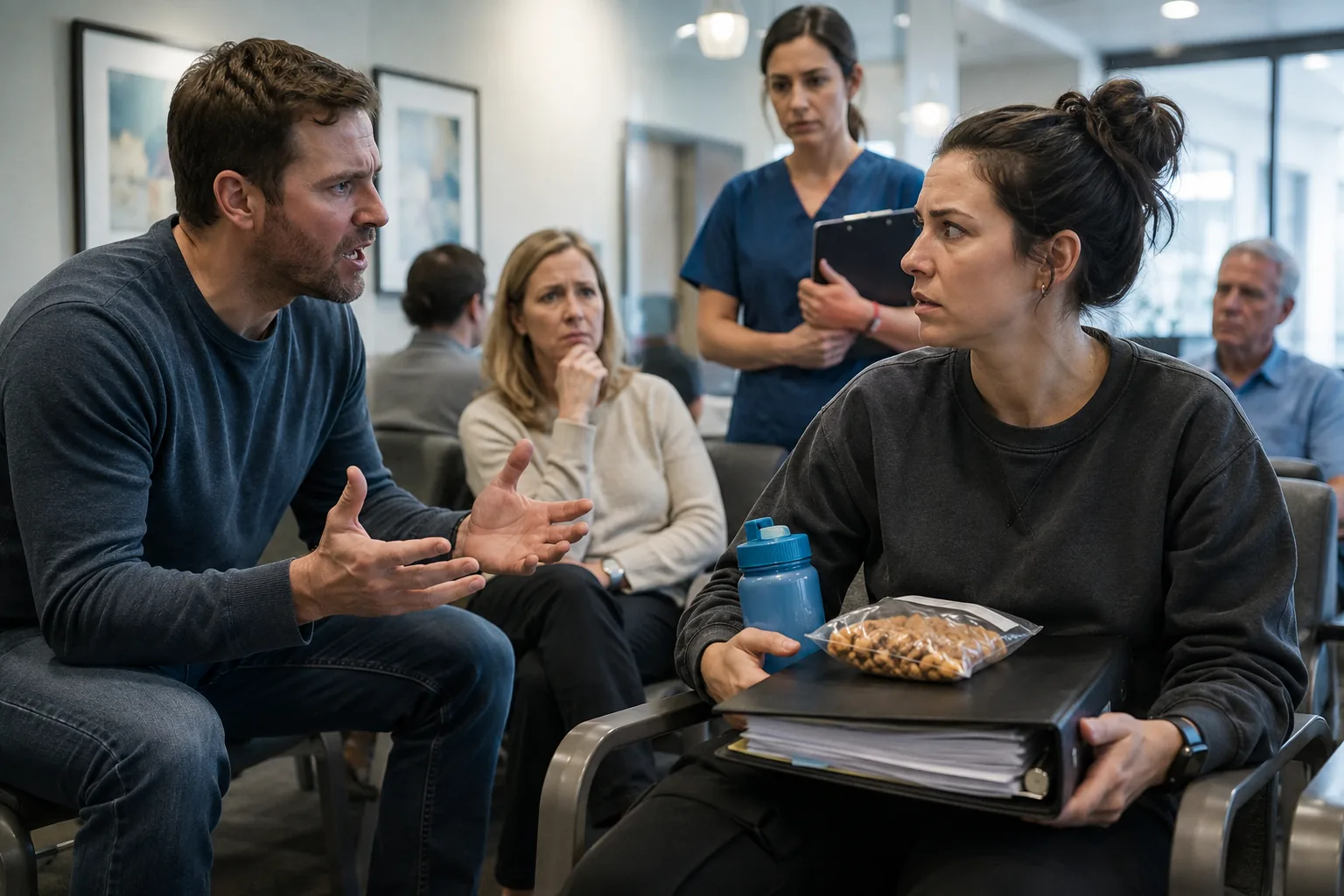
Story code: ST-000207
Part 3: The Record Did Not Bend for Him
A nurse in navy scrubs opened the door and called Leo’s name. I stood up with his bag automatically, but Drew moved at the same time, stepping half a pace ahead like he meant to lead us in. Leo reached for my hand without looking up. The nurse noticed that first.
“Come on back,” she said.
The exam room was small and too bright, with a rolling stool, a sink, a wall monitor, and a long counter covered in sealed supplies. Nina had already set my binder beside the computer. The lab report envelope was open now, its papers stacked neatly on top. Leo climbed onto the chair by the wall after I wiped the seat with one of the paper liners. He pressed his knees together and started working the chew necklace between his fingers.
The nurse confirmed his name and date of birth, took his temperature, and wrapped the blood pressure cuff around his arm. Drew stayed standing near the door, arms crossed, while I answered the questions about sleep, appetite, bowel changes, and medication timing. Every answer I gave was already in the binder. That was the strange comfort of it. I did not have to improve my own memory. I had written it down when it happened.
When the nurse finished, she looked at the computer, then at the binder. “The provider is reviewing the trend from the lab report against the home log,” she said. “Please stay available in case she has follow-up questions.”
Drew gave a short laugh. “I’m available. I just don’t want this turned into her personal recordkeeping project again.”
The nurse did not answer him. She clicked through something on the screen and left.
For a minute, all I could hear was the hum from the vent and the crinkle of the exam table paper every time Leo shifted. Drew looked at the open binder and then at me.
“You know this isn’t normal,” he said.
“Tracking what the clinic asked me to track is normal here,” I said.
“No. Building a whole system so nobody can question you.”
I adjusted Leo’s water bottle in the side pocket and kept my voice even. “You were asked for a teach-back and didn’t do it.”
His eyes snapped to mine. “That is administrative nonsense.”
Before I could answer, the provider came in with Nina behind her. The doctor introduced herself again, sat on the stool, and laid the lab report next to a flagged page from my binder. She did not look at either of us first. She looked at Leo and asked him if the blood draw had bothered him last time. He shrugged one shoulder. I said he had a rough week after, with more refusal around food and a disrupted sleep stretch.
The doctor nodded and tapped the page. “That’s consistent with what I’m seeing here. The result itself matters, but so does the daily pattern around it. The notes make that easier to interpret.”
Drew stepped in. “I need to say there are concerns about how these notes are being used. She has a way of making herself the gatekeeper.”
The doctor looked up then. “Who completed the daily entries?”
“I did,” I said.
Nina added, “The log was provided at check-in by Mara Bennett. It covers eight weeks.”
The doctor turned one page, then another. “I’m also seeing medication initials, symptom tracking, and call references that match chart contacts. That is useful.” She glanced toward Drew. “If you’re raising a care access concern, I need to understand your current role in home administration. Which doses are you regularly giving?”
He uncrossed his arms. “That isn’t the only measure of involvement. I understand the science behind the treatment.”
The doctor waited a beat. “Which doses are you regularly giving?”
He looked at the binder instead of at her. “I support decision-making.”
Nobody in the room moved. Even Leo stopped working the necklace for a second.
Nina touched a page with her pen. “The documented home administration is almost entirely Mara.”
The doctor nodded once. “Then the record I use for care planning has to reflect the person doing the daily work. That’s not a judgment. It’s the basis for safe follow-through.”
Drew’s voice sharpened. “So she gets rewarded for monopolizing access?”
“No,” the doctor said. “The record shows who was trained, who reported symptoms, and who completed tasks. Those are separate things from family disagreement.”
She went over the lab result in plain language, pointing to a range on the report and then to the week in my log where Leo’s intake dropped and his sleep split into short blocks. The pieces fit together so cleanly it made Drew’s running commentary sound thin in the room. The binder was not defending my personality. It was answering the clinic’s question.
Then the doctor asked the one thing that changed the air again.
“Before we finalize today’s update,” she said, looking at Nina, “who is currently authorized for home protocol communication and post-visit instruction in the chart?”
Nina clicked once, read the screen, and said, “At present, both family contacts are listed, but only one has completed current training requirements.”
The doctor picked up her pen. “That needs to be corrected before discharge instructions go out.”