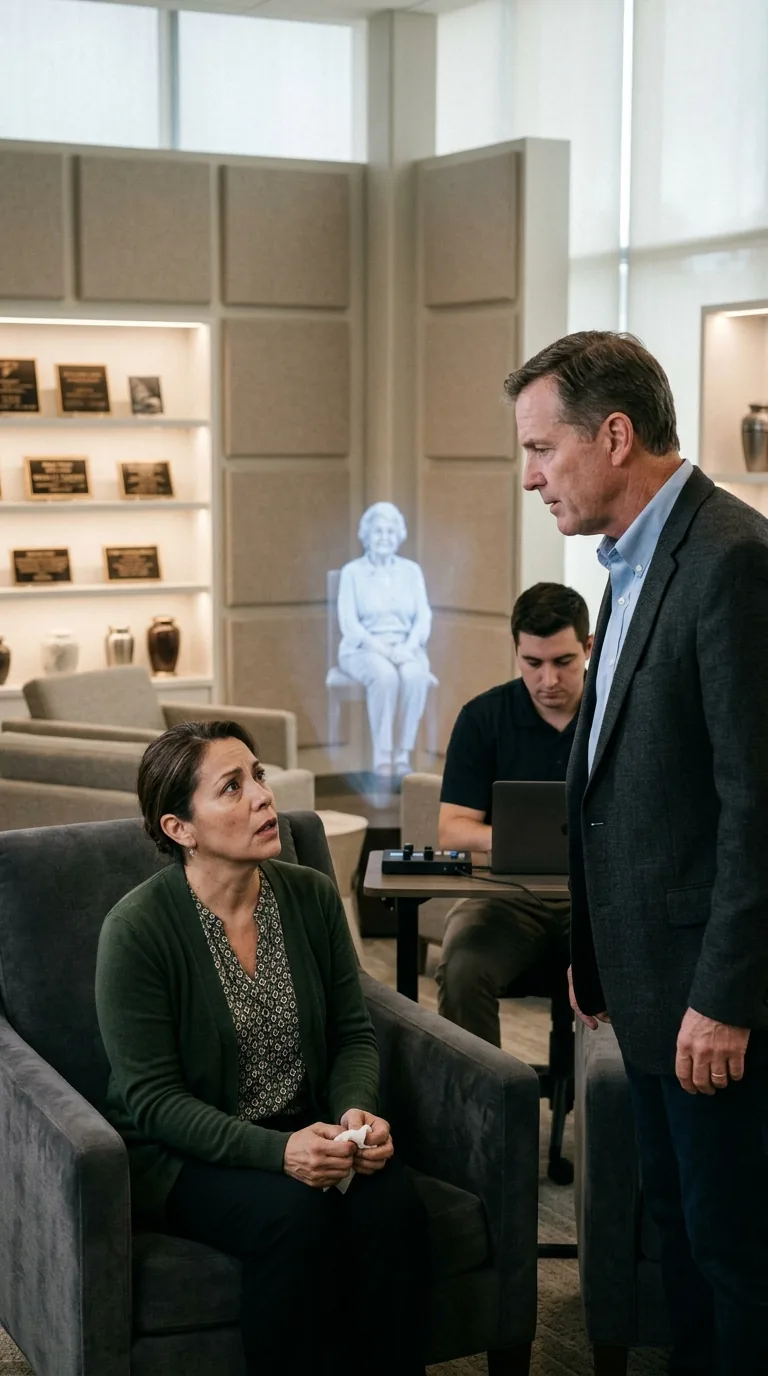
Story code: ST-000238
Part 2: The Drive That Would Not Say the Word Back
Grant heard the room go quiet around his own explanation and leaned into it harder. He moved one step closer to Nina, still facing the console, still talking at the same even volume he used when he wanted to sound like the last person in the room who understood anything. “You keep looking for a menu item,” he said. “That’s not where this lives. The lattice only appears under a live pair. If you haven’t run the resonance lock, you won’t see it.”
He pointed at the drive screen again, but he did not press the verification tab. He left his finger hovering over the glass, then withdrew it like he had already made the point. Nina did not step back, but her hands changed. One hand stayed on the stand; the other moved to the edge of the chair beside her. She asked him, “So run it.”
Grant gave a tight smile and glanced at me. “We are not starting a test because someone heard a term they don’t recognize.” He turned back to Nina. “You either trust the setup or you don’t.”
That was where the room split cleanly between his voice and the equipment. The drive was still lit amber. The speaker profile was still visible. The live test button was still there. Nothing on the panel matched the language he kept using. I could see the plain labels from where I stood: reference file, output check, verification. I could also see that the room was waiting for somebody to do the next real step instead of the next speech.
I reached for the console and paused with my hand over the verification strip. “The cycle is still pending,” I said. I kept my voice flat so it would carry without giving him extra room. “If you want the drive checked, we can run the normal verification.”
Grant looked at the panel and then at me. “It already passed bench load.” He said it fast. “This is just user confusion.”
Nina turned her head toward me. “Can you show me what he means?”
I did not answer with anything beyond what the room could see. I put two fingers on the edge of the screen and rotated it a few degrees so the status line was easier to read. The test controls were plain. No lattice. No mesh. No paired recovery window. The labels on the visible interface stayed exactly where they were. Grant saw the screen move and immediately started talking again.
“You’re looking at the wrapper,” he said. “The drive uses adaptive phrasing once the reference locks.” He nodded as if that settled it. “That’s why I told you not to confuse the on-screen layer with the actual capture path.”
He said it with enough confidence that one of the relatives on the bench looked down at her lap. But the screen did not change. The panel did not light up with any hidden layer. The drive gave the same steady amber line it had been showing since I walked in. If there was an adaptive phrasing layer, it was doing a very poor job of showing itself.
Nina looked at the panel, then at Grant, then back at me. “Then why isn’t it there right now?”
Grant opened his mouth, closed it once, and then tried a different angle. “Because you’re not in the proper mode yet.”
“Which mode?” I asked.
He named another term that did not appear anywhere on the console. He said it with a sharp nod, like he was daring the room to challenge him on vocabulary alone. I did not. I reached past him and put my hand on the verification tab.
The drive gave a short tone, and the amber light blinked once.
Grant stopped talking. Nina looked straight at the screen. The visible status line changed from pending to ready for live test, and the room lost some of its air all at once. There was still no lattice, no mesh, no recovery window. Just the same plain interface waiting for a routine check.
I left my finger on the tab and read the line again. The only question left in front of everyone was simple and ugly: if his fake term was supposed to be the reason the drive could not be tested, why did the machine answer a live test the second I touched the control?