Story code: ST-000241
Part 3: The Scan That Didn’t Help Me
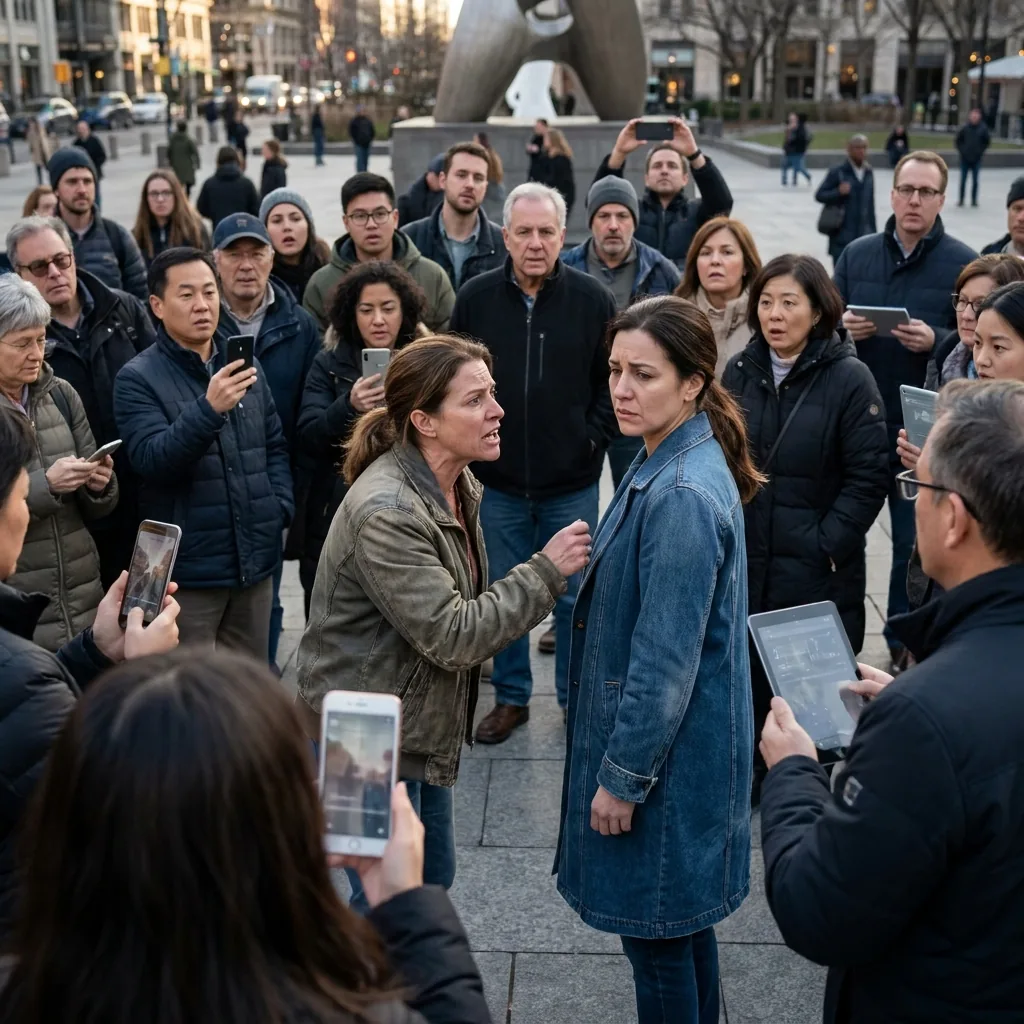
The crowd stayed packed around us, but the sound changed. People were no longer talking over the match music. They were talking under it, in the low sharp voices that show up when everybody wants to be right and nobody wants to be first.
Nolan held up his wrist device again and said the overlay was catching a deeper assist layer. He kept pointing at the red warning hovering over Maya’s glasses, but the words were thinner now. He knew the room was looking at the frame, not just the screen.
Maya turned the glasses in her hand and walked them straight to the kiosk scanner by the prize wall. The kiosk was one of those public machines the plaza uses for rentals, score checks, and hardware issues. Families lined up at it all day. No one stopped her. That alone told me the room had started to doubt the fast version.
She set the glasses under the scanner ring and said, “Read them.” Not loud. Just enough for the nearest people to hear.
Nolan followed her and tried to stop the scan with a quick swipe on his wrist device, but the kiosk had already lit up. A white line moved across the cracked hinge, then across the taped side, then across the right lens where the scuff sat near the edge. The scanner pulled up a plain repair notice on the kiosk screen: fractured frame, temporary tape hold, lens wear, no assist channel detected.
That was the first clean thing the plaza had shown all night.
The red warning over Maya’s head did not disappear right away. It kept blinking above her glasses like it was arguing with the machine. Nolan stepped in front of the kiosk screen and said the overlay was still reading a conflict. But the crowd had the physical glass in front of them and the kiosk reading behind it, and those two things did not match his claim anymore.
A woman near the snack stand said, “So it’s just broken?” Nobody answered her, because that question had a shape to it now. It did not sound like doubt. It sounded like correction.
I could feel the consequences moving before anybody named them. The big match board over the arena steps refreshed, and Maya’s player tile went gray for a second. Then it came back with a small yellow tag under her name: review pending. Not cheat confirmed. Not cleared. Review pending.
That was because I had said it first.
Dad saw the tag too. He looked at the board, then at me, then at Maya’s glasses in the scanner ring. His arms dropped from the folded position he had held since I opened my mouth. He did not say my name. He just said, “That is enough for now.” He said it to all of us, but he was looking at me when he said it.
Nolan was still talking, but the words were starting to run into each other. He said the filter had been flagging an irregular presentation path. He said the public read was not the same as the physical object. He said the system needed a reset. Every sentence sounded like a step backward. The crowd could hear it too. A few people moved out of the circle. One kid leaned on his parent and stopped staring.
Then the kiosk did one more thing I did not expect. It locked the scanner ring open and pushed a small orange notice onto the screen: hardware dispute logged. Event access limited until manual review.
The notice sat there in plain view. No one had to guess what it meant. Maya could not enter the next match lane until the plaza staff cleared the review. Her wristband stayed lit, but the lane icon beside her name was gone.
She reached for the glasses, pulled them free from the scanner, and slid them back onto her face. The mint-green tape was still there, peeled at one corner. The red warning was still hovering, but weaker now, like the plaza itself was not sure it wanted to keep lying for it.
I had made a public callout, and now the room had a public record of it. The crowd that had accepted me too fast was no longer sure where to stand, and that did not undo anything. It just made the damage easier to see.