Story code: ST-000026
Part 2: Questions That Made It Worse
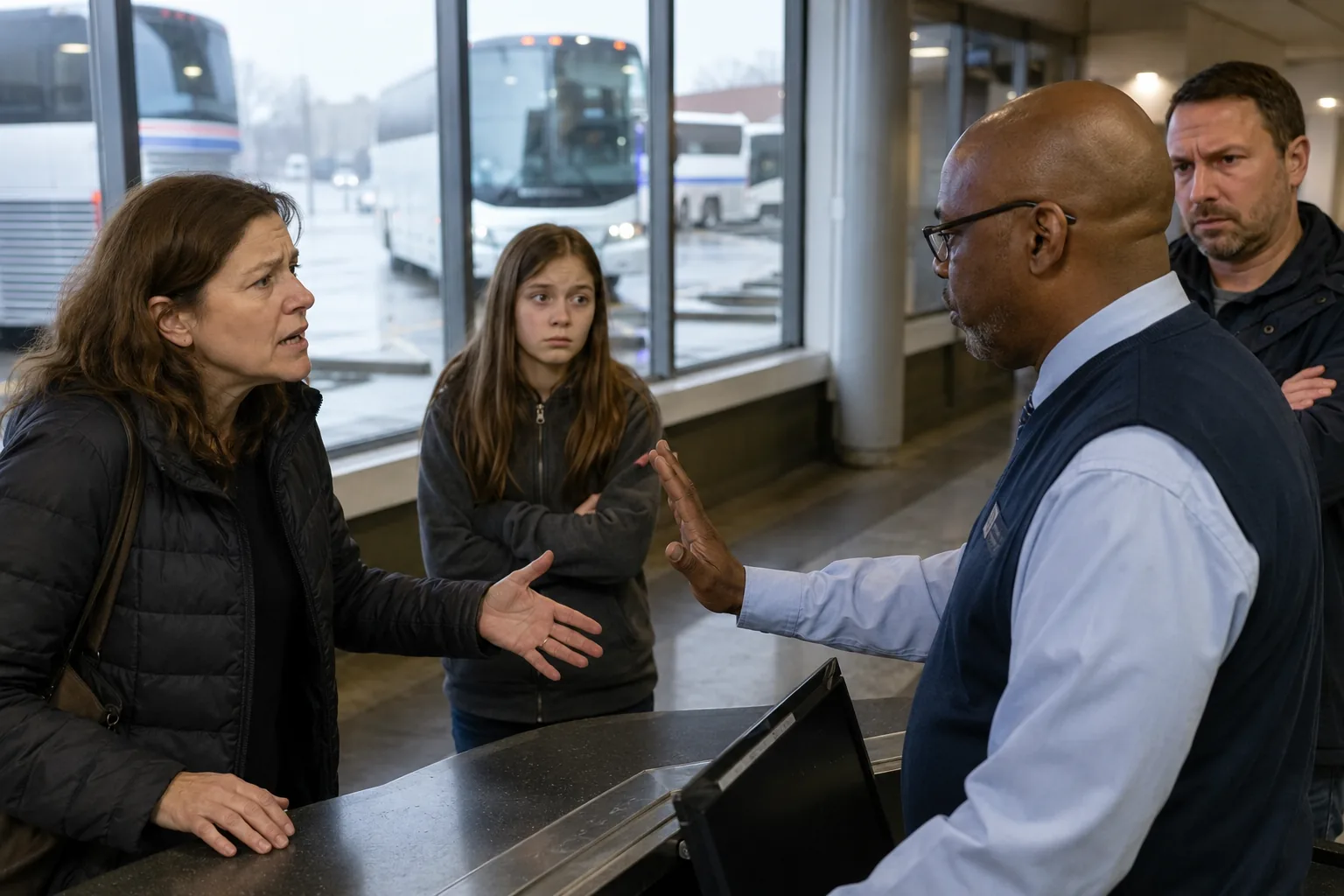
Once the suitcase tag broke the first story, every basic process question made the station’s version worse instead of clearer. Darnell stopped treating Marisol’s sponsor status like the final word, but he still kept one hand on procedure, which meant nobody was willing to move fast until each screen, sticker, and log lined up. Meanwhile Sofia was still not in front of us, and her suitcase was proving she had not traveled the way her aunt claimed.
Darnell picked up the phone behind the counter and called the baggage room. “Send Luis Ortega to the office,” he said. Then to me: “We verify the path before we suspend anything else.”
Marisol gave a short laugh without smiling. “Suspend what? You don’t even know there’s a problem.”
I turned the tag so all three of us could see it. “We know the first sequence can’t be true. That’s already a problem.”
Luis came in through the half door from the back-room baggage window with a scanner clipped to his belt and a roll of adhesive labels in one hand. He looked at the suitcase first, not at any of us.
“What’s the question?”
Darnell pointed to the timestamp. “Could this bag belong to a minor already moved through gate assignment at 1:10 and just get scanned late at 2:04?”
Luis set the label roll on the counter. “Not like this. Late loading can happen after first scan. But first scan is the start of the baggage chain. No first scan, no bag in system.”
He tapped the routing sticker. “And this marker isn’t for Atlanta direct. This sends it through a different handling path first.”
Marisol crossed her arms. “You people reroute baggage all the time.”
“Baggage, yes,” Luis said. “But not backward through time.”
That landed harder than a raised voice would have.
I asked him to walk us through the ordinary sequence, step by step. He did it the way clerks do when they are done arguing and ready to point at the machinery.
“Office clears the passenger. Counter or runner confirms the route. Bag gets tagged to match that route. First scan hits the system. After that, loading or transfer can be delayed, changed, or kicked to another run. But the first scan locks when the bag entered the path.”
I pointed to the incident log. “So if the child was already on the Atlanta movement at 1:10, what should this tag show?”
“A first scan before that, or right with it if the process is tight,” Luis said. “Not almost an hour later on a different path.”
Darnell took the printed transfer sheet and flattened it with his palm. “The gate note says outbound gate corridor at 1:18.”
“Who entered that?” I asked.
He checked the initials. “Desk staff.”
“Did desk staff physically walk Sofia there?”
He looked at the line again. “It doesn’t say.”
“Does it say who received her at the gate?”
“No.”
“Does it show a boarding scan under her name?”
He turned back to the monitor, clicked through two screens, and said nothing for a second too long.
Luis looked at him. “There isn’t one, is there?”
Darnell answered without looking up. “Not on this route.”
Marisol uncrossed her arms. “She’s a minor under transfer. Those scans lag sometimes.”
“Sometimes,” Darnell said carefully. “Not usually with no gate receipt and no baggage chain at the claimed time.”
That was the shift. He was still standing behind policy, but policy had stopped protecting her cleanly.
I asked the next plain question. “If there is no boarding scan on the Atlanta run, what is the earliest documented point proving Sofia physically reached that gate?”
Darnell said, “The desk note.”
“Meaning a staff entry, not a handoff confirmation.”
He didn’t argue.
I slid the suitcase a few inches so Luis could see the underside sticker. He bent, checked the lower edge, and straightened up with two fingers holding a second adhesive strip that had partly peeled loose from the shell.
“This is older,” he said. “Different lane code.”
Darnell held out his hand. Luis gave him the strip.
The code wasn’t Atlanta. It matched a regional shuttle lane that used the outbound corridor at the opposite end of the station before feeding passengers to a later connection. Not the route Marisol had repeated. Not the route on the transfer sheet now sitting under Darnell’s hand.
I looked at Marisol. “Why does Sofia’s suitcase carry a partial sticker for a different lane?”
“Because your people changed it,” she said.
“From what to what?” I asked.
“From the first plan to the correct one.”
“When?”
“Earlier.”
I touched the 2:04 scan again. “Earlier than this?”
She opened her mouth, then said, “I don’t know your exact times.”
Luis shook his head once. “If that older lane code touched this bag first, then somebody started Sofia’s property into one sequence and later tried to force it into another.”
No one in the office spoke for a moment. Beyond the door, the departure board clicked over and a fresh line of passengers moved toward the outbound corridor.
I asked Darnell one more thing. “If the child wasn’t boarded on the route her aunt claims, and the suitcase entered the system under a different path, who had control of Sofia between office clearance and whatever happened next?”
He looked at the transfer sheet, the tag, then Marisol.
When he answered, he did it slowly. “That’s the missing handoff. And until we identify it, nobody moves under her version of this again.”
Marisol reached for the suitcase handle, but Darnell put his hand over the bag first and told the guard at the side door to close it. Then he asked the question that made the whole room go still.
“If Sofia never made the Atlanta route,” he said, “who took her into the outbound corridor before her bag ever entered the system?”