Story code: ST-000516
Part 3: The Booth That Could Not Be Handed Off
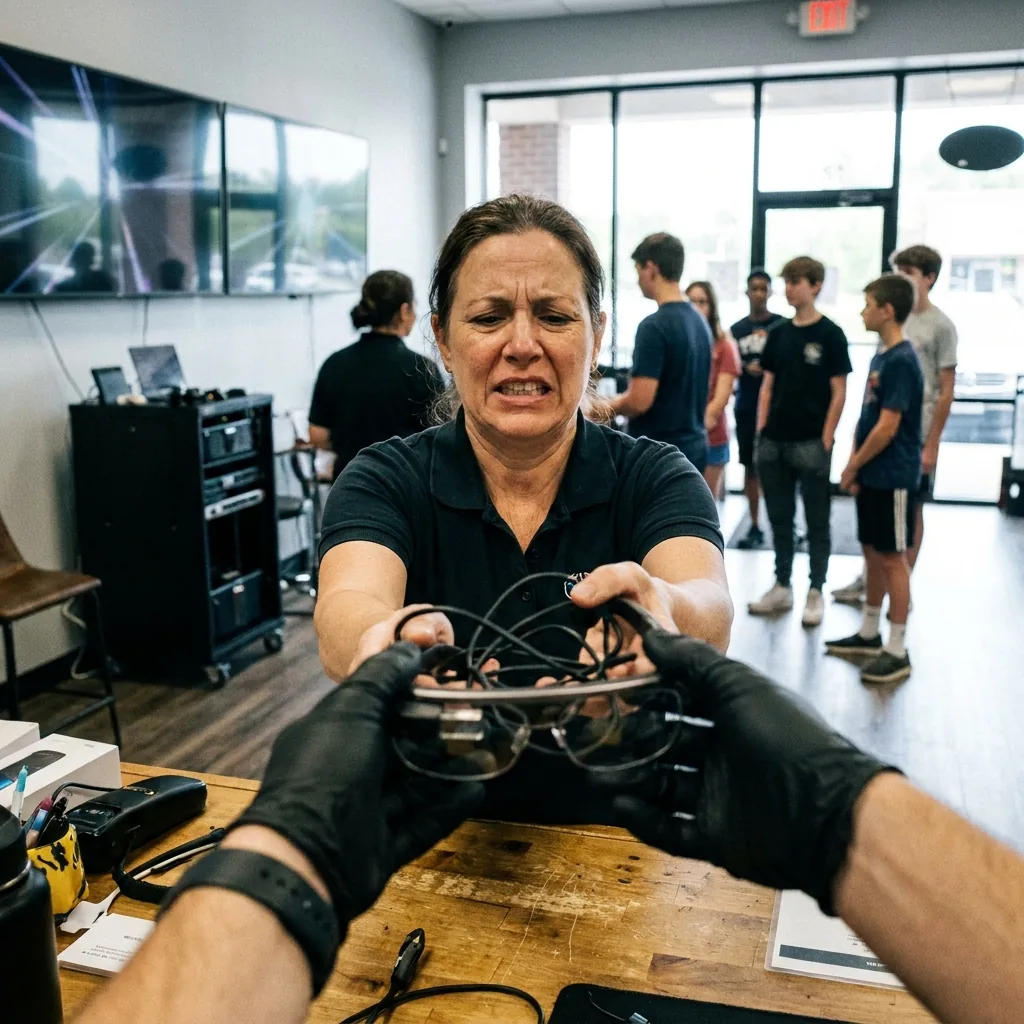
Lena did not answer Marcy right away. She set the charging cable on the front fitting bench, looked at the four premium sets lined under the charging rack lights, and said, “Overlays are not the problem. Those need fresh manual calibrations before anything gets loaded.” Marcy gave a small shrug toward Diane. “Then she should do the calibrations. She is faster.” Diane was still holding the queue tablet. “We all need to move,” she said. “Corporate check-in is in twenty minutes. Marcy, get the branded overlays ready. Lena, run calibration.” It came out smooth and automatic, the same floor reflex as every other time: assign the skill to Lena, assign the specialty title to Marcy, and keep the room from stopping long enough to notice.
Lena picked up the first premium set, then set it back down. That was the first break in the pattern I had seen all day. She wiped her thumb once across the bridge piece and said, very even, “No.”
The plaza was not silent, but that word still cut through the dragon loop and the low chatter from the waiting area.
Diane turned her head. “No what?”
“No more rescue handoffs on premium gear,” Lena said. She was not loud. That made everybody else lower their voices around her. “If Marcy is prepping the overlays for this booking, she can complete one set start to finish so we know the profile and the branded filter package match. Then I will do the rest if needed.”
Marcy let out the helpless laugh again. “You know I don’t do manual fit as well as you do. That is not my lane.”
I was standing beside the sanitizer bin with a stack of cloths. From there I could see the premium tablet screen facing the fitting bench. Diane looked from the clock over Booth Two to the front doors and back to Lena. “We do not have time for this,” she said.
Lena answered her without moving. “That is why she needs to do one now. If one profile breaks during client check-in, you will call me anyway.”
A man in a blue polo had just stepped in through the front doors with three others behind him, all of them carrying the same company lanyards. Diane’s customer smile came up fast. “Welcome in. You’re a little early, which is perfect. We are just staging your custom set.” Then sideways, out of that smile: “Marcy, take the lead.”
That was the trap closing, and everybody on the floor could see it because the clients were already there.
The blue-polo man said they wanted to test one pair before the rest of their team signed waivers. Diane told him that was standard. She brought him to the front fitting bench instead of a booth, probably because the premium glasses were still there in a row and the fitting area had better light. There was no place to hide the steps. No closed booth door. No easy drift into another task. Just the glasses, the tablet, the customer, and the family that kept pretending the same problem was random.
Marcy put on her professional voice. “Absolutely. We’ll get your branded skyline overlay seated first.” She picked up one premium set. Her hands were steady. She opened the fit panel, checked the sensor bars, and moved through the first screens without any wandering. Even the client watched her fingers after that. You can tell when somebody is searching and when somebody already knows the map.
Then she reached the manual calibration page and stopped.
“This menu is a little finicky,” she said.
Lena stayed where she was. “It’s not.”
Marcy clicked out, clicked back in, and laughed once under her breath. “The depth read won’t hold.”
From where I stood, I could see the hold toggle was still gray. Not broken. Just not switched on.
The blue-polo man looked from the screen to Diane. “Do you want us to come back after the next group?”
That made Diane step closer. “No, no. We’re good.”
Lena did not move in. She said, in the same flat voice she had used all day, “If she can’t do one premium set, she should not be loading the custom package on all four.”
Marcy’s jaw tightened. For one second she kept the helpless posture. Then it slipped. She toggled the hold setting with one exact tap, lifted the frame to the client’s face, adjusted the left arm angle, and said, “Keep your eyes on the center ring. Don’t track the edge markers until the second flash.” The words came quick and practiced. So did the rest. She ran the depth read, opened the anchor map, tightened the cheek tolerance, loaded the skyline overlay, and corrected a clipping corner on the logo without asking where anything was.
Nobody said a word while she did it.
The client blinked behind the lenses and smiled. “That is much better.”
Marcy set the tablet down too hard. Diane’s smile disappeared but she did not replace it with anything else. Lena did not look surprised. She just reached over, took the next premium set, and slid it away from Marcy’s side of the bench.
The blue-polo man glanced at all four glasses and said, polite but careful, “For our booking, I’d like the person who just fixed that logo edge to be the one who calibrates the rest, or the person you called your fixer. I don’t want them bouncing between hands.” He said it like a simple operations note. On our floor, it landed like a record.
Diane put the queue tablet down on the bench. “Marcy,” she said, and for the first time all day there was no cover voice in it, “finish the remaining three yourself, right now.”