Story code: ST-000535
Part 1: She Wanted an Emergency Until I Called One
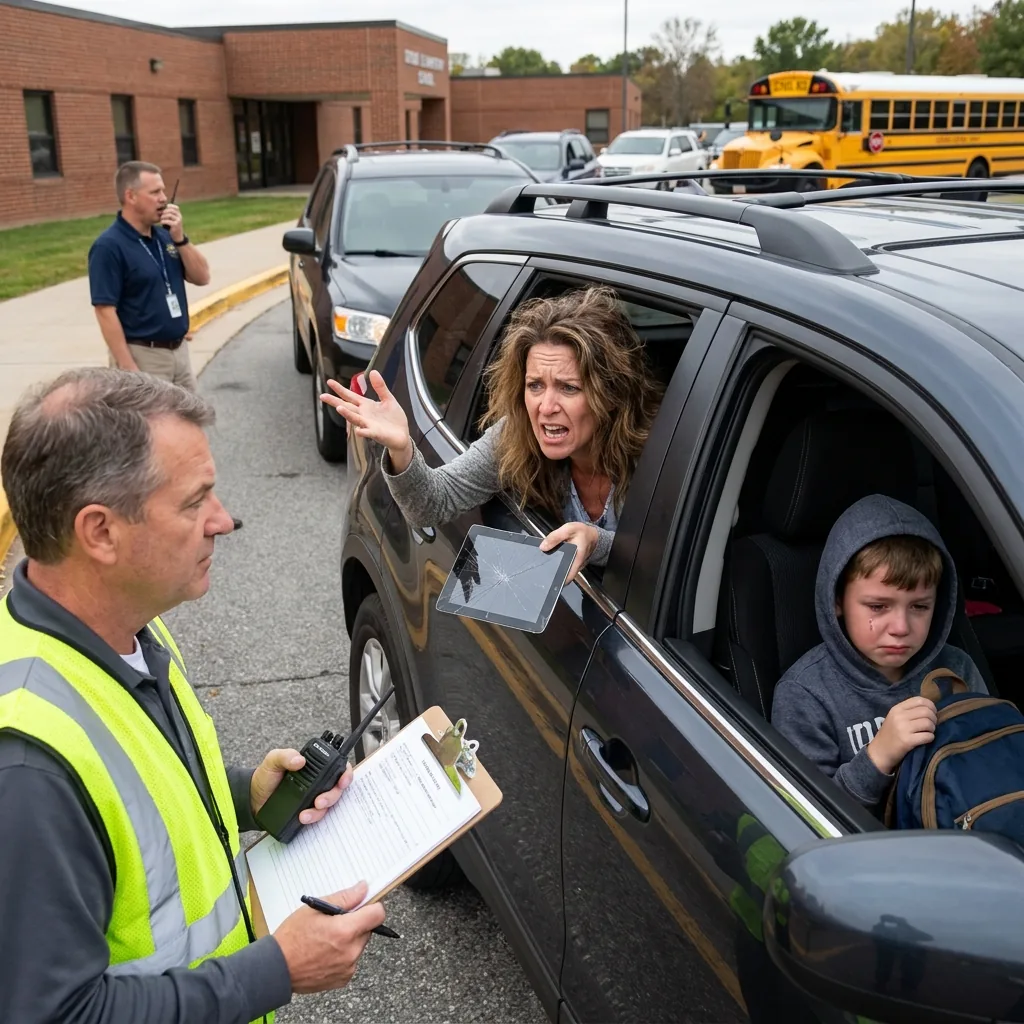
The mother in the pickup lane was shouting that her son needed emergency help right now over a broken tablet, and when I told her I had to follow release procedure first, she leaned out of her SUV window and said, loud enough for the whole line to hear, “So your school is refusing to help a child in distress?” Her son was half out of the passenger seat gripping a tablet with a screen smashed white and silver, cars idling behind them, radios crackling at my collar, and she was demanding I break the line for a problem that did not match the words she was using.
Dismissal had just hit that crowded point where every car in the queue thinks its two minutes are the longest two minutes in history. I was at the curbside staff station with the clipboard in one hand and my radio clipped at my collar, checking tags and signaling kids forward from the covered entrance.
Heather Cole cut across the normal stop point and braked right at the striped curb instead of rolling to the next marker. Her window was already down before the car fully settled.
“You need to get somebody now,” she said, pointing across the center console at her son. “Right now. He cannot leave like this.”
Brayden Cole had the tablet in both hands. The screen was spiderwebbed corner to corner. He kept turning it toward me like I was supposed to fix it by looking at it.
“It cracked,” he said. “I need it fixed right now. I have to have it.”
I stayed where I always stay when a car stops wrong, one foot off the curb and my body angled away from the lane. “I can call the office after we move your vehicle forward. We have to keep pickup moving.”
Heather cut right over me. “No. No, you are not listening. This is an emergency. He is panicking. We are not pulling forward and waiting while you people do your little routine.”
A dad in the car behind her lifted both hands off his steering wheel for half a second. Two students near the cone line stopped watching for their rides and started watching us instead.
I tried again, shorter this time. “If you are telling me this is an emergency involving your child, I can radio the nurse.”
She snapped her fingers at the tablet. “Finally. Yes. Somebody with authority. He needs help now, not after twenty cars.”
Brayden bounced one knee against the seat and said, “I can’t go home like this. I need it fixed before Dad sees it. I mean before tonight. I need it now.”
Heather shot him a look and raised her voice over his. “He is in distress. Do you want him melting down in the car line? Is that what you need to see before you act?”
That kind of question is built so there is no safe answer inside it. If I kept them there, I was ignoring an emergency. If I let them break procedure, I taught every parent in line that yelling changed the rules.
So I used the rule that actually exists.
I pressed the button on my radio. “Lane to office. I need Nurse Patel to front pickup. Parent is reporting urgent child distress at curbside.”
The answer came back with a burst of static. “Copy. Nurse Patel en route.”
The shift happened so fast it was almost physical.
Heather had been leaning halfway out the window, voice up, hand slapping the door. At the word nurse, she drew back into the driver seat and put one arm across Brayden’s chest like she was suddenly blocking him from the open window.
“No, not like that,” she said. “I didn’t say we needed the nurse-nurse.”
I looked at her. “You said emergency help for your child.”
“For the situation,” she said. “For the tablet. I need someone to authorize something. Someone from technology or the front office. Not a whole scene.”
Behind her, another car horn tapped once. Not angry yet, just confused. My coworker at the crosswalk glanced over. The office doors were still shut, but the response path from the building cut straight to where we were. Once help was moving, it was visible.
Brayden held the tablet lower now, closer to his lap. “Mom.”
Heather kept talking to me like she could outpace the radio call if she used enough words. “You made this sound medical. That’s not what I meant. He is upset because the device is school-related and time-sensitive and I asked for assistance. There is a difference.”
I kept my voice flat. “You said he needed emergency help right now and could not wait for normal release procedure.”
“Because nobody was listening,” she said. “Don’t twist this. Just cancel it.”
I don’t cancel the nurse once a parent says a child is in urgent distress in the lane. I especially don’t cancel it with twenty cars watching and two staff members within earshot.
I could hear the main office door click open behind me.
Heather heard it too, because she turned in her seat, saw who was coming down the sidewalk, and said the one thing that made every waiting parent in that line go even quieter.
“No,” she said sharply, one hand up toward the approaching nurse. “Do not bring her over here.”
The mother in the pickup lane was shouting that her son needed emergency help right now over a broken tablet, and when I told her I had to follow release procedure first, she leaned out of her SUV window and said, loud enough for the whole line to hear, “So your school is refusing to help a child in distress?” Her son was half out of the passenger seat gripping a tablet with a screen smashed white and silver, cars idling behind them, radios crackling at my collar, and she was demanding I break the line for a problem that did not match the words she was using.
Dismissal had just hit that crowded point where every car in the queue thinks its two minutes are the longest two minutes in history. I was at the curbside staff station with the clipboard in one hand and my radio clipped at my collar, checking tags and signaling kids forward from the covered entrance.
Heather Cole cut across the normal stop point and braked right at the striped curb instead of rolling to the next marker. Her window was already down before the car fully settled.
“You need to get somebody now,” she said, pointing across the center console at her son. “Right now. He cannot leave like this.”
Brayden Cole had the tablet in both hands. The screen was spiderwebbed corner to corner. He kept turning it toward me like I was supposed to fix it by looking at it.
“It cracked,” he said. “I need it fixed right now. I have to have it.”
I stayed where I always stay when a car stops wrong, one foot off the curb and my body angled away from the lane. “I can call the office after we move your vehicle forward. We have to keep pickup moving.”
Heather cut right over me. “No. No, you are not listening. This is an emergency. He is panicking. We are not pulling forward and waiting while you people do your little routine.”
A dad in the car behind her lifted both hands off his steering wheel for half a second. Two students near the cone line stopped watching for their rides and started watching us instead.
I tried again, shorter this time. “If you are telling me this is an emergency involving your child, I can radio the nurse.”
She snapped her fingers at the tablet. “Finally. Yes. Somebody with authority. He needs help now, not after twenty cars.”
Brayden bounced one knee against the seat and said, “I can’t go home like this. I need it fixed before Dad sees it. I mean before tonight. I need it now.”
Heather shot him a look and raised her voice over his. “He is in distress. Do you want him melting down in the car line? Is that what you need to see before you act?”
That kind of question is built so there is no safe answer inside it. If I kept them there, I was ignoring an emergency. If I let them break procedure, I taught every parent in line that yelling changed the rules.
So I used the rule that actually exists.
I pressed the button on my radio. “Lane to office. I need Nurse Patel to front pickup. Parent is reporting urgent child distress at curbside.”
The answer came back with a burst of static. “Copy. Nurse Patel en route.”
The shift happened so fast it was almost physical.
Heather had been leaning halfway out the window, voice up, hand slapping the door. At the word nurse, she drew back into the driver seat and put one arm across Brayden’s chest like she was suddenly blocking him from the open window.
“No, not like that,” she said. “I didn’t say we needed the nurse-nurse.”
I looked at her. “You said emergency help for your child.”
“For the situation,” she said. “For the tablet. I need someone to authorize something. Someone from technology or the front office. Not a whole scene.”
Behind her, another car horn tapped once. Not angry yet, just confused. My coworker at the crosswalk glanced over. The office doors were still shut, but the response path from the building cut straight to where we were. Once help was moving, it was visible.
Brayden held the tablet lower now, closer to his lap. “Mom.”
Heather kept talking to me like she could outpace the radio call if she used enough words. “You made this sound medical. That’s not what I meant. He is upset because the device is school-related and time-sensitive and I asked for assistance. There is a difference.”
I kept my voice flat. “You said he needed emergency help right now and could not wait for normal release procedure.”
“Because nobody was listening,” she said. “Don’t twist this. Just cancel it.”
I don’t cancel the nurse once a parent says a child is in urgent distress in the lane. I especially don’t cancel it with twenty cars watching and two staff members within earshot.
I could hear the main office door click open behind me.
Heather heard it too, because she turned in her seat, saw who was coming down the sidewalk, and said the one thing that made every waiting parent in that line go even quieter.
“No,” she said sharply, one hand up toward the approaching nurse. “Do not bring her over here.”