Story code: ST-000594
Part 2: Every Solution Made Him Larger
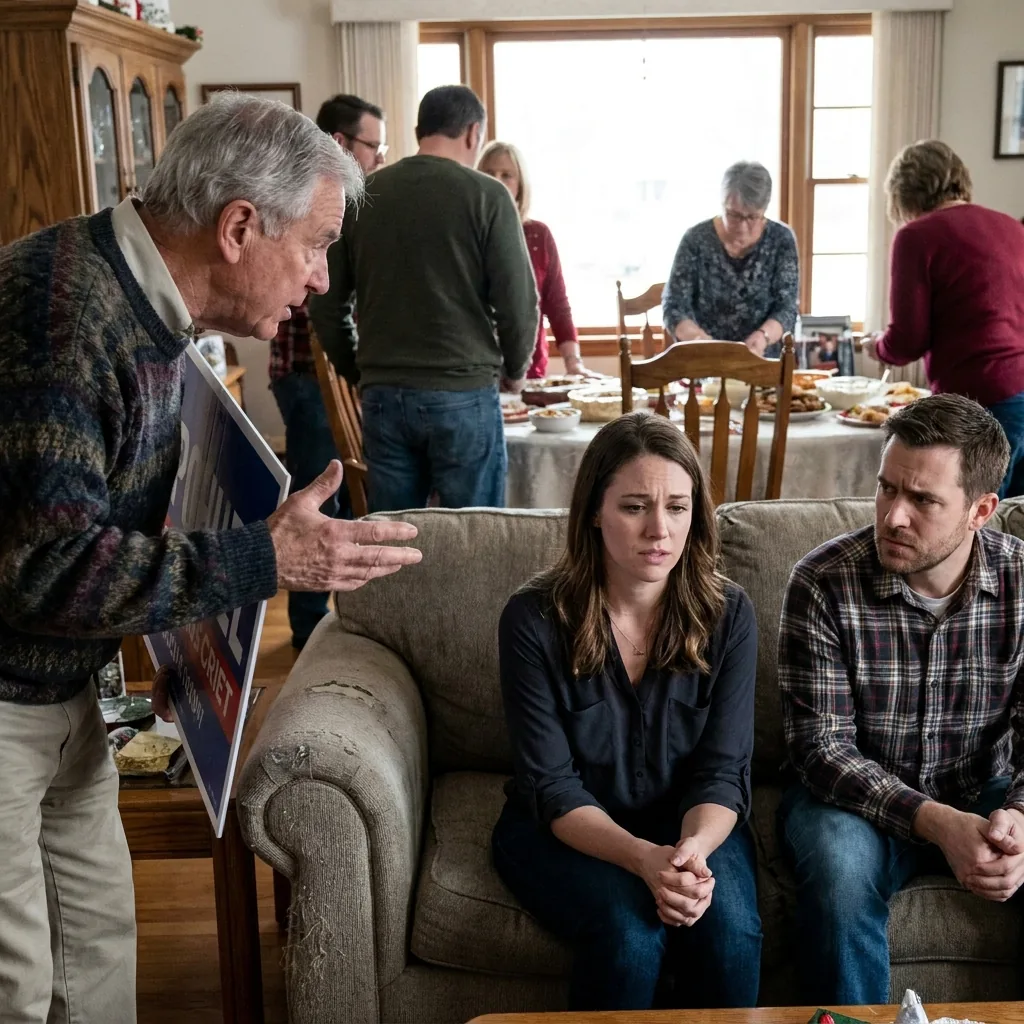
By the time I was scraping casserole into a smaller dish in the kitchen, Uncle Rick had turned one yard sign into a reason he should have a say over every family plan we made. He said the sign had made him a target, said he carried that burden for all of us, and then used it to press for access, input, and deference. The part I could not ignore was this: every time I tried to reduce the friction, he made the burden bigger instead of lighter. The kitchen adjoined the dining room, so nothing was fully private. I could still hear forks against plates and Linda doing her careful peacemaker voice. Dana stood beside the sink rinsing a serving spoon. She kept her voice low. “He’s winding himself up,” she said. “He already has,” I said. Dana dried her hands and leaned one hip against the counter. “Do you want me to step in?” “Not yet.” That was always the hard part. If we pushed back too soon, the room would act like the pushback was the event instead of the pressure that caused it. From the dining room, Rick’s voice carried clean through the doorway. “I’m not asking for praise. I’m asking for basic consideration.” A second later Linda answered, “Of course. Nobody’s saying otherwise.” That phrase again. Nobody was ever saying otherwise, and somehow he still ended up with more room than everyone else. I carried the dish back out. Rick had shifted from his chair to the space near the sideboard, close to the front window where the sign could stay in sight like an exhibit behind him. He wasn’t yelling. That almost made it worse. He was speaking in that measured, injured tone that made every objection sound rude before anyone opened their mouth. He saw me and picked right back up. “Megan, this is what I mean. You think logistics are neutral. They aren’t. Who runs communication decides who gets sidelined.” I set the dish down. “Nobody is sidelining you.” “Then why do I always hear about things after the fact?” “You don’t.” He spread his hands. “See? This. Immediate denial. No acknowledgment at all that maybe I’ve earned more than that.” There was the exchange in full: complaint, correction, then his claim that correction itself proved disrespect. I said, “Earned what, exactly?” He looked around the table instead of answering me directly. “Maybe a little weight. Maybe a little trust. Maybe not being managed by people who’ve never had to put a target in their own yard.” A couple people dropped their eyes to their plates. Nobody wanted the sentence to land on them. Dana came to stand near the doorway, not close enough to challenge him, just close enough that I didn’t feel stranded. I kept my voice flat. “If the sign is causing that much trouble, you don’t have to keep dealing with it alone.” He blinked at me once. “What does that mean?” “It means if the issue is really the sign being out there and drawing attention, that can be solved.” Linda looked up at that. Not sharply. Just enough to show she had followed the sentence. Rick folded his arms. “Solved how?” I nodded toward the front walk. “It’s a sign. It can come down.” The room went quieter than it had been all night. Not a dramatic silence. Just the kind where even silverware seems louder because people are waiting to hear whether someone will laugh it off. Rick didn’t laugh. He said, “That is not the point.” I held his gaze. “You said it has made the house a target. You said you’re tired of what it costs you. I’m saying you don’t have to carry that if you don’t want to.” He let out a short breath and looked past me toward the yard. “So your answer is to take it away? To make me hide because other people can’t handle it?” I had not said hide. I had offered relief in the exact place he said the burden lived. Dana spoke for the first time from the doorway. “She said if it’s making life harder, it doesn’t have to stay up.” Rick turned toward Dana like the clarification itself annoyed him. “I heard what she said.” Then he started adding layers. It wasn’t just neighbors anymore. It was principles. It was backbone. It was what message it would send if he touched the sign now. It was how some people depended on seeing that not everyone had folded. The burden he had described five minutes earlier as personal inconvenience suddenly became public duty the second removal was possible. Nobody at the table challenged him, but nobody rushed in to rescue the story either. Linda had gone still. One of my cousins pretended to be very interested in cutting ham. The shift was tiny, but I could feel it. The complaint and the solution were no longer matching in front of witnesses. I said, “I’m not telling you what your politics should be. I’m talking about the problem you just described.” He pointed one finger at the floor between us. “The problem is being treated like my sacrifice gives me no standing in this family.” There it was again, cleaner this time. The sign was not just a problem. It was a credential. I asked, “So this isn’t about easing the burden. It’s about what the burden gets you.” Linda made a small sound, almost like she meant to interrupt and thought better of it. Rick’s jaw tightened. “You always do this. You twist things around and make me sound unreasonable.” I had repeated his own words back in simpler order. That was all. He stepped closer to the sideboard and lowered his voice. “If you appreciated what that sign has cost me, you wouldn’t be so quick to act like you and Dana should keep deciding how everything runs.” That was the clearest link yet. Not sign to neighborhood. Sign to control. I.