Story code: ST-000594
Part 3: He Would Not Let Go of the Weight
I did not raise my voice after that. I did not need to. Uncle Rick had already said the quiet part out loud in front of the people he usually used as cover.
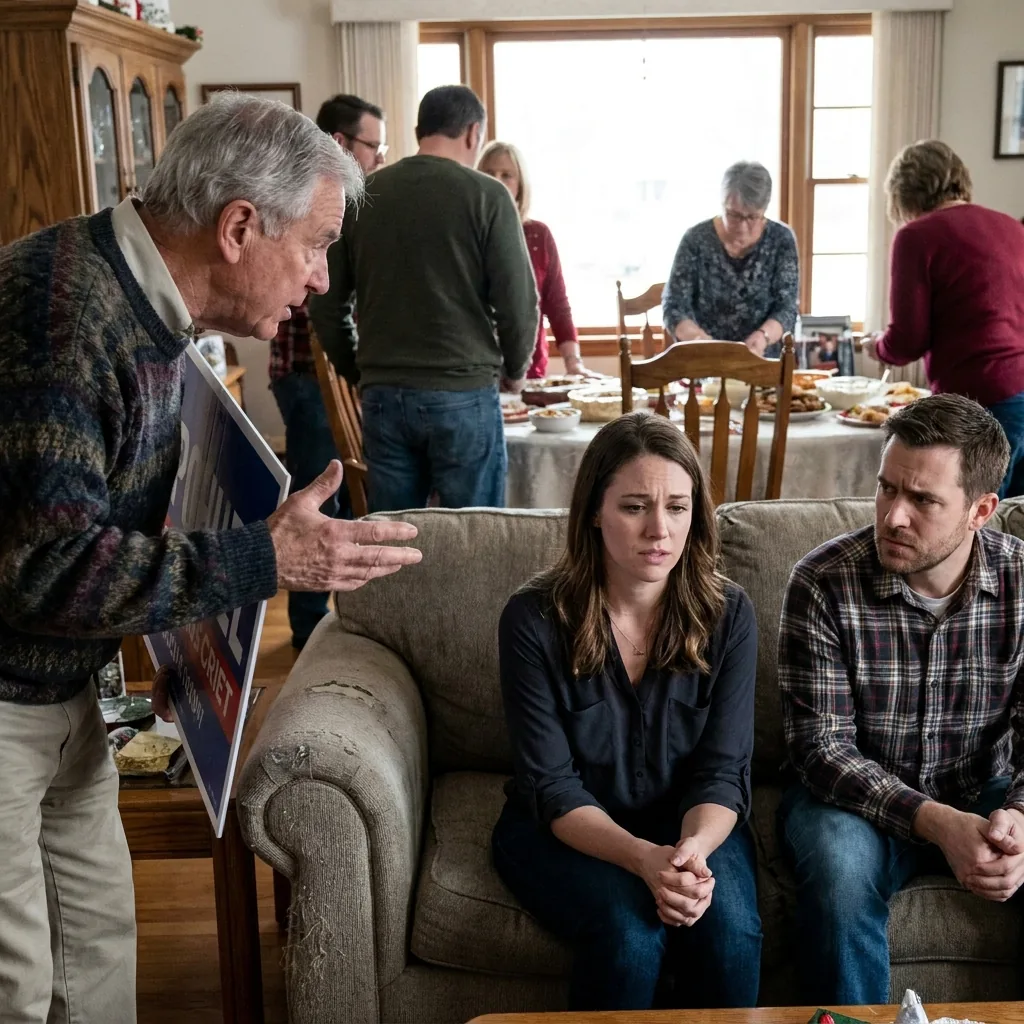
He kept one hand on the sideboard and stared at me like I had broken some rule by taking him literally. The front window was right behind him, and his sign sat out by the walk in the yellow porch light, square and bright and ordinary. It looked flimsy from inside. Cheap stakes, corrugated plastic, two words in giant print. You would never know, looking at it, how much family air he expected it to buy.
I said, “Then let’s be exact. If the sign stays, it stays because you want it there. Not because you’re trapped under it.”
Linda shifted in her chair. “Megan, maybe this isn’t the time.”
Rick answered before I could. “No, let her finish. She thinks she’s got some point.”
I kept my eyes on him. “You said the sign makes the house a target. You said neighbors remember. You said it costs you every season. I offered to take down the thing causing the burden. You don’t want that.”
His mouth pulled tight. “Because taking it down proves people like you get to pressure me in my own family too.”
That landed harder than if he had shouted. A couple people looked up fast, then down again. Dana stayed in the kitchen doorway with a dish towel in her hands, still and watchful.
I said, “Nobody is pressuring you to change your politics. I offered to remove the problem you described.”
“You offered to erase the evidence that I stood up,” he said.
There it was. Not relief. Evidence.
He started talking faster after that, almost tripping over his own examples. He said people needed to see the sign. He said family should remember who had been willing to take public heat. He said there was a difference between being included and being respected, and respect meant not having decisions made without him. Christmas planning. Easter hosting. The summer barbecue. He named each one like exhibits in a case he had been building for months.
I noticed Linda was no longer nodding along. She had both hands wrapped around her water glass and was looking at the window instead of at Rick. One of my cousins got up to refill ice nobody had asked for. The room had that careful stillness people use when they do not want to help either side but can tell something has already shifted.
I said, “So when you talk about what the sign cost you, what you mean is that the sign should give you more say over the family.”
“I mean,” he said, each word clipped, “that people who carry the heat should not be treated like they have no standing.”
He never answered the actual offer. Not once. He kept circling away from it because the plain version made him look foolish. If the sign was the burden, removal was relief. If relief was unacceptable, then the burden was doing a job for him.
Dana finally spoke. “Rick, the planning chat isn’t a prize. It’s reminders, grocery lists, head counts, and people changing dessert at the last minute.”
He turned on her immediately. “That isn’t the point and you know it. Access matters. Information matters. If I’m such a problem to include early, then say that with your whole chest instead of hiding behind logistics.”
I felt something click into place then, not because I learned his private reason, but because I no longer needed it. I knew what he was doing with what I could already see. He used complaint to demand access. He used thanks to demand obedience. And he needed the sign to stay loaded with meaning so he could keep converting it into leverage.
I set the serving spoon down on the platter and said, as evenly as I could, “You keep talking like we owe you control because of that sign. We don’t.”
Linda inhaled softly. No one else spoke.
Rick laughed once, short and sharp. “That from the person who controls the family communication.”
The second he said it, Dana looked at me. Just a look. That was all. But it was enough. He had tied his grievance directly to the one practical thing he actually wanted.
The family group chat wasn’t glamorous. It was ours because somebody had to manage addresses, holiday counts, arrival times, and who was hosting what. Rick did not need it to know when dinner started. He wanted it because it let him insert himself early, redirect plans, and corner people one at a time before anything was settled.
I wiped my hands on a napkin and said, “Excuse me. I need to check the pies.”
Nobody stopped me. Dana followed me into the kitchen a beat later, and I could still hear Rick in the dining room, explaining himself bigger and bigger now that the first version had failed.
At the counter, with the mixer pushed back and the pie server beside the stove, I unlocked my phone and opened the family planning chat. Dana came to my side and looked at the screen.
Quietly, I said, “He doesn’t want relief. He wants the channel.”
Dana nodded once. “Then close the channel he keeps turning into a weapon.”
My thumb hovered over the admin settings while his voice kept carrying in from the next room, still talking about sacrifice, still talking like the sign and the family calendar belonged in the same sentence. That was when I knew exactly what I was going to lock before the night was over.