Story code: ST-000720
Part 3: I Said the Sequence Out Loud
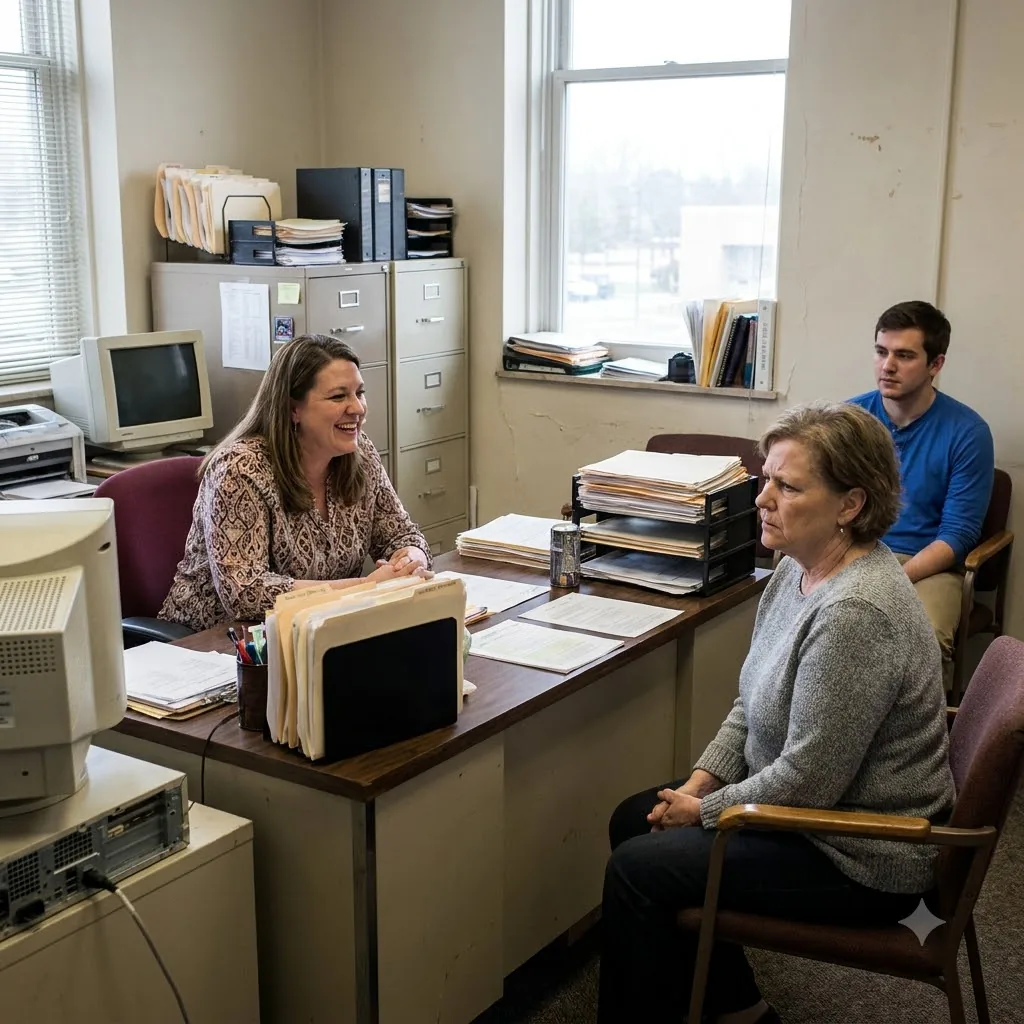
She looked at me like I had stepped into a script she thought she controlled.
I said, “Yes. I want to do this. I want you to tell me the order.” My voice came out calmer than I felt. “What happened first. What was missing. What you fixed. And where, exactly, I agreed to owe you for it.”
Tina rested two fingers on the packet again. “You are turning basic help into an accusation.”
“No,” I said. “I’m separating help from debt.”
That got Mrs. Ellis to look up fully this time.
Tina gave a short smile. “I caught an issue that could have hurt your file. That means I stepped in for you. Most students understand what that means.”
“Then say it clearly,” I said. “Because what I understand is this: my packet moved through routine steps, a routing code was missing, and you corrected that late in the process. After that, when I asked where my file stood, you started telling me I needed to be cooperative because of what you did.”
The copy machine clicked back to life behind her and then stopped again. Tina did not move.
“You keep using that word like it’s ugly,” she said. “Cooperative.”
“It is when it’s attached to my future,” I said.
She leaned in slightly. “You came in here needing support. I made sure your materials were seen. I protected you from a delay. And now you’re standing here acting like I created a problem.”
There was the turn I had been trying to pin down. I heard it more clearly because she said it in one run, without pausing long enough to smooth it out.
I asked, “Did you create the problem?”
Mrs. Ellis’s stamp stopped mid-motion.
Tina let out one breath through her nose. “That’s not what I said.”
“I know,” I said. “That’s why I’m asking.”
Her eyes went to Mrs. Ellis, then back to me. “Packets come through different hands. Codes get missed. People fix things. That’s how an office works.”
“Then it was office work,” I said. “Not a personal favor I have to repay.”
She straightened. “You are being unbelievably ungrateful.”
“Ungrateful for what?” I asked. “For routine correction? For a problem nobody explained? Or for being told I shouldn’t ask questions because it might make things harder on me?”
The student in the waiting area looked over, then back down at his phone. Nobody else said anything.
Tina lowered her voice enough that I had to lean in to hear her. “You do not want to make me your obstacle.”
I heard the words and then I heard the silence after them. No office language. No polished wrapper. Just a warning, sitting plain between us.
I said, just as quietly, “Thank you for saying that where Mrs. Ellis can hear it.”
Mrs. Ellis did not jump in, but she did set her stamp down carefully and pull the packet a little closer to her side of the desk.
Tina noticed. “This is getting ridiculous,” she said, louder now. “Maya is upset because I asked for basic respect after helping her.”
I shook my head. “No. I’m upset because you keep changing the story. First you said you pushed my packet through. Then the routing slip showed you corrected a missing code. Then you said you prevented harm to my future. Now you’re saying I should worry about making you an obstacle. Which version am I supposed to owe you for?”
Her mouth tightened. “I don’t have time for this.” She reached toward the packet, but Mrs. Ellis kept her hand on it.
“I’ll hold this for the moment,” Mrs. Ellis said in the same neutral tone she used for everything else in the office.
Tina looked at her, then at me. “Fine. If Maya wants everything done by the book, then we can do everything by the book. No extra explanation. No flexibility. No informal help when things need quick attention.”
She meant it as a punishment. The problem was that once she said it out loud, it sounded like the exact thing I should have asked for from the start.
I said, “By the book is good.”
That landed harder than if I had argued.
For a second Tina just stared at me. Then she laughed once, without humor, and said, “You say that now. Wait until you see how slow this gets when nobody goes out of their way.”
I looked at the routing slip again. Blue initials. Dates. Boxes. The packet had moved because people logged steps and passed it on, not because one person claimed ownership of it.
I asked Mrs. Ellis, “If I want all updates through standard process, who do I ask?”
Before Mrs. Ellis could answer, Tina cut in. “Seriously?”
I ignored her.
Mrs. Ellis said, “You can submit a communication note for your file at the front desk or with me. It tells staff how you want contact handled.”
Tina’s head turned so fast the hoop in one ear caught the light. “We do not need a note for this.”
Mrs. Ellis did not look at her. “Students can request one.”
That was the first thing I had heard all week that sounded solid.
I said, “I want the note. And I want a copy of whatever status update is currently attached to my packet before I leave.”
Tina’s face changed then, not dramatically, but enough for me to see the edges come off the smile for good.
“If you put a note on that file,” she said, “don’t expect me to touch your packet again.”
I met her eyes. “That’s exactly the point.”
Her hand dropped from the desk.
Mrs. Ellis opened a drawer, took out a small white form, and placed it between us like she was setting down something heavier than paper.