Story code: ST-000905
Part 4: We Paid to Be Done With It
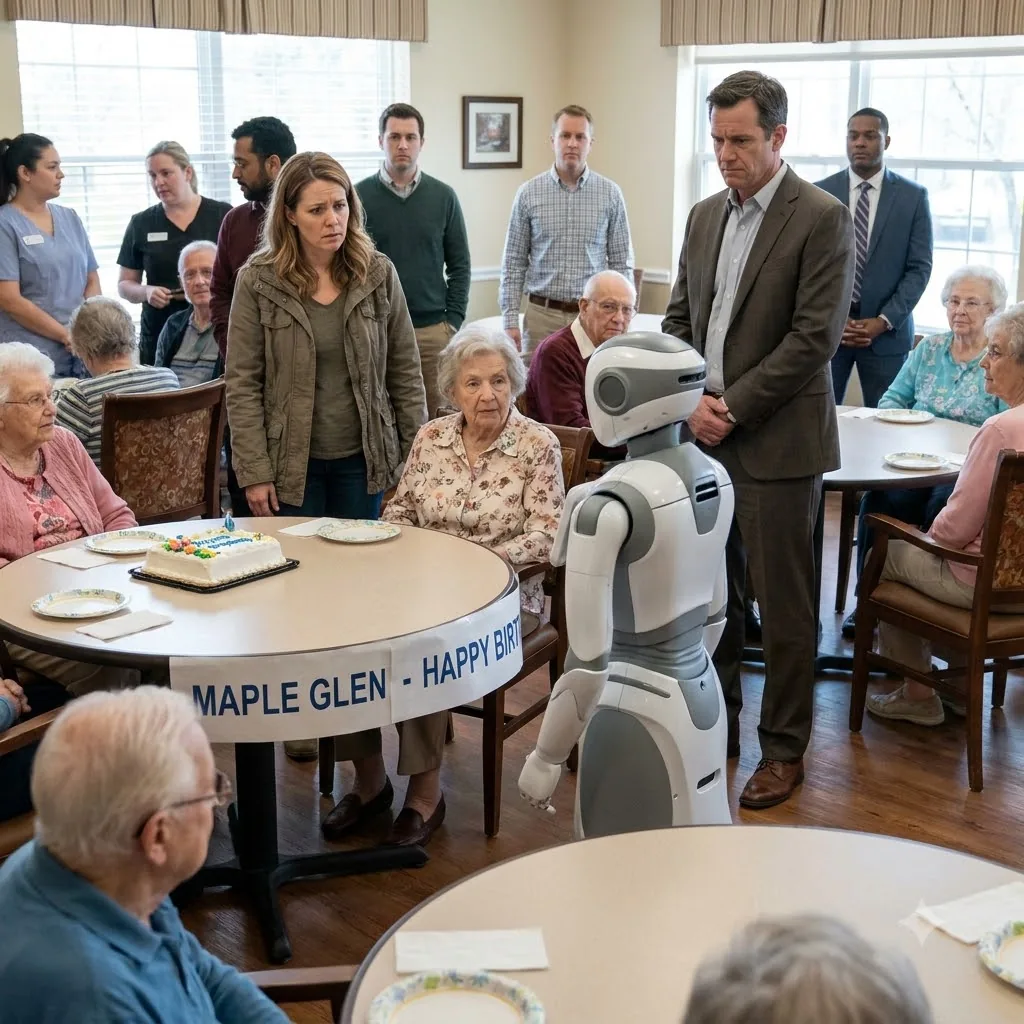
After that, nobody in the common room argued about whether the robot had a second life. The proof had become too plain. Its own voice had said Wynn residence. The logs had shown the household icon. Tessa had named the command screen, and Maya had matched the missing floor rounds to the same windows.
What changed next was not volume. It was control.
Owen stopped trying to sell the simulation story. He straightened his tie, picked up the tablet, and said, “This unit needs to be secured until vendor review is complete.”
Maya answered, “It is not leaving this floor with resident settings still active.”
“Then power it down,” he said.
My mother looked at the robot for a long second before she spoke. “No. Not until my daughter hears what it has stored under my routines.”
That sentence made everyone hold still again.
I stepped beside her chair. “Mom.”
She kept her eyes on the unit. “If he used my sleep setting to move it, I want the room to hear what else traveled under my name.”
Maya nodded once. “Companion, list recent tasks tagged to Resident Elaine Bell profile that occurred off Maple Glen property.”
Owen said, “Do not answer that.”
The robot chimed anyway. “Recent tasks under Elaine Bell profile: nighttime reassurance, medication assist, fall-risk corridor reminder, dinner companionship, Sunday hymn playback, missed call notification for ‘Dad.'”
It did not need to say more. My mother had no Dad waiting in another house. She had not asked for dinner companionship in somebody else’s dining room. The opening mistake paid for itself right there. The robot had not confused two lives; it had been taught both and filed one under her.
Maya extended her hand toward Owen. “Badge.”
He did not hand it over.
She said it again, flatter. “Your floor access badge. Right now.”
He unclipped it and placed it on the cart without another word. Quiet devastation looked like that: a strip of plastic, a logo, and a hand withdrawing from it.
Then came the part that actually hurt.
Maya crouched by my mother’s chair. “Elaine, I can keep the unit here tonight as evidence for the facility and lock vendor access from our side. But I can’t promise safe use after what we just heard. If we disconnect it fully, you’ll lose reminders, reading, message relay, all of it, until we patch together coverage. We can put aides on paper checks, but not one-to-one companion support.” She glanced at me. “Private agency overnight help is available if the family wants it. It won’t be cheap.”
Owen finally found one last line to stand on. “If the family breaks contract before replacement review, rental and emergency setup fees will apply.”
Maya looked at him as if he had said something into bad weather. “Noted.”
I asked the number because numbers are harder to blur than sympathy. He gave it this time. Nine hundred for emergency transfer. Seventy-five a day for a temporary non-network unit. Private overnight aide at Maple Glen rates, separate.
My mother listened to the figures with both hands flat on the arms of her chair. Then she said, very clearly, “Take it off me.”
Not out of the room. Off me.
There was the irreversible choice.
I asked, “You’re sure?”
She turned her head and looked at the banner with her name on it drooping over the cake table. “It carried my quiet into somebody else’s house,” she said. “I won’t have breakfast from it tomorrow.”
Maya brought a paper form from the nurse station window, but it was not a court thing or some grand hearing document. It was a plain care restriction note for the floor binder: companion unit removed from resident use pending safety review; manual reminders required each shift; family accepts temporary private-pay coverage. She read each line aloud before marking it.
I gave her my card for the deposit. My thumb shook once when I signed the receipt on her handheld terminal. Visible cost. Counted cost.
Then Maya changed the robot’s status in front of us. She disabled voice interaction, detached it from my mother’s profile, and placed a red tape strip across the dock label that said OUT OF SERVICE. That little strip did more to end Owen’s control than any speech could have done.
Tessa stepped closer only after the robot went dark. “I’m sorry,” she said to my mother, not loudly, not for the room. “We were told it was extra inventory. Nights only. Then it started knowing your name.”
My mother did not offer comfort and did not ask for more. “Now it won’t,” she said.
Owen stood by the cart without badge, without access, with his own tablet reduced to something he could hold but not use. No one escorted him out dramatically. No one needed to. Maya told the front desk through the station phone that his vendor privileges were suspended on the floor pending facility review, and she said it in the same voice she used for meal changes.
The aides brought a printed overnight checklist and taped it beside my mother’s chair. Water at seven. Pills at eight. Call daughter if restless. Reading light by hand.
The celebration meal never resumed. The cake stayed cut. The balloon kept moving every time the vent kicked on. I wheeled the dark robot to the side alcove myself because my mother didn’t want it near her table.
When I came back, she held out the paper copy of the private-pay receipt and folded it once down the middle.
“Keep that,” she said. “It’s the price of knowing what was in the room with me.”
So I kept it.