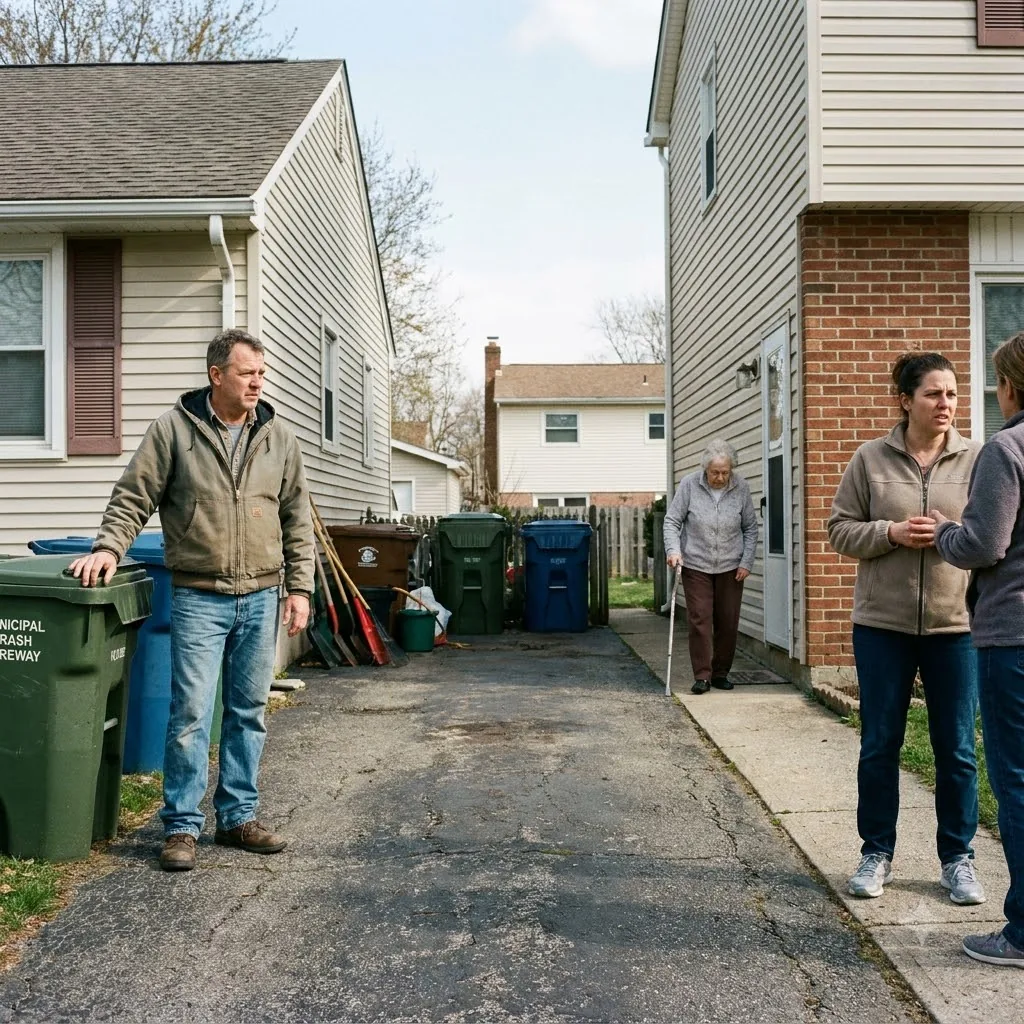
Story code: ST-000967
Part 3: The Sticker Said More Than She Did
That sanitation sticker changed the texture of the whole thing for me.
Up to then, I had my notes and my own eyes, and Miguel had a few short factual comments, but Kelsey still had room to talk over all of it. She could say I moved things around after the fact. She could say I was exaggerating. She could point at her mother and act like I was using ordinary neighbor help to make some bigger point. A bright city sticker on a still-full recycling bin was different. It was plain, dated, and sitting right there on the lid at the curb where anyone could read it.
I did not touch their bin.
I went back up the driveway with my own can and put it in by my garage. Lorraine was still by her side door. I said, “There’s a pickup notice on the recycling.”
She looked toward the curb and then at me. “I figured.”
That was all she said. She had one hand on the doorframe and her keys in the other. I could not tell what she knew before that morning or what she had argued about inside the house. I only knew she had seen the same full bin I had.
That evening Kelsey came home carrying two shopping bags and talking into an earpiece. She cut the call as soon as she saw the sticker. She walked down to the curb, peeled at one corner, and then looked up and saw me standing by my garage.
“Did you mess with our recycling too?” she called.
I said, “I didn’t touch it. It was tagged when I got home.”
She let out one of those little laughs she used when she wanted a witness more than an answer. “Convenient.”
Miguel was parking across the street. He shut his truck door and glanced over. Kelsey noticed him and raised her voice.
“This is what I’ve been talking about. She interferes, then acts innocent when there’s a problem.”
I said, “The bin was still full at noon, Kelsey.”
She turned fully toward me. “Because somebody probably moved it after pickup placement.”
That was the first time she had said something specific enough to pin down. I took one step forward and kept my tone flat.
“I have notes on when I stopped touching your bins unless your mother was standing there blocked by one. And on the days I did move one, it was after pickup, not before.”
Her face changed for a second, not softer, not louder, just tighter around the mouth. “So you admit you’ve been tracking my house.”
“I’ve been writing down what happens in a shared driveway after you started telling people I was the problem.”
Miguel stayed by his truck. He did not come over, but he did not leave either.
Kelsey jerked the sticker off halfway, then stopped because it tore and left half the notice attached to the lid. She shoved the shopping bags higher on her arm and said, “You need to stay away from us.”
Then she rolled the recycling bin up crooked, left the trash can at the curb, and went inside with the notice still flapping from the handle.
The next morning the trash can was still down there.
By then I had started paying attention to the sanitation truck itself, not just the bins. The driver came through our street at nearly the same time each Tuesday, and the recycling truck followed close behind. That week, after the trucks passed, I watched from my porch while the Brand trash can stayed at the curb and the half-torn notice on the recycling bin snapped in the wind. Miguel left for work, slowed by the mailbox, and said, “They tagged that yesterday.”
I said, “You saw it too?”
He gave one nod. “And last week their trash was still out when I got back after lunch.”
I did not push him for more. I had learned that if I crowded facts, people backed away from them.
What forced the next step was Lorraine.
On Friday afternoon she was at the side door with a small tied grocery bag of trash. The Brand trash can had been left near the curb since Tuesday, and the recycling bin was tucked badly near the fence line, close enough to narrow her path again. She looked at the bag, then down the drive, then back toward the inside of the house. I walked over only far enough to be heard and said, “Do you want me to take that to my can?”
Before she answered, Kelsey opened the door from behind her so fast it hit the stop. “No. She does not.”
Lorraine’s hand dropped to her side.
Kelsey stepped into the doorway and pointed at me, right over her mother’s shoulder. “This is exactly how she does it. Little favors so she can keep inserting herself and then tell everyone I don’t do anything.”
I said, “Your trash can has been at the curb for three days.”
Kelsey answered without even looking back at it. “Because people keep interfering with our setup.”
It was such a clean lie, spoken while the bin sat in plain view, that something in me went cold.
Lorraine said quietly, “Kelsey.”
Kelsey kept talking over her. “Stay off our side. Stay away from my mother.”
Then Lorraine did something she had not done once in all of this. She held out the little trash bag toward me and said, without raising her voice, “Dana, would you mind? The can is still down there.”
Kelsey froze with her hand on the door.
Miguel, standing by his mailbox again at the exact wrong or right time, looked from Lorraine to the curb and said, very evenly, “It’s been down there since Tuesday morning.”