Story code: ST-000967
Part 4: The Route Closed the Story
After Miguel said that, nobody in the driveway argued for a few seconds.
Not because there had been a dramatic reveal. Not because Kelsey admitted anything. It was quieter than that. Lorraine was still holding out the little trash bag. The can was still sitting at the curb where anyone with eyes could see it. The torn pickup notice was still on the recycling bin handle. And Miguel had just attached a plain time stamp to what had been happening in front of all of us.
I took the bag from Lorraine and walked it down to my own trash can by the garage.
I did not carry it to the Brand can. I did not move either of their bins. I was done giving Kelsey one more thing to point at.
Lorraine gave me one short nod and went back inside. Kelsey stayed in the doorway long enough to say, “This is unbelievable,” but she said it toward the concrete, not toward me. Then she pulled the door shut.
That should have felt like winning. It didn’t. It felt like reaching a line where I finally understood I was not going to be cleared by one argument, because Kelsey had built the whole thing out of tone and repetition. The only thing that was going to finish it was the routine itself.
The next Tuesday, I stayed out front on purpose after the trucks came.
I brought my own bins in, then watered the planter by the garage and kept an eye on the curb. The sanitation truck had left another notice on the Brand trash can this time, a smaller one stuck near the lid handle. From where I stood, I could not read it, but I could see the bright strip against the dark plastic. An hour later a white city pickup supervisor SUV rolled slowly down the street, stopped near the curb line, and the woman inside got out with a clipboard and looked at several bins on the block.
That was not something I had arranged. It looked like a route check, the kind they do when tags keep showing up on the same address or placement point.
She stopped at the Brand bins longer than anywhere else. She checked the sticker, looked up the driveway, and then looked at the placement area where our shared apron narrowed. Kelsey came out fast when she saw her.
I could hear most of it because the driveway carried sound.
Kelsey said, “Our neighbor keeps moving our bins. That’s the issue.”
The woman with the clipboard asked, “Before pickup or after?”
Kelsey opened her mouth, then closed it.
The woman tapped the sticker with her pen. “These notes are for repeated setout and retrieval problems on collection days. If bins aren’t accessible at pickup time or are left in the street envelope afterward, we mark the address. We’ve got multiple route notes here.”
Kelsey said, “Well, I told you, someone has been interfering.”
The woman looked up the driveway again. “Ma’am, our driver logs position when the tag is issued.”
That was it. No speech. No big neighborhood circle. Just a dry sentence from somebody doing her rounds.
Miguel was loading something into his truck across the street. He paused with the tailgate half open. The couple from two houses down were outside with their kids’ scooters. Nobody said a word.
The woman with the clipboard handed Kelsey a printed notice and said, “Continued improper placement or abandoned curbside storage can result in temporary non-collection until corrected. Bins need to be set out properly and removed from the curb in a timely manner. If another household is handling them, that needs to stop. The account holder is responsible.”
Then she got back in the SUV and moved on to the next house.
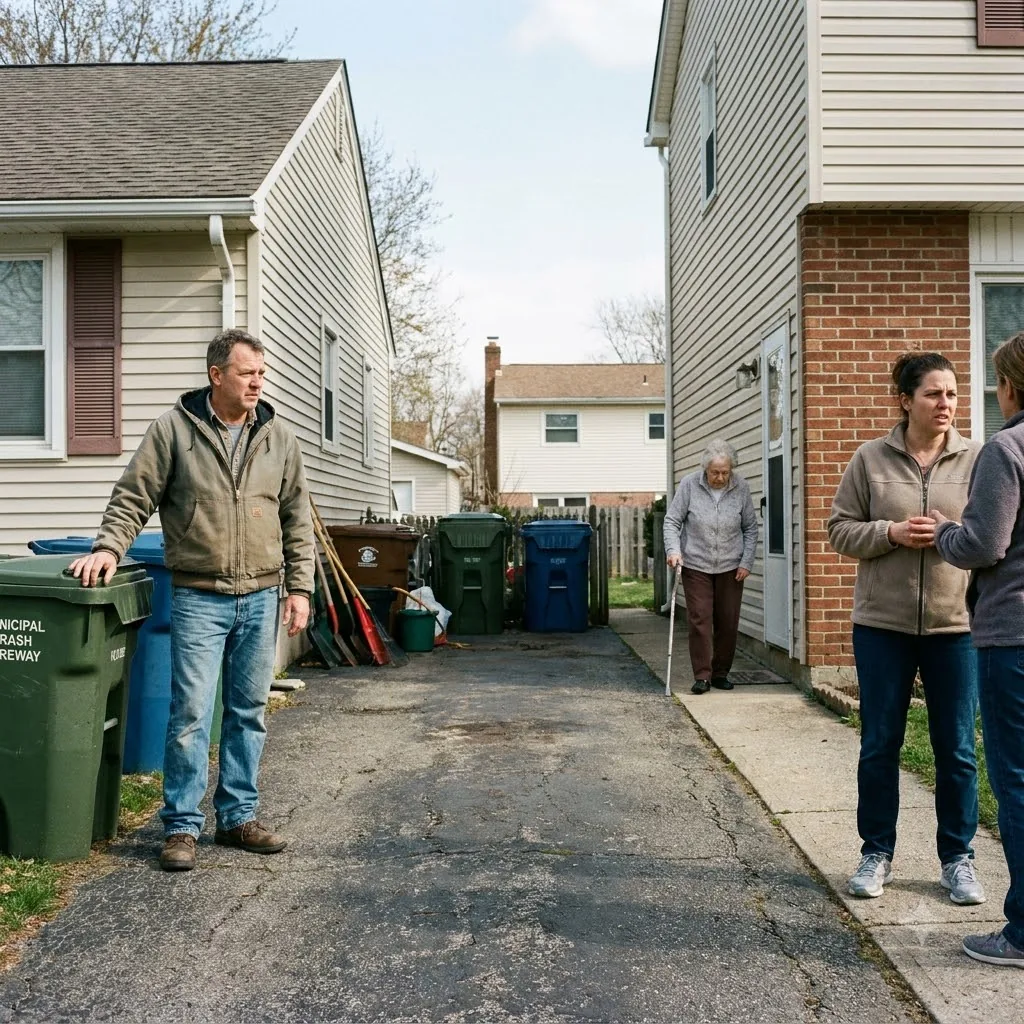
Kelsey stood there with the paper in her hand. She did not look at me. She did not point at the bins. She rolled both cans up the driveway herself, one at a time, awkward and hard, with the wheels bumping over the seam in the concrete. At the top, she tried to tuck them by the fence, had to pull one back out because it narrowed Lorraine’s path, then repositioned it again. No one helped her.
By evening, the story had changed without anybody needing to announce it. The woman who had once told me she hoped things would smooth over just said, “Looks like the city said something,” in that careful neighborhood voice people use when they realize they backed the wrong version too early. Miguel, taking in his mail, said, “Guess the route notes answered it.”
I said, “Looks that way.”
That printed notice stayed taped inside the Brand storm door for three days. I saw it every time I pulled into my garage. After that, Kelsey started bringing her bins in on time. Not always neatly, but on time. More important, she stopped talking about me in the driveway like I was some kind of threat circling her mother.
I also stopped helping.
A week later Lorraine was at the side door when I was heading out with my gloves. The path was clear. The bins were in place. She gave me a small nod and said, “Thank you for before.”
I said, “I hope it stays easier.”
So did I keep peace? Not really. Kelsey and I do not wave. We do not chat. We move around each other in that narrow shared strip of concrete like people who know exactly what was said there and what was proven there after.
But the bins come in now. The path stays open. And nobody on this block calls me the problem anymore.
That was enough. Cold, plain, and enough.