Story code: ST-000098
Part 2: Nothing in the Room Matched His Explanation
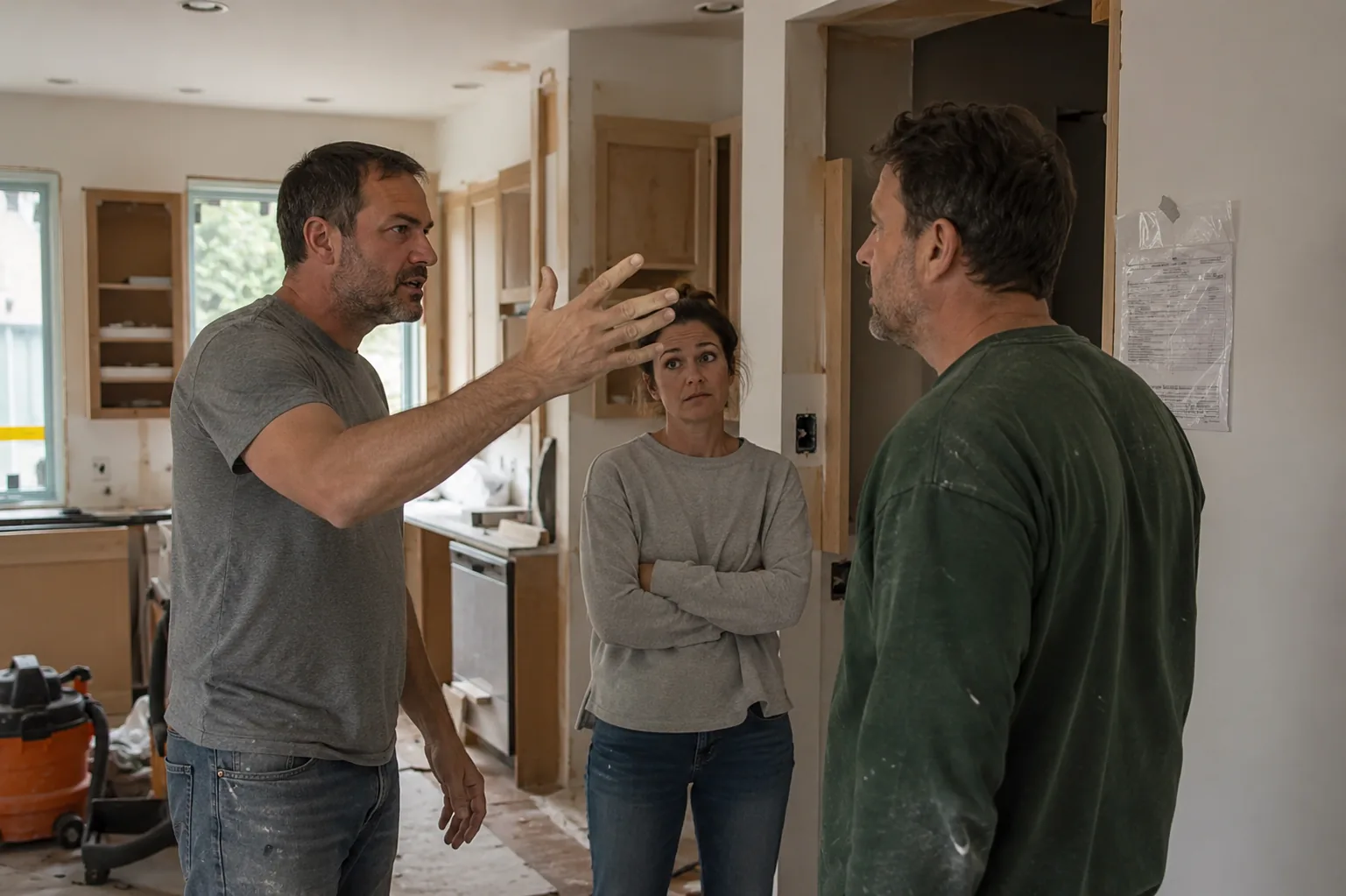
Evan stood in that half-finished kitchen talking like the mess around his boots was a textbook, and the longer he explained his “stagger-vent bridge,” the less any part of the room matched the words. The permit tag still hung by the doorway with the rough plumbing inspection line blank, the sink wall was still open, and Mrs. Calder kept looking between the paper and the pipe opening like she was trying to make them agree.
He stepped over the coil of tubing and crouched by the sink base. “Look,” he said, using two fingers to trace the air above the drain line. “Waste arm here. Transition here. Vent continuity maintained through offset. Once this side closes, the bridge resolves.”
He never touched an actual vent connection when he said it. His fingers moved over empty space, then landed on the cabinet frame.
I stayed where I could see both him and the permit tag. “What pipe is the vent in that sentence?”
He looked up at me with that same patient voice he used when he wanted me to sound slow. “You don’t isolate it like that.”
“Why not?”
“Because it’s an assembly.”
I pointed at the open wall. “Assemblies still have parts.”
He stood up in one motion and brushed dust off his jeans. “This is exactly what I mean. You hear one term and decide it’s fake because you’re not used to field language.”
Mrs. Calder set her mug down on a folded drop cloth. “I’m not used to field language either,” she said. “Can you show us where the vent goes right now?”
For a second the room went still except for the plastic at the hall opening making a soft tick against the trim.
Evan turned toward the wall again. He kept his chin high and spoke to the studs, not to either of us. “The vent path is preserved by offset until final tie-in. I have said that three times.”
I walked over to the permit tag and read the rough plumbing line out loud. “Inspection required before concealment.” Then I looked back at him. “What gets inspected if the vent tie-in is ‘final’ later?”
He answered right away, too polished. “The rough path. Inspectors know how to read intended continuity.”
That was new. Up to then he had talked like the thing was standard enough to be obvious. Now it sounded like the inspector was supposed to imagine the finished version from loose parts and a speech.
I moved closer to the sink wall. The cutout under the future window line was open enough to see the drain and the line rising beside it. There was no mystery from this distance, just wood, pipe, screws, and the dark opening between studs. “Then where does it continue?” I asked.
He gave the wall two quick taps with his knuckles. “Behind the closure plane.”
I looked at the bare studs. “There is no closure plane.”
Mrs. Calder made a small sound in her throat, not a word, just enough to mark the sentence landing.
Evan shifted and pointed down toward the floor, then up again, then across. “You are both getting hung up on temporary exposure. This is why jobs stall. Nobody trusts sequencing anymore.”
I bent and looked into the base opening without touching anything. The pipe run was visible enough to follow with my eyes. Drain. Trap arm location. Stud notch with a metal plate. Open rise. No covered chase. No hidden branch in front of me. “If it’s behind something, what is it behind?”
He didn’t answer that one directly. He took two steps back and folded his arms. “What you’re doing right now is pretending trade shorthand is evidence of a problem.”
“And what you’re doing,” I said, “is naming something none of us can identify in the room.”
He looked at Mrs. Calder. “Do you want your kitchen finished, or do you want a seminar?”
That landed harder than the earlier jab because it put a price on asking questions. Mrs. Calder’s hand went to the mug again, then stopped halfway. She looked at the permit tag for a long second, then at the open wall. “I want it done right.”
No one raised a voice after that.
Evan uncrossed his arms and went back to the sink base with a quick, clipped movement. “Fine,” he said. “I can prove continuity when I set the test.”
I straightened. “What test?”
He wiped his hand on his shirt and reached for a capped stub near the floor. “A live check,” he said. “You want to see whether the path holds, I’ll show you whether the path holds.”
The way he said it was still confident, but the speech had changed. He was no longer asking us to accept the term. He was moving to something the room could answer.
I looked once more at the blank inspection line on the permit tag, then at the open plumbing under the sink wall. If the setup in front of us really worked the way he claimed, the test would make it visible. If it didn’t, there would be nowhere left to hide the phrase he’d been using like a badge.
Then he put his hand on the line he said carried the vent path, and I saw why his explanation had kept sliding around the room instead of staying on one pipe.