Story code: ST-000057
Part 3: The Question That Needed a Name
By Thursday morning, the dispute had been reduced to a narrow lane Jenna Morales could finally work with. The camera was still the object. Derek Collins was still using the word compliance. But Alicia Grant’s first message stripped out everything else.
It came through on the same email thread Marisol had started the day before. Alicia’s note was short enough to read in one screen without scrolling.
Please provide the issuing authority, exact language, and scope of the claimed restriction affecting routine laptop camera use during scheduled work meetings. If the restriction is household-only and not grounded in lease, building, legal, or employer policy, please state that plainly for the file.
There was no lecture in it. No accusation either. Just categories Derek had been avoiding since Monday.
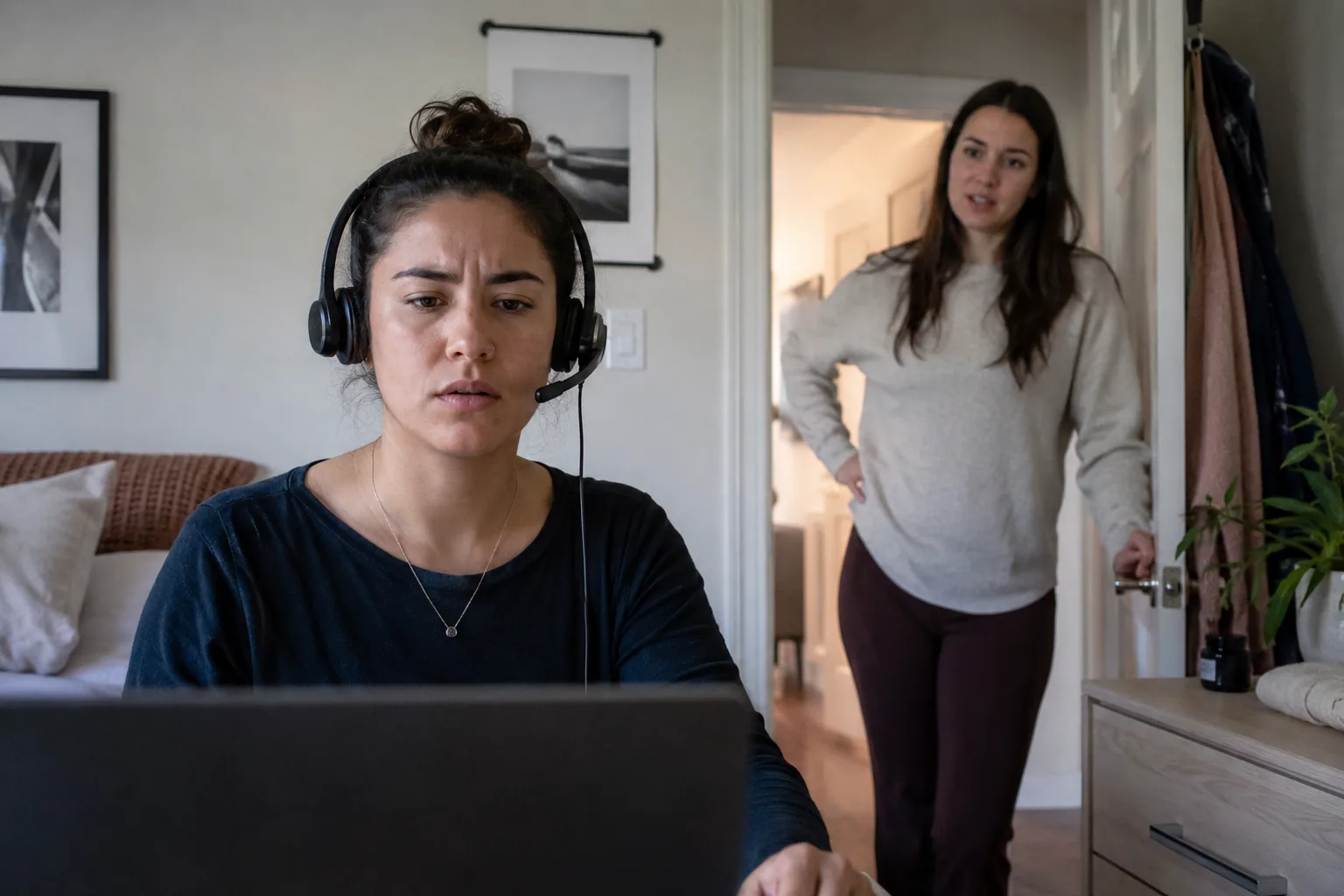
Jenna read it at her desk with her work laptop open and her headset beside the keyboard. The built-in camera sat dark above the screen, same as it had every time Derek had treated it like a controlled device. Marisol sent one direct message a minute later.
Do not argue with him. Just keep the record clean.
Jenna answered: Understood.
At 9:18, Derek appeared in the doorway again, looking at her screen instead of at her. “Your company doesn’t get to define house standards,” he said.
Jenna kept her voice even. “They’re asking who issued the rule you keep using to block my camera.”
He said, “I already explained that.”
She turned the laptop slightly and read the line aloud: “Please provide the issuing authority, exact language, and scope.”
He stayed in the doorway for several seconds without interrupting. Then he said, “It’s an internal household compliance measure.”
Jenna asked, “Issued by who?”
“The household.”
“That’s not a person or a rule source.”
He gave a small shrug and said, “It doesn’t need to be, unless they’re trying to interfere.”
That exchange mattered because he had now been asked the same question in text, in person, and on an email thread copied to his name through Jenna’s forwarded screenshots. Each time, the answer shifted away from anything concrete.
Alicia’s second step arrived before lunch. Instead of asking for another free-form explanation, she attached a one-page clarification form. It was not dramatic. It looked like the kind of document people fill out when someone has used a formal-sounding term and an office wants to know whether that term means anything. Jenna could see the fields from her inbox preview.
Claimed third-party restriction.
Issuing entity.
Written source attached.
Applies to which device or function.
Date restriction began.
Temporary or ongoing.
At the bottom was a checkbox section with two plain options:
I am providing a verifiable outside rule.
I am not providing a verifiable outside rule and am describing a personal household preference or request.
Marisol wrote only one line after that: If he wants us to treat this as a real restriction, he needs to complete this.
Jenna did not send the form to Derek right away. She printed nothing. She just forwarded the email to the address he had used in his text screenshot explanation after Marisol asked her to keep everything in one trail. The subject line stayed intact.
Clarification requested for asserted camera restriction.
At 12:07, Derek texted from the kitchen instead of walking to her room.
Why am I being sent forms by your job?
Jenna answered: Because you are the one asserting the rule.
He came to the doorway two minutes later with his phone in his hand. “This is ridiculous,” he said. “They’re turning a home standard into paperwork.”
Jenna said, “Then check the box that says it’s a household request.”
He looked down at the phone, then back at the laptop. “That’s not how it works.”
“Then fill in who issued it and attach the rule.”
He did not answer that directly. He went back to old language instead. “You’re using business equipment in a shared environment. That creates exposure.”
Jenna asked, “Exposure under what written rule?”
His thumb moved across the edge of the phone case. “You’re reducing it too much.”
“They’re reducing it to source and scope,” Jenna said.
The hallway stayed quiet after that except for the dryer running in the next room and a Slack notification from Jenna’s laptop. At 2:40, Alicia sent a follow-up to the same thread. If no written source exists, please complete the attached acknowledgment by end of day so we can classify the issue correctly for attendance records.
That line changed the pressure. Up to then Derek had been free to keep talking in circles. Now the process had two boxes and his bluff only survived if he chose one. Either he named a real authority, or he signed onto the record that there was no verifiable rule behind what he had been calling compliance.
At 4:11, Jenna saw him standing in the hall outside her partly open door, reading the form on his phone with his jaw set and one finger hovering over the screen. He asked without stepping in, “If I mark it as a household request, what happens?”
Jenna said, “Then it stops being treated like a restriction on my work access.”
He looked back at the phone.
For the first time all week, the question was no longer whether he could block the camera from the doorway. It was whether he would put his own wording into a record that could not be talked around later.