Story code: ST-001031
Part 2: What Stopped Moving
By the next morning, the compost bin had become the first thing Eli noticed when he walked into the garage. Its lid was shut, but a brown smear had dried near the hinge, and one of Maya’s neat labels had started to curl at the corner from being wiped too hard. Dana’s regular car still sat in its usual spot. The key hook above the freezer was empty except for a single house key and a coupon ring from the hardware store.
Maya was already there in leggings and a sweatshirt, sorting through a paper grocery bag on the floor. She pulled out a glass jar, held it up to the light from the open garage door, frowned at whatever film was still inside, and set it aside with more force than usual.
“Did Mom say when she’s taking me to the refill store?” she asked without looking up.
Eli set a case of bottled water by the wall. “I thought you weren’t buying bottled water anymore.”
“It’s for the soccer field cooler,” he said.
Maya waved that off. “Did she say?”
“No.”
That answer hung there a second. Maya tied the paper bag closed, untied it again, and reached for her phone. She made one call, then another. On the second, her voice sharpened.
“You said Tuesday,” she said. “No, I can’t carry forty pounds of detergent tabs on my bike.”
She ended the call and looked toward the interior door. Dana came through a minute later in the same quick, work-ready way Eli was used to seeing: travel mug, laptop bag, lunch container balanced against her forearm. This time she went straight past the regular car and toward the side gate.
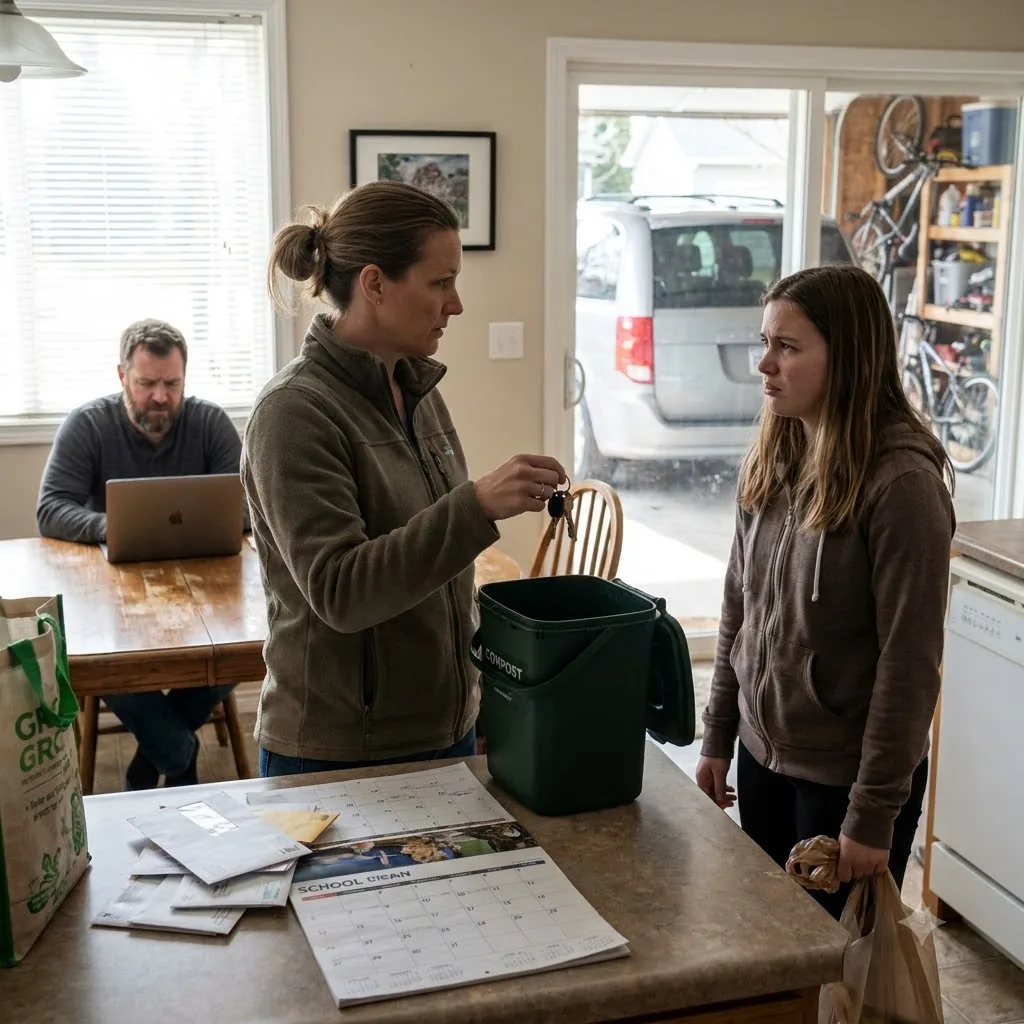
“Your car keys are right there,” Maya said, holding up the ring she had taken the day before.
Dana did not reach for them.
“Keep them,” she said.
She opened the gate. The blue hatchback chirped again from the side yard.
Maya followed two steps. “I need to do the refill run before noon. And the market compost drop-off. And you said you’d stop by the bulk place on your way back.”
Dana pulled the gate wider with one hand. “I said that before you started assigning penalties in the garage.”
There was no raised voice. That made the list sound even plainer. Refill run. Market drop-off. Bulk place. Eli leaned against the washer and watched Maya’s hand tighten around keys to the wrong car.
Dana left in the hatchback again. After the engine faded, the garage sounded louder than usual: the fridge hum, a dripping hose nozzle, the scrape of Maya pulling the kitchen caddy closer with her shoe.
By afternoon, the ordinary routine had started showing gaps. The city compost cart at the curb was packed crooked, lid tipped up by a pizza box that should have been torn down. Maya came outside twice with a bowl of scraps and nowhere to put them cleanly. She opened the garage compost bin, shut it fast, then carried the bowl back into the house. A delivery box sat by the side door because nobody had broken it down. Two rinsed jars stood on the freezer instead of their shelf. The floor around the sorting station looked busier, not cleaner.
Eli noticed something else by dinner. Dana usually stopped in the garage before coming inside for good. She moved shoes off the walkway, reset the trash liners, pushed the bins into a row that let the car fit and the side door open cleanly. That evening she came in through the front with her work bag and did not pass through the garage at all.
Maya opened the interior door once, looked out at the clutter, and shut it again.
The next day was worse in smaller ways. A bag of food scraps sweated through at the bottom and left a dark patch on the concrete. The weekly donation box for glass jars was still by the shelving. The little container of freezer compost bags sat empty. Maya carried two reusable totes to the driveway, then dragged them back inside when no car pulled up.
“Can you take me after your shift?” she asked Dana that evening as Dana unloaded a pharmacy bag from the hatchback.
Dana set the bag on the hood and closed the hatch. “I already arranged my rides for this week.”
“It’s twenty minutes.”
Dana picked up the pharmacy bag again. “So was my drive to work when you held my keys over the compost bin.”
Maya glanced toward Eli, who was coiling an extension cord by the wall. Then she looked back at the garage shelves as if the labels there might settle it for her.
“You are making this bigger than it was,” she said.
Dana nudged a leaking scraps bag away from the tire of the regular car with the side of her shoe. She did not touch the sorting station, the lid, or the keys Maya still carried. “No,” she said. “I’m leaving it the size you made it.”
That night Eli took a trash bag out and saw three things at once under the garage light: the regular car still trapped in place by errands nobody was running, the compost area starting to fail without Dana’s usual reset, and Maya standing with her phone lit in her face, scrolling through contacts as if looking for another driver who knew the route, the stores, the timing, and the exact set of containers she always expected to find ready.
By the end of the second day, Maya had Dana’s keys, the labeled bins, and the rules. Dana had the old hatchback and a new way around the trap. Eli could see which one of those arrangements was starting to hold, and which one was already breaking in plain sight.