Story code: ST-001035
Part 2: He Started Rewriting It In Real Time
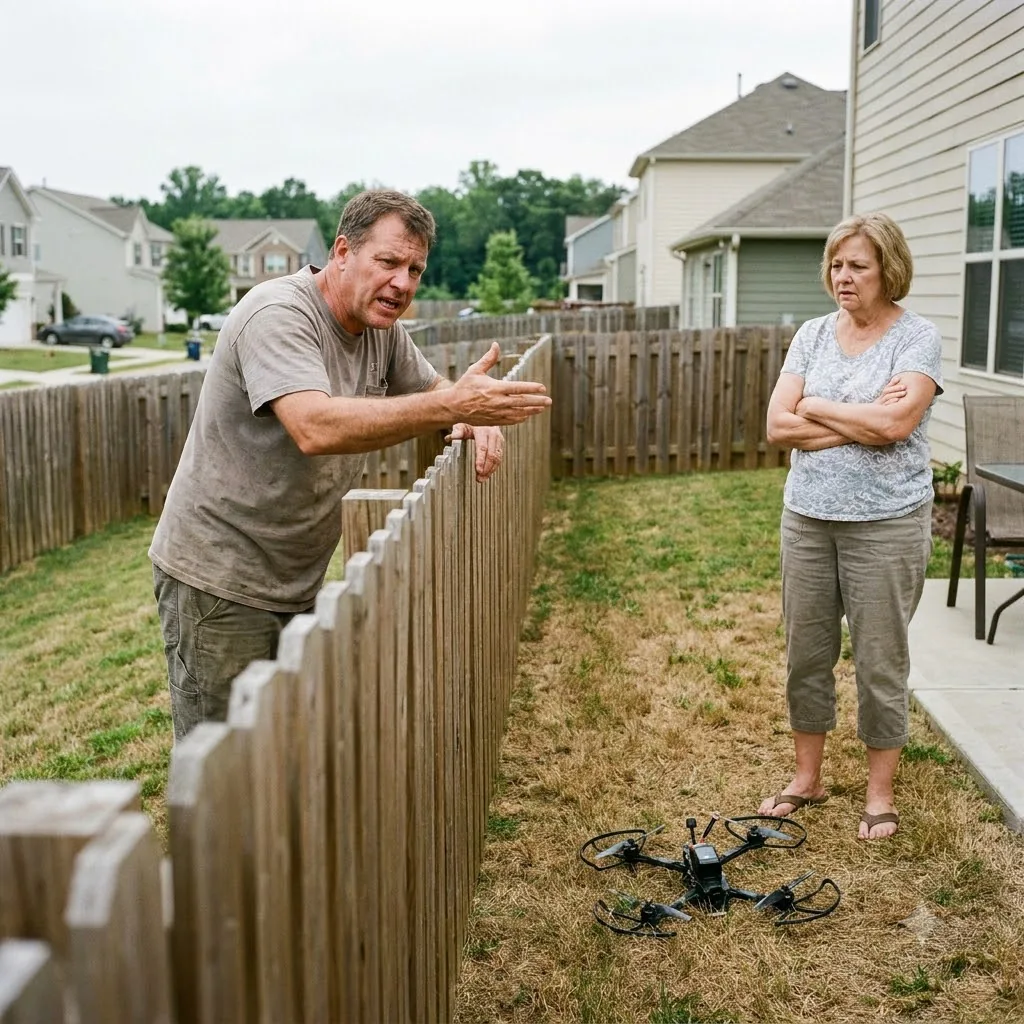
By the time I unlocked my phone, Evan had changed his story twice without moving from the fence. First it was “the battery will explode,” then it was “the battery could vent,” and now he was saying I was the one making it dramatic for not touching a crashed drone in my own yard. Tina stayed where she was near the patio edge and did something I was grateful for right away: she started repeating his exact words back while he could still hear them.
“You said thirty seconds,” she called. “I heard that part from over here.”
Evan threw one hand up over the fence line. “I said there was urgency.”
“No,” I said. “You gave me a countdown.”
He ignored that and went back to the drone. “The longer it sits there, the worse it is. Just get it to me.”
I put the phone on speaker before dialing the local non-emergency line. I did it slowly and in full view, because by then the sequence mattered more than the volume. I wanted there to be no question about what I was doing and when.
As it rang, Evan started talking faster.
“Don’t tell them it exploded,” he said. “Don’t use that word. Tell them it landed hard and I need my property back. That’s all.”
I looked at the fence. “A minute ago you were yelling that it was an emergency.”
“Because you weren’t moving,” he shot back.
That answer just hung there. Tina let out a little “wow” under her breath, not loud, but enough to cut through the yard.
The dispatcher answered, and I gave my name, address, and the plain version: my neighbor’s drone had fallen into my fenced yard, he was saying the battery might be dangerous, and I needed instructions on whether to touch it or wait for someone to look at it. I kept my voice level and left the phone on the patio table so every word was out in the open.
Evan immediately leaned into the fence again. “Tell them there’s no need to send police. This is not a police thing.”
I raised one finger toward him without taking my eyes off the phone. The dispatcher asked whether there was smoke, fire, or visible swelling. I answered only what I could actually see: no smoke, no flames, one blinking light, one damaged propeller, and the drone still resting where it fell near my raised bed.
“Do not touch it if you don’t have to,” the dispatcher said. “Keep clear of it and we’ll have someone come by to assess.”
Before I could respond, Evan cut in loud enough for the phone to catch him. “No, that’s not necessary. I can retrieve it myself if she just opens the gate.”
The dispatcher heard that too. She asked, “Is the device on your property or the caller’s property?”
“My fenced backyard,” I said.
Tina spoke up from her side, not to the dispatcher exactly, but loud enough to carry. “And he told her if she called, people would overreact and make it worse.”
Evan swung toward her voice. “Tina, stay out of it.”
“You dragged all of us into it by shouting ‘thirty seconds,'” she said.
The dispatcher told me to stay inside the fence line, keep the gate secured, and wait near the front access if an officer or responder needed entry. I said okay. The call lasted maybe three more minutes, but Evan kept trying to narrow what was happening the entire time.
“Tell them it’s resolved,” he said.
Nothing had been resolved.
“Tell them I’m the owner and I know these batteries,” he said.
Then, almost in the same breath: “Don’t let them mess with it.”
That was the part that made the whole thing feel less like a neighbor asking for help and more like a man trying to control the exact words around the object in my yard.
When I ended the call, the yard went quiet for a second except for a dog barking somewhere down the block. Evan broke the silence first.
“You really called them over a hobby drone?”
I picked up the bag of potting soil and moved it farther from where the drone had landed. “You said it was an emergency.”
“I said it needed to be handled correctly,” he replied.
Tina answered before I could. “That is not what you said. You said, ‘It will explode if you don’t hand it back.'”
He pointed over the fence, though he still could not see the drone from his side. “You’re both twisting this.”
I looked at the fallen drone again. Same position. Same blinking light. Same fence line between us. The only thing changing was his wording.
Then he asked the question that sharpened everything.
“How long until someone gets there?”
I told him I did not know.
He stopped talking for a beat, then said, much tighter than before, “When they come, don’t let them take it anywhere. I’m serious. I just need them to look at it from the gate.”
That was a new rule from the man who had opened with a countdown and a threat. He had moved from demanding immediate handoff to trying to set limits on the help he said I should not call in the first place. And standing there with Tina listening and the drone still inside my fence, I realized Part 3 was not going to be about getting his property back. It was going to be about what he did when someone neutral finally looked at the exact emergency he claimed was happening.