Story code: ST-001051
Part 3: The One Thing He Could Not Cover For
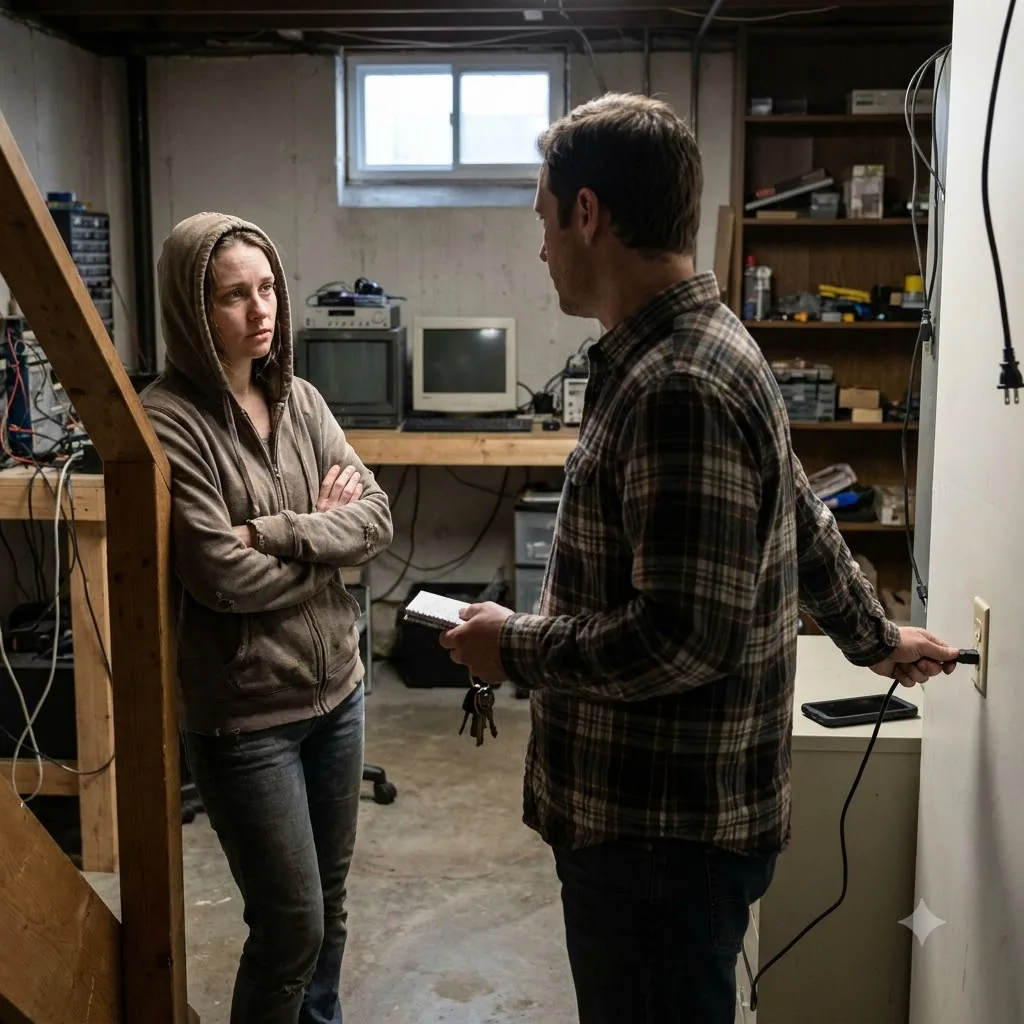
I set the notebook on the stair step, plugged my phone in, and used the last safe minute to send Lenora the file. The upload bar crawled across the screen while the coil rig cooled in little metal ticks behind me.
When the confirmation hit, I took a screenshot, texted it to her, and watched the three dots appear.
Got it, she sent. You still need to reset all credentials before end of day.
That part landed harder than I wanted it to. The notebook had gotten me through the immediate mess, but Evan had still cost me an afternoon of access, a client scare, and whatever explanation I would have to give later about why my account had gone sideways in the first place.
I looked at him across the bench. “You made me almost lose a contract over this.”
He did not deny it. He was adjusting a dial with his thumbnail, not looking at me. “You did not lose it.”
“That is your defense?”
He lifted one shoulder.
I picked up the second postcard again. The line at the bottom sat there plain as a threat and plain as a map: He cannot do the alignment check without you reading the marks aloud.
The white and red grease-pencil lines were drawn on the shielding plate in a narrow row. Some were tiny, close enough together that from where he stood they blurred into one chalky seam.
I walked over and looked harder.
There were pencil letters beside them. Not real labels. My labels.
LATE.
HOLD.
NOW.
He saw where my eyes went and reached for the plate too late to stop me from seeing. I turned to him.
“I wrote these.”
“You copied what you saw before.”
“When?”
“Earlier runs.”
“You never let me this close before.”
He did not answer.
That was the moment the whole ugly shape of it narrowed down. Not just my handwriting on the postcards. My phrasing on the marks. My timing words. The exact little ugly capitals I use when I write in a hurry because lowercase takes longer. He had not just needed a second person in some generic way. He needed the person who had already stood here, already said those words, already written them down.
I said, “The loop is not that you need help. The loop is that you need me to do it the same way I already did it.”
His jaw moved once before he spoke. “You are dramatizing this.”
“No. I am finally using the right word.”
He set both hands on the bench. “Mara, listen carefully. We are already inside the chain. The cards arrived because the actions happen. If they do not happen, you do not just prove me wrong. You create a break in something that is already here.”
“And what does that do?”
“I do not know exactly. The previous object may never have arrived. The sequence may collapse on itself. The timing drift could fry the tray, the supply, all of it.”
“So if I walk out, your proof dies with the machine.”
He looked at the tray instead of at me.
That was answer enough.
I stepped to the locked garage-side door again and held out my hand. “Open it.”
“We are not done.”
“That was not an answer.”
“You cannot leave yet.”
“You just told me I can end this by leaving.”
He came around the corner of the bench, not fast, but for the first time he was the one talking too quickly. “You think this helps you? If the loop fails, then what? You still have to explain the account issue. You still need a ride because your car key is upstairs. You still have nowhere to point if you try to tell anyone what happened down here.”
Every word in that was practical, which made it uglier. He knew exactly which losses to hold up where I could see them.
I said, “Where is my car key?”
He glanced toward the basement stairs.
After lunch, the card had said.
I moved before he could say anything else, went up the first five steps, and saw my key on the narrow ledge by the old laundry sink, tucked behind a detergent bottle where I would not have looked first. I picked it up and came back down slowly enough for him to watch me do it.
His mouth opened, then shut.
The third thing the postcards had nailed.
I put my key in my pocket and felt the room change again. Not safer. Clearer.
On the timer, red numbers crawled toward the next sequence window. Evan wiped his hand down the side of his jeans and said, very even, “If you want to leave with your work intact, read the marks when I say. Then you go.”
I looked at the plate, at the tray, at both postcards with my handwriting on them, and understood the narrow action the whole basement wanted from me.
All I had to do to preserve his future was stand in my old spot and say three words out loud at the right times.
All I had to do to destroy it was keep my mouth shut.
Then the tray gave a dry little pop, and a third postcard edge pushed up from the slot before the next run had even started.