Story code: ST-001060
Part 3: The Diagnostic Log
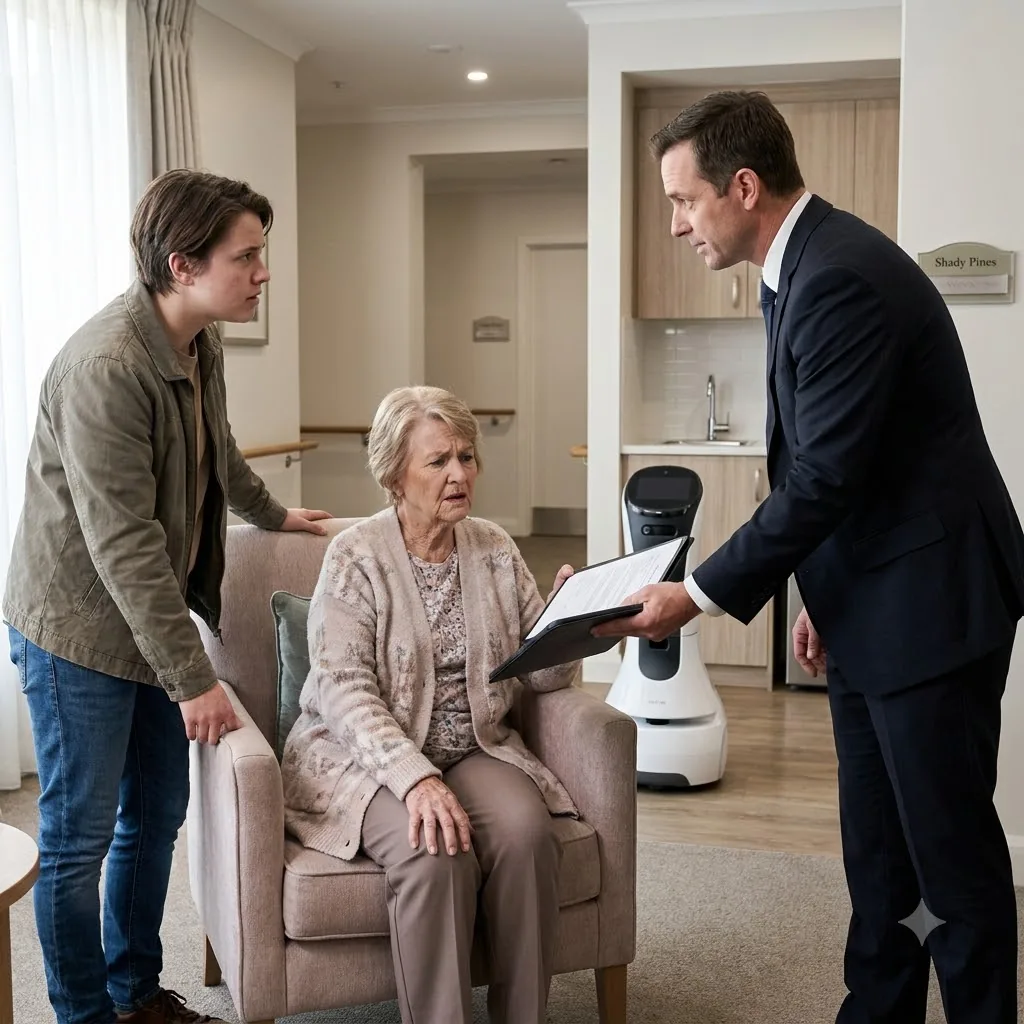
After Arthur Vance left Room 114, the heavy silence of the assisted living room returned. Aura stood near the window, its chrome frame catching the late afternoon sun, the blue indicator lights on its base pulsing with a slow, mechanical rhythm. My mother remained in her armchair, her hands still trembling slightly as she set her teacup down on the side table. She looked at the silent machine, then back at me.
“Leo,” she whispered, her voice barely carrying over the quiet hum of the room’s ventilation. “Are they going to make me leave? I can’t afford to move again.”
“No one is making you leave, Mom,” I said, though my chest tightened with a sudden weight. I walked over to the Aura unit. The small, integrated touchscreen terminal on its charging dock was still active, displaying a diagnostic summary of the day’s physical interactions. Under the rules of the Shady Pines facility contract, commercial AI vendors were required to leave the local system terminals unlocked for family legal proxies. I pulled out my phone, located my proxy authorization card, and tapped the NFC chip against the unit’s receiver. The screen blinked, shifting from the glossy customer interface to the raw system logs.
I scrolled past the gait calibration reports and the cloud-upload notifications. If Arthur was using my mother’s daily movements to train his company’s new algorithms, there had to be a record of the initial authorization. I tapped on the directory labeled “User Onboarding & Verbal Consent.” A list of audio files appeared, each stamped with a timestamp from the past week. The very first file was dated Tuesday morning, at 9:15 AM-the exact hour Arthur had rolled Aura into the room and left her here as a “friendly trial.”
I plugged my headphones into the terminal’s audio jack so as not to wake my mother, who had closed her eyes to rest. I tapped play on the first file.
Arthur’s voice came through the earphones first, crisp and impatient: “Setting up unit for Margaret Kelly. Initiating standard verbal onboarding sequence.”
Then, the robot’s soft-spoken synthetic voice spoke: “To initiate gait calibration, please state your name.”
“Margaret Kelly,” my mother’s voice replied, sounding small and confused.
“Calibration mode requires active user feedback,” Aura continued. “Under SilverAge Developer Protocol 4-B, ambient physical interaction during the calibration phase is classified as system testing. By participating in this software development trial, the user agrees to developer credit compensation of two hundred and fifty dollars per hour, offset against any operational liabilities. Do you accept these terms to proceed?”
There was a brief pause, then my mother’s voice: “Yes, I agree.”
I stared at the screen. The machine had explicitly stated the terms of its own testing program. I closed the audio file and opened the active telemetry log. The counter showed that Aura had spent fifty-eight hours in active gait-tracking and balance-calibration mode while assisting my mother.
At two hundred and fifty dollars an hour, that came to exactly fourteen thousand, five hundred dollars. Arthur’s invoice was for twelve thousand dollars.
I copied the audio file and the system telemetry report to my personal drive, locking the terminal screen. The predatory debt Arthur had manufactured wasn’t just void; according to the machine’s own automated smart-contract logs, his company actually owed us money. I sat down in the chair opposite my mother, waiting for the morning when Arthur would return to collect his payment.