Story code: ST-001138
Part 2: The System Check
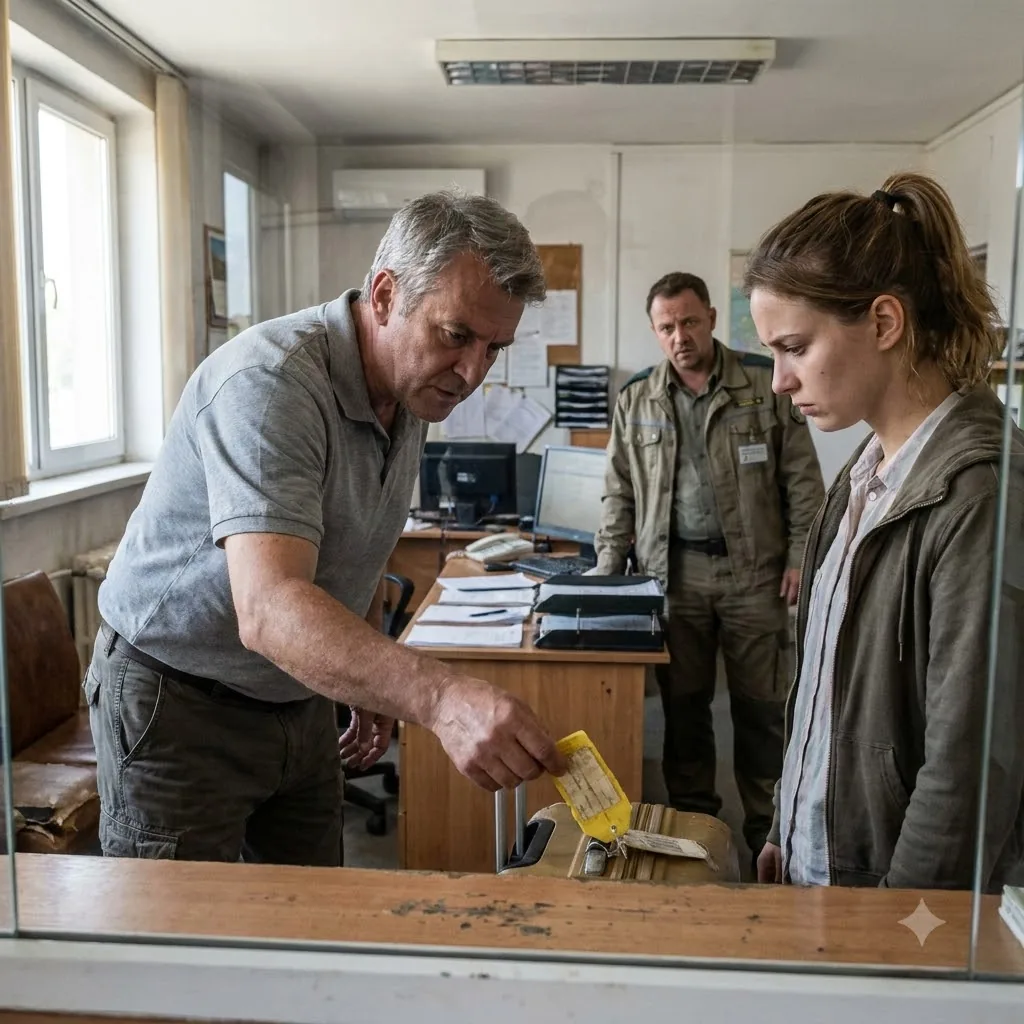
Richard leaned his elbows on the laminate counter, his posture expanding as if he owned the small, fluorescent-lit specialist room. “It’s a standard safety override,” he continued, gesturing toward Sofia’s bag. “When a sponsored traveler is assigned a yellow tag without a secondary stamp, the system automatically flags it at the state line. If she boards with it, the liability falls directly on me as her sponsor. That is why Section 14-B requires the immediate physical custody transfer of the baggage to the sponsor.”
Sofia looked from Richard to me, her breathing shallow. She didn’t speak, but her hands tightened even further around her handbag. Her eyes remained fixed on her suitcase, which Richard had now pulled fully onto his side of the partition.
“I see,” I said, pulling the desktop terminal scanner closer to my keyboard. “And you’re stating that this yellow tag lacks the necessary secondary validation under that specific code?”
“Exactly,” Richard said. “As her sponsor, I am simply protecting her from a federal violation. I will take the suitcase back to my residence, clear the documentation, and ship it to her destination once the clearance is processed. She can travel today, but the bag stays with me. It’s the only legal pathway.”
His explanation was seamless, delivered with the smooth authority of someone who expected his words to go unchallenged. He reached into his coat pocket and pulled out his official sponsor identification card, sliding it across the counter toward me. “Go ahead and log the override. Use my ID number.”
I picked up his card. The plastic was worn at the edges, bearing his name: Richard Vance. Below his name was his registered sponsor ID. I looked at Sofia. “Did you authorize this transfer of property, Sofia?”
Before she could speak, Richard intervened. “She doesn’t have the authority to authorize or deny it,” he said, his voice dropping to a low, firm register. “The sponsorship agreement grants me administrative oversight of her transit logistics. She signed the papers. She knows how this works.”
Sofia kept her mouth shut. She nodded once, a brief, jerky motion, but her eyes did not meet mine. She looked instead at the security camera mounted in the corner of the ceiling.
I turned back to my monitor. I opened the station’s active baggage registry database. Every tag issued at the front desk was linked to an active transit record, complete with routing details, sponsor verification codes, and security clearances. If a tag was non-compliant, the database flagged it automatically the moment it was printed.
I reached across the counter and pulled the yellow tag toward me, stretching the plastic loop. The tag felt cold and slightly greasy under my fingers. The barcode was clean, the handwritten initials ‘CHI’ indicating the Chicago route.
“We don’t rely on manual overrides for baggage classification,” I said, checking my screen. “Every tag is validated in real time against the federal transit database. I’m going to run a live scan of this tag to verify the Section 14-B restriction.”
Richard’s eyebrows twitched, a brief flicker of movement before his face hardened back into a confident expression. “Go ahead,” he said, folding his arms. “The database will verify exactly what I just told you. But do it quickly. Her bus leaves in twenty minutes, and I don’t want her missing it because of administrative foot-dragging.”
I picked up the handheld laser scanner. The red beam flared across the desk, illuminating the yellow tag.