Story code: ST-001157
Part 1: The Arbitrary Threshold
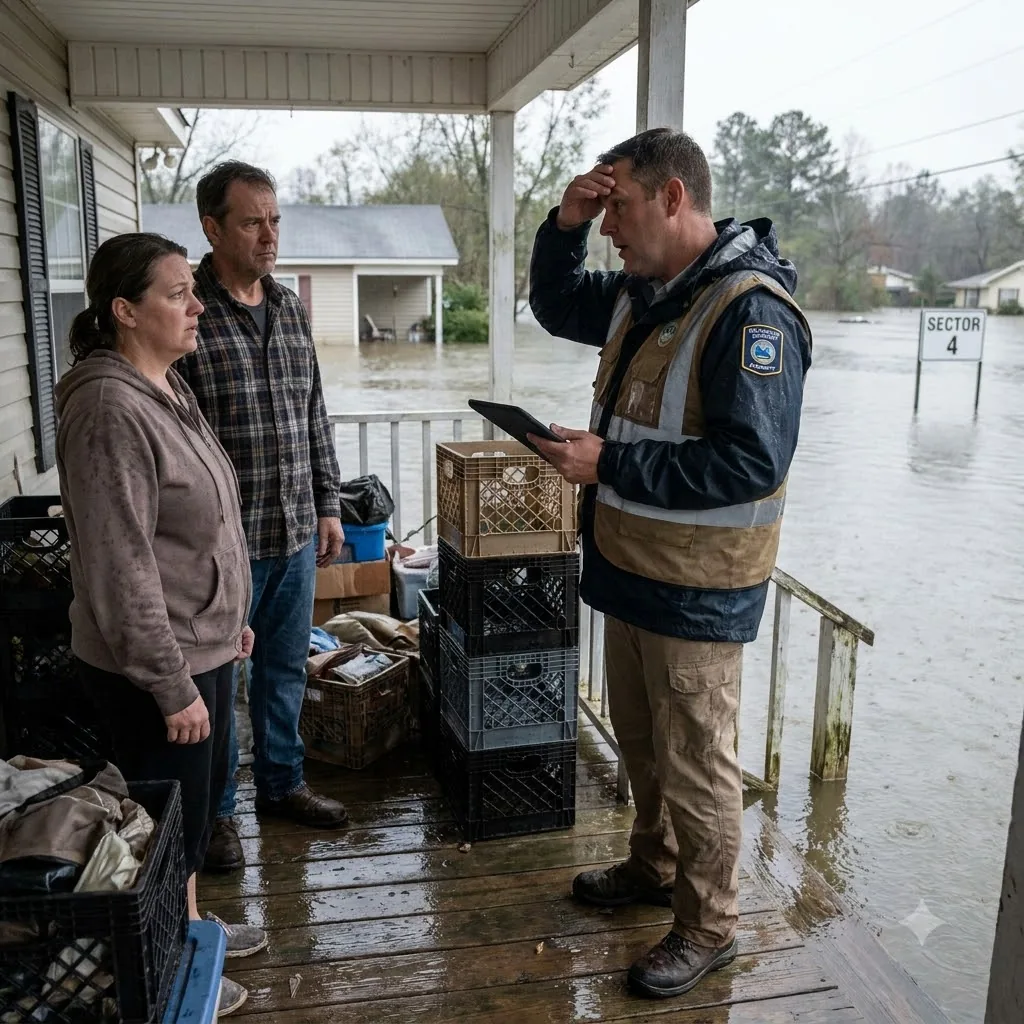
According to the audio logs and video metadata recovered from the Sector 4 evacuation, relocation planner Marcus Vance stood on the Miller family’s flooded porch and announced with absolute authority that they could not pack their stripe-banded evacuation tote, citing an unverified size code 104-B. Sarah Miller, standing in the rising water that sloshed against her shins, stopped packing the heavy-duty plastic bin to demand written proof of a rule that threatened to strip her family of their medicine and legal documents. This investigation reconstructs how a fabricated safety protocol, used to stall departures on a day when transport boats were quietly over-capacity, began to unravel under the glare of a porch light.
The footage shows Sarah resting her hands on the edge of the tote. The yellow zip-tie, meant to seal the container once approved, dangled from her fingers. “I’ve read the emergency relocation guide cover to cover, Mr. Vance,” she said, her voice recorded clearly despite the sound of rain hitting the metal porch roof. “There is no mention of a code 104-B restricting standard-issue emergency containers.”
Vance, wearing a damp utility vest that clung to his shoulders, clutched his digital clipboard. The video captures him tapping the screen repeatedly, though the angle reveals the display remained on a static home screen. “The guide is out of date,” Vance replied, his tone formal but strained. “Sectors under active flood warnings are subject to strict weight and volume limits. Code 104-B is a temporary administrative override. I cannot sign off on the transit clearance for this tote.”
Sarah did not back away. “Then show me the database entry. Pull up the override text on your terminal and let me read it.”
Vance shifted his weight, his boots splashing in the shallow water covering the deck. He wiped sweat from his temple, his eyes darting toward the flooded street where the evacuation transport was scheduled to arrive. “The local network is experiencing high latency due to the storm. I can’t load the full index right now, but the rule is clear. If I sign off on a non-compliant container, the ferry operators will reject your entire family at the boarding plank.”
The stand-off on the flooded porch continued for three minutes, marked only by the ambient sounds of rising water and the rhythmic tapping of Vance’s stylus against his screen. Sarah remained stationary, shielding the tote with her body.
The dynamic changed when heavy splashes approached from the side yard. Leo Miller, Sarah’s brother and neighbor, walked up the steps onto the porch. He was carrying a small duffel bag and a plastic cooler. He stopped, looking at Vance, then at the stripe-banded tote sitting between his sister and the planner.
“Is he trying to pull code 104-B on you, too?” Leo asked, setting his duffel bag down on a dry wicker bench. He pointed a finger at Vance. “Ten minutes ago at the north dock, this planner told me my cooler was barred from the ferry because it violated code 104-B. He told me it was an over-width violation for refrigeration units.”
Sarah turned her gaze back to Vance. “An over-width refrigeration code? For a standard vertical evacuation tote?”
The camera record shows Vance’s throat tighten. He clicked his stylus three times in rapid succession. When Sarah asked him to explain how a single code could apply to two entirely different objects with different dimensions and purposes, Vance remained silent, his gaze fixed on the blank screen of his tablet. The gatekeeper could not explain the cross-application, leaving his authority hanging by a thread in the rising water.
According to the audio logs and video metadata recovered from the Sector 4 evacuation, relocation planner Marcus Vance stood on the Miller family’s flooded porch and announced with absolute authority that they could not pack their stripe-banded evacuation tote, citing an unverified size code 104-B. Sarah Miller, standing in the rising water that sloshed against her shins, stopped packing the heavy-duty plastic bin to demand written proof of a rule that threatened to strip her family of their medicine and legal documents. This investigation reconstructs how a fabricated safety protocol, used to stall departures on a day when transport boats were quietly over-capacity, began to unravel under the glare of a porch light.
The footage shows Sarah resting her hands on the edge of the tote. The yellow zip-tie, meant to seal the container once approved, dangled from her fingers. “I’ve read the emergency relocation guide cover to cover, Mr. Vance,” she said, her voice recorded clearly despite the sound of rain hitting the metal porch roof. “There is no mention of a code 104-B restricting standard-issue emergency containers.”
Vance, wearing a damp utility vest that clung to his shoulders, clutched his digital clipboard. The video captures him tapping the screen repeatedly, though the angle reveals the display remained on a static home screen. “The guide is out of date,” Vance replied, his tone formal but strained. “Sectors under active flood warnings are subject to strict weight and volume limits. Code 104-B is a temporary administrative override. I cannot sign off on the transit clearance for this tote.”
Sarah did not back away. “Then show me the database entry. Pull up the override text on your terminal and let me read it.”
Vance shifted his weight, his boots splashing in the shallow water covering the deck. He wiped sweat from his temple, his eyes darting toward the flooded street where the evacuation transport was scheduled to arrive. “The local network is experiencing high latency due to the storm. I can’t load the full index right now, but the rule is clear. If I sign off on a non-compliant container, the ferry operators will reject your entire family at the boarding plank.”
The stand-off on the flooded porch continued for three minutes, marked only by the ambient sounds of rising water and the rhythmic tapping of Vance’s stylus against his screen. Sarah remained stationary, shielding the tote with her body.
The dynamic changed when heavy splashes approached from the side yard. Leo Miller, Sarah’s brother and neighbor, walked up the steps onto the porch. He was carrying a small duffel bag and a plastic cooler. He stopped, looking at Vance, then at the stripe-banded tote sitting between his sister and the planner.
“Is he trying to pull code 104-B on you, too?” Leo asked, setting his duffel bag down on a dry wicker bench. He pointed a finger at Vance. “Ten minutes ago at the north dock, this planner told me my cooler was barred from the ferry because it violated code 104-B. He told me it was an over-width violation for refrigeration units.”
Sarah turned her gaze back to Vance. “An over-width refrigeration code? For a standard vertical evacuation tote?”
The camera record shows Vance’s throat tighten. He clicked his stylus three times in rapid succession. When Sarah asked him to explain how a single code could apply to two entirely different objects with different dimensions and purposes, Vance remained silent, his gaze fixed on the blank screen of his tablet. The gatekeeper could not explain the cross-application, leaving his authority hanging by a thread in the rising water.