Story code: ST-001176
Part 3: The Execution under Pressure
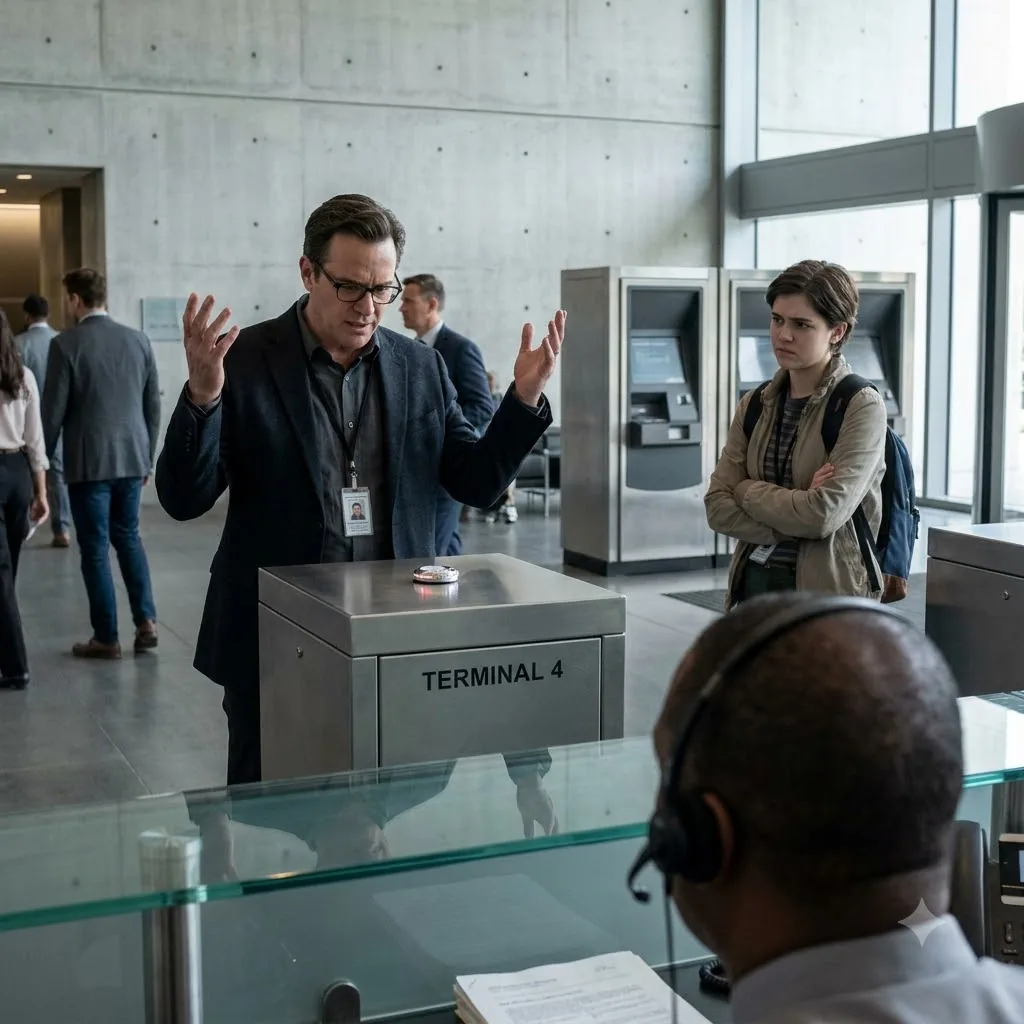
From the security desk, I watched the countdown timer on Terminal Station 4 blink down to seven minutes. The red status bar stretched across the screen, a visual warning that the recovery partition would lock permanently if the handshake failed.
Julian Vance stood before the terminal, his fingers hovering inches above the keyboard. He looked back toward the glass entry doors, his chest rising and falling in rapid, shallow breaths. The lobby remained empty. Elena was not coming back to enter the bypass codes for him.
The auditor, a tall man named Miller, tapped his stylus against his digital tablet. “Six minutes, Mr. Vance. If the partition remains uninitialized, we will mark this console as a failure and report the system security breach to the board.”
Julian’s head jerked toward Miller. “The hardware is unresponsive,” Julian said, his voice straining. “The token must be damaged. I need a replacement token from the vault before I can proceed.”
Miller did not move from his position. “The token diagnostics are green on our end. Please insert the token and begin the sequence.”
Julian’s hand trembled slightly as he picked up the physical quantum access token. He looked at the slot, then looked at the security desk where I sat. I kept my face neutral, meeting his gaze without offering any assistance. He had no avenue of escape. If he failed the test, the resulting audit report would document his failure under his unique login, leading to an immediate suspension and an inquiry that would reach Uncle Arthur.
He inserted the token. The screen immediately prompted for the master configuration key.
For fifteen seconds, Julian did not touch the keys. The rolling key indicator in the corner of the monitor began its thirty-second cycle, shifting from blue to yellow.
Then, Julian’s posture changed. The nervous, hunched curve of his shoulders vanished. He stood upright, his weight balancing evenly on both feet.
His right hand reached out and pressed the initialization sequence.
On my monitor, the keylogger diagnostics feed began to scroll. I watched the keystroke rate visualizer.
Julian did not search for the characters. His fingers moved across the split keyboard in a series of rapid, fluid taps. The complex hexadecimal validation strings appeared on the screen as fast as the system could register them.
Miller took a step forward, his eyes fixed on the terminal screen.
Julian didn’t look at the auditor. His focus remained locked on the monitor as the interface transitioned to the secondary security layer. The system demanded the parity alignment key. Without hesitation, Julian’s left hand entered the configuration string. It was a twelve-character sequence that changed based on the token’s rolling seed, requiring active calculations.
He entered it in less than three seconds.
The terminal chimed, confirming the first phase of the recovery.
I looked at the system monitor on my desk. The metric tracker recorded his entry speed at over four hundred characters per minute, with zero backspaces.
The progress bar on Terminal Station 4 reached eighty percent. Julian’s face was illuminated by the blue light of the console, his expression completely blank, his movements stripped of all simulated clumsiness. He was entering the administrative bypass keys with the speed of an engineer who had designed the system itself.
The final verification screen appeared, requesting the manual routing path.
Julian paused, his fingers resting lightly on the home row. He looked up at the auditors in the conference room window, then down at the keyboard, his hands poised to complete the final segment of the audit.