Story code: ST-001195
Part 2: The Pressure Valve
Leo kept his hand pressed firmly against the phone hook, his fingers rigid. His shoulders, previously hunched in panic, straightened as he stepped between me and the wall unit. The urgency that had filled his voice just moments ago when he ran through the door had completely vanished.
“We are not calling anyone,” Leo said, his voice dropping to a flat, quiet tone.
I stared at his hand on the receiver. “You just told me we have an active biological leak. If that vial is venting, the vapor is already in the housing. We need professional mitigation before the ventilation system carries it out of the garage.”
“We don’t need them,” he repeated. His eyes remained fixed on the console of the analyzer, where the startup sequence was beginning to cycle.
I looked past his shoulder to the digital readout on the analyzer. The internal chamber pressure sensor read a steady 101.3 kilopascals. If the vial cap had indeed fractured and begun to leak its pressurized contents, the sensor would have registered an immediate spike in the sealed environment. The graph on the screen remained a perfectly flat blue line, showing no deviation whatsoever.
“The chamber pressure isn’t moving, Leo,” I said. “If the seal on that vial were compromised, the internal chamber would show the pressure change.”
Leo did not look at the screen. He stepped back from the phone, but positioned himself directly in front of the workbench, blocking my access to the analyzer controls. “It’s a slow release. It hasn’t pressurized the chamber yet.”
“That’s not how a cap fracture behaves,” I said. “You know the physics of these vials. If there’s moisture on the cap, the seal is gone, and the pressure drops instantly. The chamber sensor would have picked it up by now.”
He rubbed his palms against his thighs, his gaze shifting to the floor. “We just need to run the test. Once the sequence is finished, we can neutralize whatever is in the chamber. There’s no need to bring inspectors into this garage.”
“You’re asking me to violate the civil liability agreement we both signed,” I said, watching his chest return to a normal breathing pattern. “If the county finds out we hid a breach, we lose the equipment and the license.”
Leo looked toward the garage door, then back to the locked analyzer. “They won’t find out because there’s nothing to find. Just start the run.”
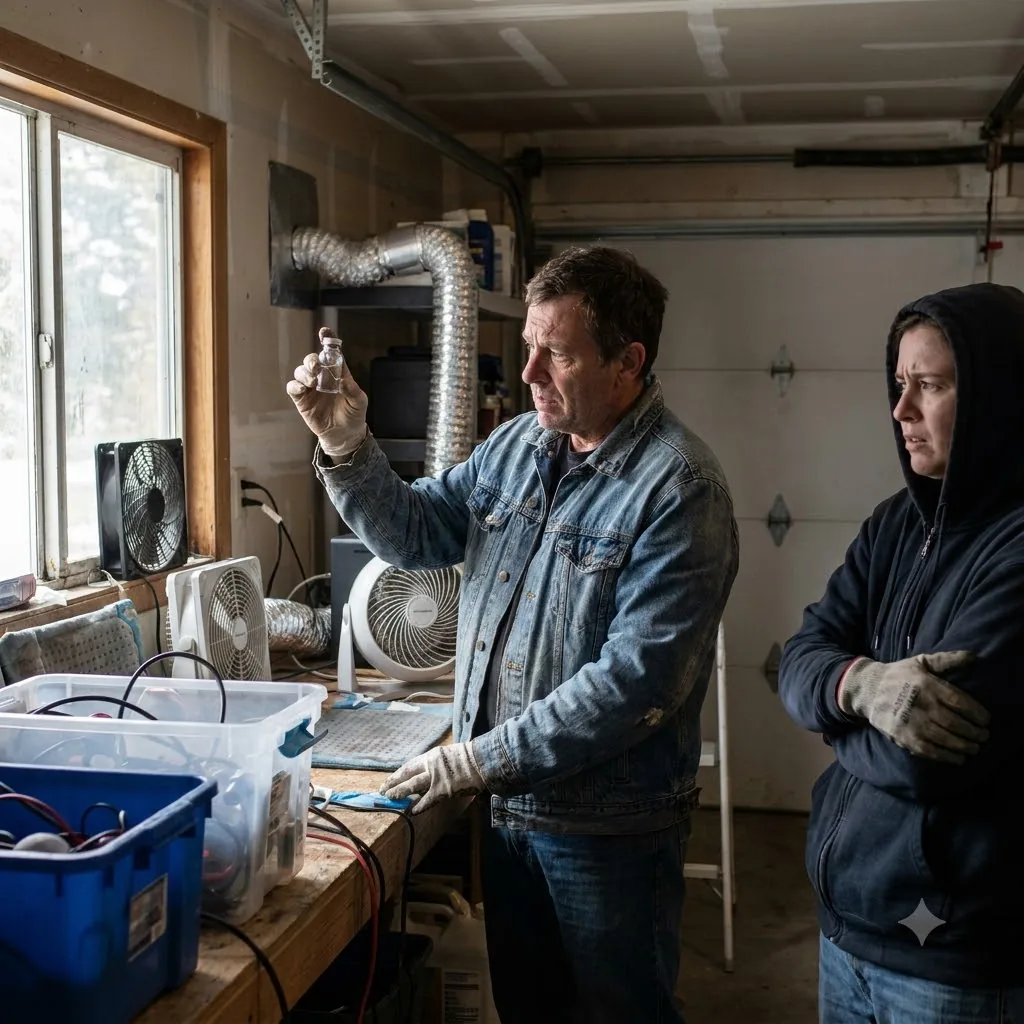
I stood still, looking from the flat line on the monitor to the dry collar of the vial visible through the chamber window. The bead of moisture on the cap hadn’t grown or shifted since he brought it in.
He stayed silent for several seconds, the only sound in the room being the low hum of the ventilation fans. His hands remained stuffed in his pockets, his posture defensive.
“I needed the data run tonight,” he said quietly. “The deadline is tomorrow morning, and you wouldn’t have let me bypass the stabilization wait otherwise.”
I stared at him, the silence stretching between us as the analyzer clicked, indicating it was ready for the command to begin the test.