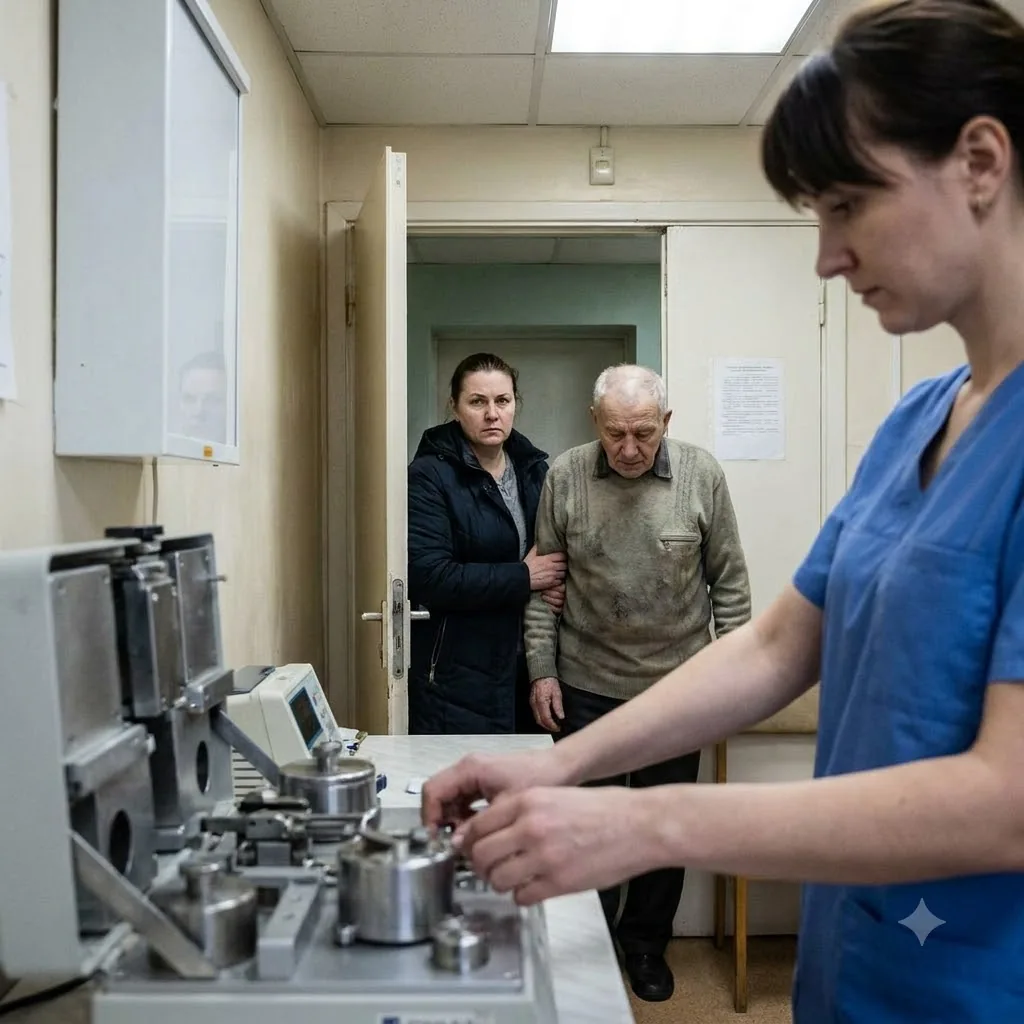
Story code: ST-001215
Part 3: The Locking Mechanism
Clara’s knuckles turned white against the edge of the keyboard. She did not look at Arthur, whose head remained tilted back against the headrest, his eyes half-closed and fixed on the opposite wall. The hum of the stabilization cradle was the only steady sound in Room 14.
“Release the drive, Elena,” Clara said, her voice dropping to a controlled, hushed tone. “We are leaving.”
Elena did not move her hands from the desk. “The moment you swiped your advocate card and initiated the emergency bypass, the cradle locked the Model-9. You know the hardware safety features. The stabilization cradle will not release the drive until the sequence is resolved-either by Dr. Aris’s verification or by a completed diagnostic run.”
I pointed to the primary monitor. “The diagnostic is at forty-eight percent. If we pull the power now, the system triggers a critical hardware failure report. That goes directly to the state regulatory board.”
Clara’s gaze snapped to me, then back to Elena. Her breathing was fast, her chest rising and falling in short, shallow movements. “Then complete the diagnostic, but do not send the telemetry to Aris. Keep it local.”
“The emergency protocol doesn’t allow local storage,” Elena said. She pointed to the red flashing indicator on the terminal. “The system requires a destination IP. If I don’t input Aris’s terminal ID, the system defaults to the central audit registry. It will flag the emergency as unverified.”
Clara reached for her advocate ID card, still slotted into the secondary terminal reader. She tugged at it, but the slot’s physical solenoid lock was engaged. A small red LED next to the card reader glowed steadily, indicating an active session.
“Unlock the card, Elena,” Clara said. “Now.”
“I can’t unlock it,” Elena replied. “The console locks all credentials during an active emergency bypass to prevent advocates from abandoning a patient mid-transfer. It’s a consumer protection rule. You helped lobby for it.”
Clara’s lips pressed into a thin line. She took a step back, her boots clicking loudly on the sterile linoleum. She looked at the door, then at Arthur, who remained motionless, his breathing slow and even. The green line of his telemetry scan remained flat and regular on the display, showing no signs of the collapse Clara had claimed.
“If Aris receives this telemetry,” Clara said, her voice shaking slightly, “he will see the baseline readings. He will log it as a false filing.”
“If he logs it as a false filing, the registry will review your queue-bypass history,” Elena said. Her voice remained level, devoid of anger or hesitation. “Is that why you don’t want him called?”
Clara did not answer. She reached into her pocket, pulled out her personal device, and pressed a button, the dark screen reflecting the bright fluorescent lights of the room. “We will wait for the standard queue. Cancel the emergency. Tell the system it was an operator error.”
“Operator error requires a diagnostic log showing sensor malfunction,” Elena said. “The sensors are reading Arthur’s vitals perfectly. There is no malfunction.”
On the primary monitor, the progress bar for the live-test diagnostic reached sixty percent. The cooling fans in the Model-9 drive began to whir, a high-pitched drone filling the small room.
“If you don’t cancel this, Elena,” Clara whispered, stepping closer to her sister, “I will report a protocol breach on your license. I will say you refused to assist an emergency patient.”
Elena did not flinch. She reached for the mouse, her index finger resting on the prompt that would send the active telemetry directly to Dr. Aris’s tablet. “Then we let the specialist decide.”