Story code: ST-001277
Part 1: The Standoff at Counter 4
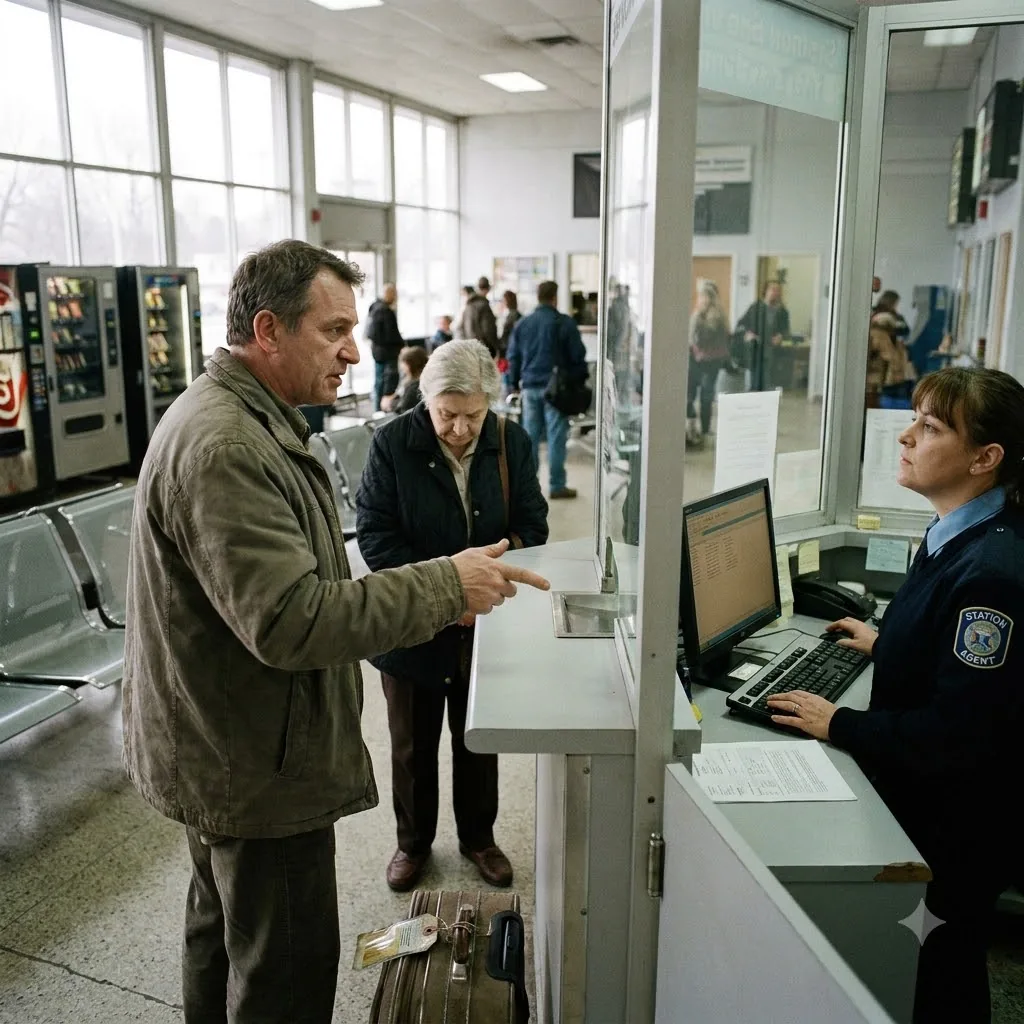
According to the timestamped security footage from Greybound Terminal Counter 4, Marcus Vance stood before the ticket clerk, pointed at his niece Elena’s laminated barcode suitcase tag, and loudly announced that corporate policy prohibited the boarding of any sponsored passengers without a physical signature release from the original financial buyer. This sudden, invented rule instantly halted Elena and her daughter’s travel, denying them access to the bus they had already checked into. Investigator Miller’s reconstruction of the incident, compiled from audio channel transcripts and terminal transaction logs, reveals a deep contradiction: the terminal registry contained no such restriction, yet the physical standoff at the counter had already begun.
The audio log from Counter 4 captures the background hum of ordinary activity inside the bus station-the roll of heavy suitcases on linoleum, the crackle of the PA system announcing departures, and the shuffling of feet in the boarding lines. On the video feed, Elena Vance stands beside a single blue suitcase, holding her young daughter’s hand. Her right hand presses her passport flat against the counter, while her left repeatedly checks the digital ticket on her phone screen. Marcus Vance stands to her left, his hands placed flat on the high metal counter, his posture rigid and unyielding.
“The ticket was purchased under my corporate account,” Marcus says on the audio track, his voice controlled and measured. “Under corporate transit bylaws, a sponsor has the right to halt baggage loading at Baggage Loading Area B if the physical signature verification is not complete on the barcode tag. Scan the tag, agent. You’ll see it requires sponsor clearance.”
Agent Davis, the ticket clerk behind the counter, is seen squinting at the green-tinted CRT monitor. His keyboard clicks rapidly. He reaches for a laminated policy binder beneath the counter, flipping through the pages. “I am checking the manifest log,” Agent Davis says, his voice falling into a flat, repetitive corporate drone. “But the system checked them in twenty minutes ago. The ticket status is active.”
“The system checked them in before I filed the sponsor hold,” Marcus responds, his hand gesturing toward the laminated barcode suitcase tag attached to Elena’s bag. “Look at the tag. It doesn’t have the secondary validation marker. If you load that bag, your station is liable for unauthorized transit of sponsored dependents.”
Elena Vance does not look at Marcus. The security footage shows her head turned toward Agent Davis, her lips moving as she speaks in a defensive tone. “The ticket is paid for, and the transaction log shows the payment cleared last Tuesday. The tag was printed by your own kiosk.”
Agent Davis continues to tap the keys. He picks up the hand scanner, his hand hovering over the barcode on the suitcase tag. The red laser line sweeps across the laminated surface, registering a beep in the audio log. On the monitor, the Terminal Manifest Log V3.1 displays a pending status, but no error code appears.
Marcus Vance does not retreat. Instead, he turns his head toward the passenger standing directly behind Elena in the queue-an unrelated traveler holding a similar green bag. Marcus points at the traveler’s luggage tag. “It’s the same for him,” Marcus asserts, his voice rising slightly. “If his sponsor didn’t sign the registry, he shouldn’t be boarding either. Check his tag, agent. Apply the policy consistently.”
Agent Davis blinks, looking from Marcus to the bystander, then back to his monitor. The video shows Davis tracing his finger along the laminated policy page, his mouth opening, then closing. He cannot explain how a rule supposedly governing Marcus’s private corporate account could possibly apply to the luggage of an unrelated passenger in the general queue. The gatekeeper’s silence hangs over Counter 4 as the line behind them begins to stall.
According to the timestamped security footage from Greybound Terminal Counter 4, Marcus Vance stood before the ticket clerk, pointed at his niece Elena’s laminated barcode suitcase tag, and loudly announced that corporate policy prohibited the boarding of any sponsored passengers without a physical signature release from the original financial buyer. This sudden, invented rule instantly halted Elena and her daughter’s travel, denying them access to the bus they had already checked into. Investigator Miller’s reconstruction of the incident, compiled from audio channel transcripts and terminal transaction logs, reveals a deep contradiction: the terminal registry contained no such restriction, yet the physical standoff at the counter had already begun.
The audio log from Counter 4 captures the background hum of ordinary activity inside the bus station-the roll of heavy suitcases on linoleum, the crackle of the PA system announcing departures, and the shuffling of feet in the boarding lines. On the video feed, Elena Vance stands beside a single blue suitcase, holding her young daughter’s hand. Her right hand presses her passport flat against the counter, while her left repeatedly checks the digital ticket on her phone screen. Marcus Vance stands to her left, his hands placed flat on the high metal counter, his posture rigid and unyielding.
“The ticket was purchased under my corporate account,” Marcus says on the audio track, his voice controlled and measured. “Under corporate transit bylaws, a sponsor has the right to halt baggage loading at Baggage Loading Area B if the physical signature verification is not complete on the barcode tag. Scan the tag, agent. You’ll see it requires sponsor clearance.”
Agent Davis, the ticket clerk behind the counter, is seen squinting at the green-tinted CRT monitor. His keyboard clicks rapidly. He reaches for a laminated policy binder beneath the counter, flipping through the pages. “I am checking the manifest log,” Agent Davis says, his voice falling into a flat, repetitive corporate drone. “But the system checked them in twenty minutes ago. The ticket status is active.”
“The system checked them in before I filed the sponsor hold,” Marcus responds, his hand gesturing toward the laminated barcode suitcase tag attached to Elena’s bag. “Look at the tag. It doesn’t have the secondary validation marker. If you load that bag, your station is liable for unauthorized transit of sponsored dependents.”
Elena Vance does not look at Marcus. The security footage shows her head turned toward Agent Davis, her lips moving as she speaks in a defensive tone. “The ticket is paid for, and the transaction log shows the payment cleared last Tuesday. The tag was printed by your own kiosk.”
Agent Davis continues to tap the keys. He picks up the hand scanner, his hand hovering over the barcode on the suitcase tag. The red laser line sweeps across the laminated surface, registering a beep in the audio log. On the monitor, the Terminal Manifest Log V3.1 displays a pending status, but no error code appears.
Marcus Vance does not retreat. Instead, he turns his head toward the passenger standing directly behind Elena in the queue-an unrelated traveler holding a similar green bag. Marcus points at the traveler’s luggage tag. “It’s the same for him,” Marcus asserts, his voice rising slightly. “If his sponsor didn’t sign the registry, he shouldn’t be boarding either. Check his tag, agent. Apply the policy consistently.”
Agent Davis blinks, looking from Marcus to the bystander, then back to his monitor. The video shows Davis tracing his finger along the laminated policy page, his mouth opening, then closing. He cannot explain how a rule supposedly governing Marcus’s private corporate account could possibly apply to the luggage of an unrelated passenger in the general queue. The gatekeeper’s silence hangs over Counter 4 as the line behind them begins to stall.