Story code: ST-001291
Part 1: The Ultimatum at the Partition
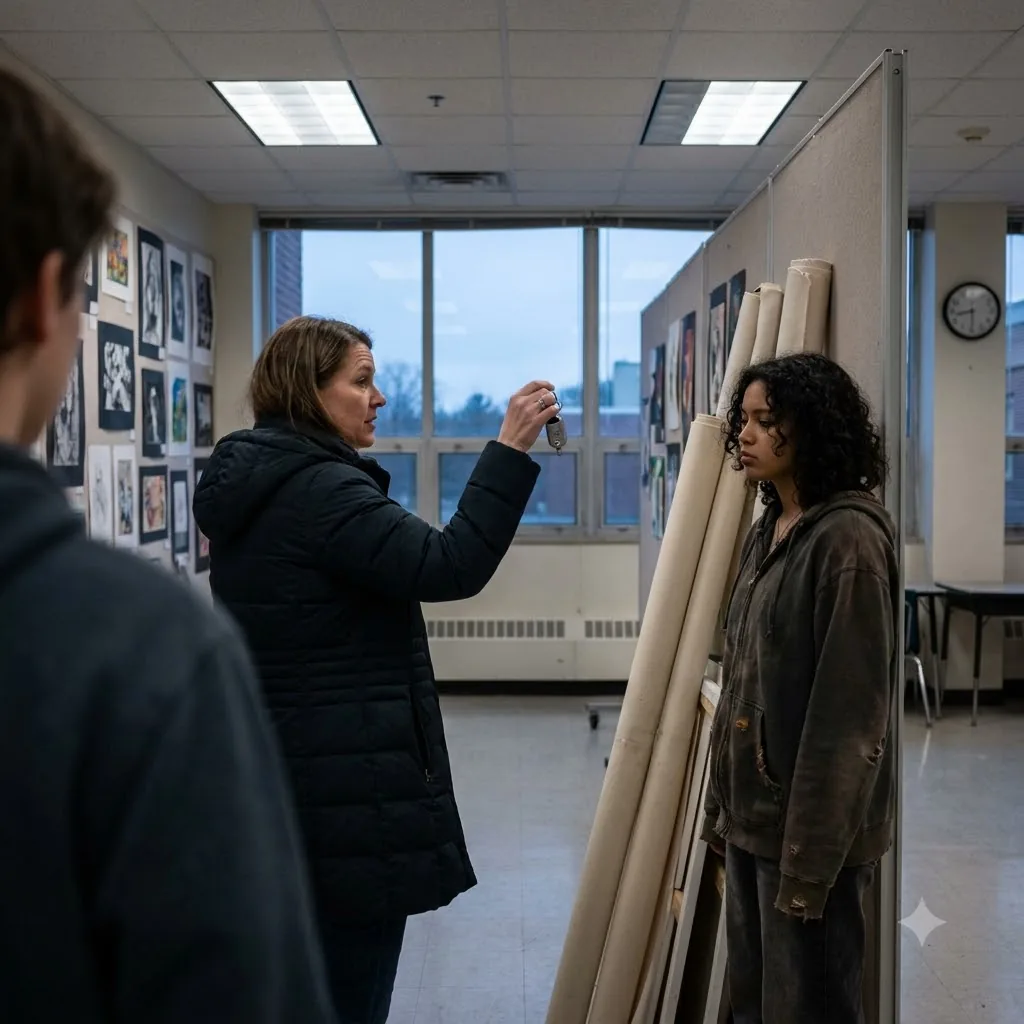
At exactly 8:30 PM in the Oakridge High School Art Gallery, Helen stood by the display partitions, holding a silver key fob aloft while telling her daughter, Maya, that she would not load Maya’s heavy canvas rolls of charcoal drawings into the SUV unless Maya signed a college declaration majoring in business. It was a direct ultimatum, leaving the quiet senior stranded with months of award-winning work and no way to transport the oversized rolls home before the gallery’s mandatory 9:00 PM lock time. As the gallery cleanup assistant, I stood just ten feet away, holding my green storage logbook and stacking folding chairs, observing every detail of the exchange. The ambient noise of the ordinary activity inside the school art show was winding down. A few remaining parents were gathered near the reception desk, chatting in hushed tones, while teachers dismantled the temporary lighting grids. Helen’s posture remained rigid and unyielding. She adjusted her designer coat, her eyes fixed on the three-foot-wide paper cylinders stacked against the partition. The canvas rolls were wrapped in thick brown kraft paper and bound tightly with industrial masking tape, containing months of Maya’s detailed charcoal work. Helen spoke with a sharp, expectant ring that carried easily through the emptying hall. “It’s a very simple decision, Maya. I have the trunk cleared out and ready. But I am not hauling these bulky things home just so you can spend the next four years painting in a basement. If you want a ride for yourself and your art, you sign the papers I left on the dashboard. Otherwise, you can figure out how to carry them.” Maya did not flinch. She stood with her arms crossed, looking down at her canvas rolls and then back at her mother. Her expression remained neutral. “I’m not signing it, Mom,” she said, her voice low-toned and sparse. “Then they stay here, and so do you,” Helen replied. She took a step back, letting the key fob dangle from her index finger, its metal ring clinking in the quiet space. “You know the school rules. Everything must be out of here by nine. You don’t have a driver’s license, you don’t have a car, and you certainly can’t walk three miles down the highway carrying thirty pounds of charcoal paper. I suggest you think about your future.” I moved a stack of metal chairs to the side, my boots squeaking on the vinyl tile. The gallery rules were clear: any items left unsecured after 9:00 PM would be disposed of by the custodial staff unless officially checked into the overnight vault. Maya knew this; she had read the exhibition guidelines posted on the bulletin board. Helen, however, seemed entirely focused on the leverage she believed she held. “I’ll be waiting in the car for exactly fifteen minutes,” Helen added, turning toward the glass exit doors. “The choice is yours.” She walked away, the heels of her boots clicking sharply against the polished concrete, leaving Maya standing alone beside the massive rolls of artwork as the gallery lights began to dim, leaving the pressure unresolved.
At exactly 8:30 PM in the Oakridge High School Art Gallery, Helen stood by the display partitions, holding a silver key fob aloft while telling her daughter, Maya, that she would not load Maya’s heavy canvas rolls of charcoal drawings into the SUV unless Maya signed a college declaration majoring in business. It was a direct ultimatum, leaving the quiet senior stranded with months of award-winning work and no way to transport the oversized rolls home before the gallery’s mandatory 9:00 PM lock time. As the gallery cleanup assistant, I stood just ten feet away, holding my green storage logbook and stacking folding chairs, observing every detail of the exchange. The ambient noise of the ordinary activity inside the school art show was winding down. A few remaining parents were gathered near the reception desk, chatting in hushed tones, while teachers dismantled the temporary lighting grids. Helen’s posture remained rigid and unyielding. She adjusted her designer coat, her eyes fixed on the three-foot-wide paper cylinders stacked against the partition. The canvas rolls were wrapped in thick brown kraft paper and bound tightly with industrial masking tape, containing months of Maya’s detailed charcoal work. Helen spoke with a sharp, expectant ring that carried easily through the emptying hall. “It’s a very simple decision, Maya. I have the trunk cleared out and ready. But I am not hauling these bulky things home just so you can spend the next four years painting in a basement. If you want a ride for yourself and your art, you sign the papers I left on the dashboard. Otherwise, you can figure out how to carry them.” Maya did not flinch. She stood with her arms crossed, looking down at her canvas rolls and then back at her mother. Her expression remained neutral. “I’m not signing it, Mom,” she said, her voice low-toned and sparse. “Then they stay here, and so do you,” Helen replied. She took a step back, letting the key fob dangle from her index finger, its metal ring clinking in the quiet space. “You know the school rules. Everything must be out of here by nine. You don’t have a driver’s license, you don’t have a car, and you certainly can’t walk three miles down the highway carrying thirty pounds of charcoal paper. I suggest you think about your future.” I moved a stack of metal chairs to the side, my boots squeaking on the vinyl tile. The gallery rules were clear: any items left unsecured after 9:00 PM would be disposed of by the custodial staff unless officially checked into the overnight vault. Maya knew this; she had read the exhibition guidelines posted on the bulletin board. Helen, however, seemed entirely focused on the leverage she believed she held. “I’ll be waiting in the car for exactly fifteen minutes,” Helen added, turning toward the glass exit doors. “The choice is yours.” She walked away, the heels of her boots clicking sharply against the polished concrete, leaving Maya standing alone beside the massive rolls of artwork as the gallery lights began to dim, leaving the pressure unresolved.