Story code: ST-000117
Part 2: When the Rule Crossed Over
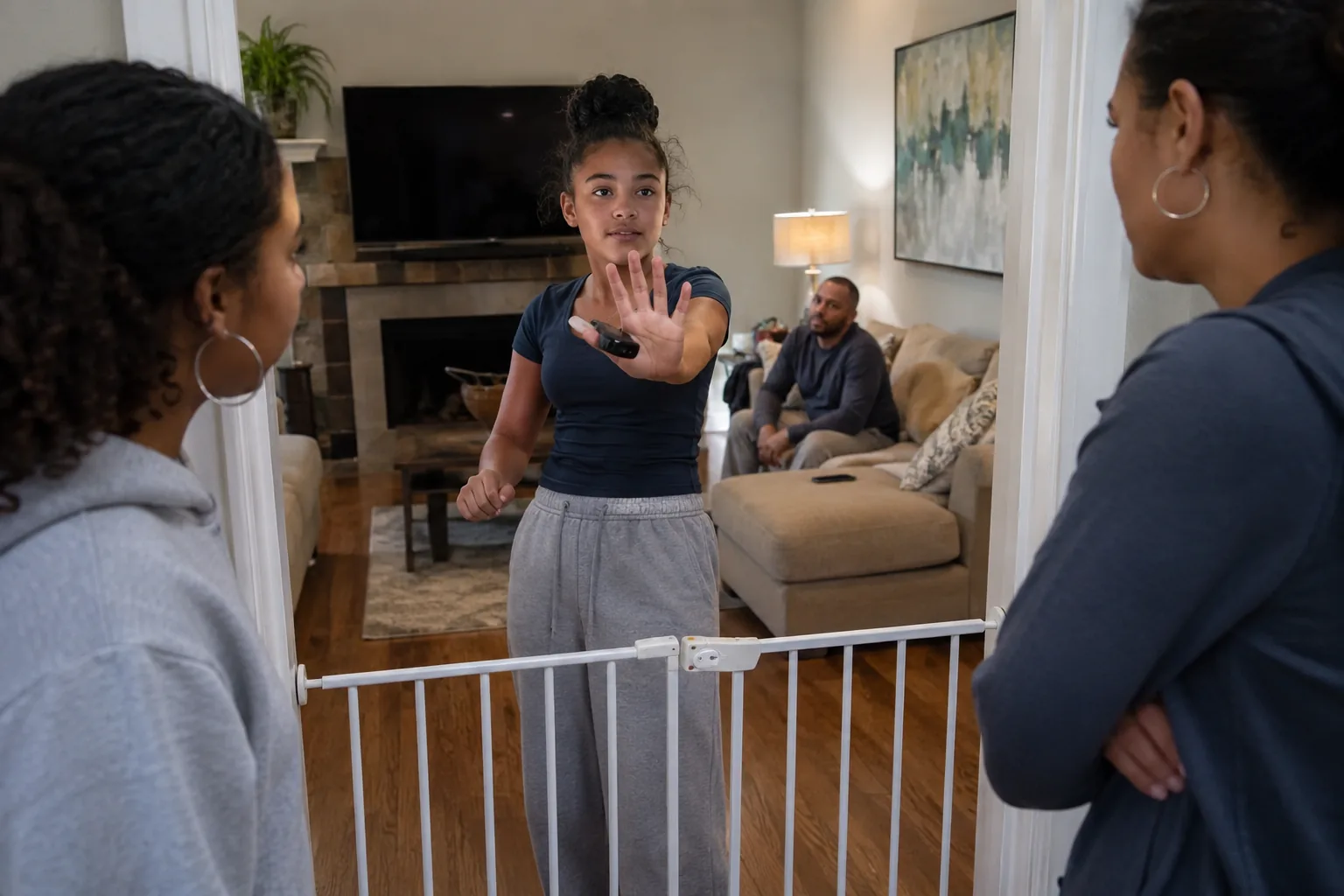
By the time Maya asked again, the room had gone from loud to careful. Nobody was dancing anymore. Nobody touched the remote. The draft video still sat open on the TV stand, and the second phone was still on the side table, lit up with a different clip that Tessa had not explained. Mom stayed where she was, eyes moving from one screen to the other, waiting for Tessa to make the rule make sense.
Maya pointed at the side table. “You said it applies there too. What does that mean?”
Tessa said, “It means don’t touch either one until I finish handling it.”
“That is not the same as the rule you said before.”
“It is the same idea.”
Mom’s voice stayed even. “Then say the idea in one sentence.”
Tessa exhaled through her nose and glanced toward the hallway again, like she expected the question to get answered by someone else. There was nobody else. The living room was still the whole stage: coffee table, couch, TV stand, ring light, shoes by the wall, the draft clip paused on the screen. Maya did not move. She waited. That was the part that made the bluff harder to hide. If Tessa wanted control, she had to keep talking.
“I am not letting you mess up the timing,” Tessa said.
Maya looked at the paused clip. “Mess up how?”
“By moving it around before I’m ready.”
Mom leaned forward a little. “Ready for what?”
Tessa did not answer. She reached for the first phone, then stopped with her fingers just above the screen. That tiny pause said more than the rest of her speech. She had started with a rule. She had moved it to a second draft. Now she was being asked to explain why the same rule controlled both, and she could not do it without sounding inconsistent.
Maya kept her hands at her sides. “You blocked me from the draft because of a rule. Then you said the same rule covered the other draft too. Explain how that works.”
Tessa finally looked at her. “It just does.”
Mom shook her head once. “No. Not like that. If the rule is real, you can say where it came from. If it is not, you should stop saying it like it is.”
That landed. Tessa’s mouth opened, then shut again. She picked up the side-table phone and tapped through the open draft as if speed could replace an explanation. The screen showed the same kind of upload menu, the same draft flow, the same simple choices. There was no menu item for the rule she had invented, no note attached to either clip, no locked setting that would support her claim. She looked at the screen, then at the TV, then at Mom.
“I told you, I am handling it,” she said.
“You are explaining it,” Mom replied. “Those are different.”
Maya stepped one pace closer to the coffee table, careful and deliberate. “Then say what happens next. Do I get the draft back, or do you want to keep pretending this rule exists?”
Tessa did not answer that either. She held the phone too tightly now, thumb pressed hard against the case. The second draft stayed open on the side table, and the contradiction had become plain enough that nobody in the room needed help seeing it. Tessa had tried to use one rule as a gate and then cross it over to another place where it made no sense. When Mom asked for a straight explanation, Tessa had nothing that matched what she had already said.
Maya looked from the draft on the TV to the one on the side table and back again. “If the rule is real, show it in both places,” she said. “If you cannot, what exactly were you blocking me with?”
Tessa went still for a second, and the silence made the answer harder to avoid than any raised voice would have. Then Mom said the line that changed the shape of the room: “Because right now, it looks like you made it up to keep control of the draft.”
Tessa stared at her, still holding both phones, with no clean reply ready for either screen.