Story code: ST-000126
Part 2: The Receipt That Would Not Sit Still
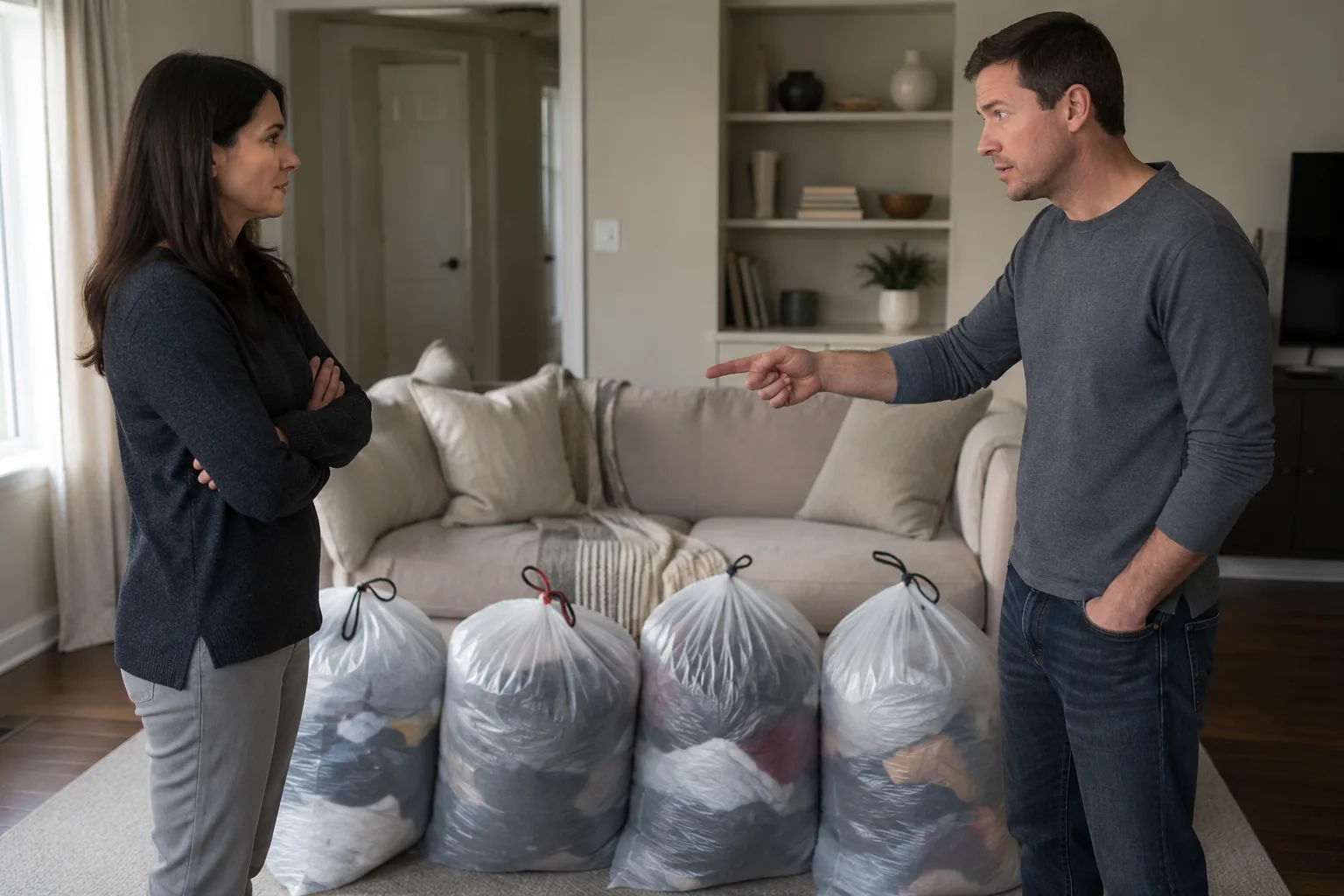
By the time Mara picked up the second slip, Evan had moved the first bag back into line with the others, as if straightening them could straighten the story. The living room stayed stripped and bright around them, with the donation bags anchored in the middle like they were evidence on a table nobody had named. Nina had not sat down. She kept one hand on the windowsill and looked from the labels to Evan’s phone every time he lifted it.
“Let me see the log,” Mara said.
Evan kept the screen angled down. “It is not necessary.”
“It is if you say the bags were already handled.”
“They were.” He pointed at the slips again, then at the hallway closet. “You put them together. I moved them out of the way. That is the sequence.”
Mara did not answer right away. She crouched beside the bags instead and checked the tape on the handles. The masking tape was still clean at the edges. No dust marks. No wear from being loaded in and out of a car. The top seam on the coat bag was pressed flat, the kind of flat that came from sitting untouched against the rug, not from a donation dock or a back seat.
Nina said, “Then why does the center time say after one?”
Evan looked at her for the first time. “Because intake records don’t capture every step.”
“That is not what it says.” Nina tapped the paper slip with one finger, careful and light. “It says received at 1:15.”
Evan exhaled through his nose and shifted his weight. “And the house rules say finished means finished.”
Mara stood up with the receipt in her hand. The paper had a crease down the middle where it had been folded into the bag. She turned it once, then again, and found the little printed sequence line at the bottom. It listed time, item count, and clerk initials. Nothing vague. Nothing that could be stretched. The line made the order plain: the bags had been accepted after the hour he kept using to shut the discussion down.
That was when the first crack showed in his voice. Not a shout. Not even volume. Just a sharper edge when he said, “We are not reopening this.”
Mara set the receipt on the coffee table and reached for the third bag. Evan moved fast enough to block it, his forearm crossing the space between her hand and the handle. He did not touch her, but he did not leave room either. “Stop,” he said. “If you keep pulling apart the process, nothing gets done right.”
“Then show the process,” Mara said.
He glanced at Nina, then back at the bags. The room held that pause long enough for the refrigerator to click on again. Outside, a car passed and faded. Inside, the labels stayed in their row, and the timestamp on the slip kept refusing to match the story he was telling.
Nina leaned forward and read the top line under the barcode. “This says the bags were checked in after lunch.”
Evan’s jaw moved once. He looked at the hallway, then at the front door, then back at the table where Mara had laid the receipt. “That is not the full record,” he said.
It was the kind of sentence that made the room feel smaller. Mara looked at the bag in front of her, at the tape, at the printed time, at Evan’s hand still hovering where he had blocked her. The bags were still there. The receipt said they had already been accepted. The labels said the house had not let them go yet. And Evan was still standing between her and the only thing that could make the sequence make sense.
So why was he suddenly watching the front door like someone else might walk in with the rest of the record?