Story code: ST-000178
Part 2: Ask It Back in Plain Words
When the whistle stopped, Derek stepped in again before Noah could move. He did not leave room between sentences. He pointed at the cone nearest the hash and said the blincher gate showed up when a player “over-rotated the carry line” and missed the pocket window by a half beat. He said it like he was translating for us, but he never used plain words. He just stacked one technical phrase on top of another until the whole sideline sounded busy.
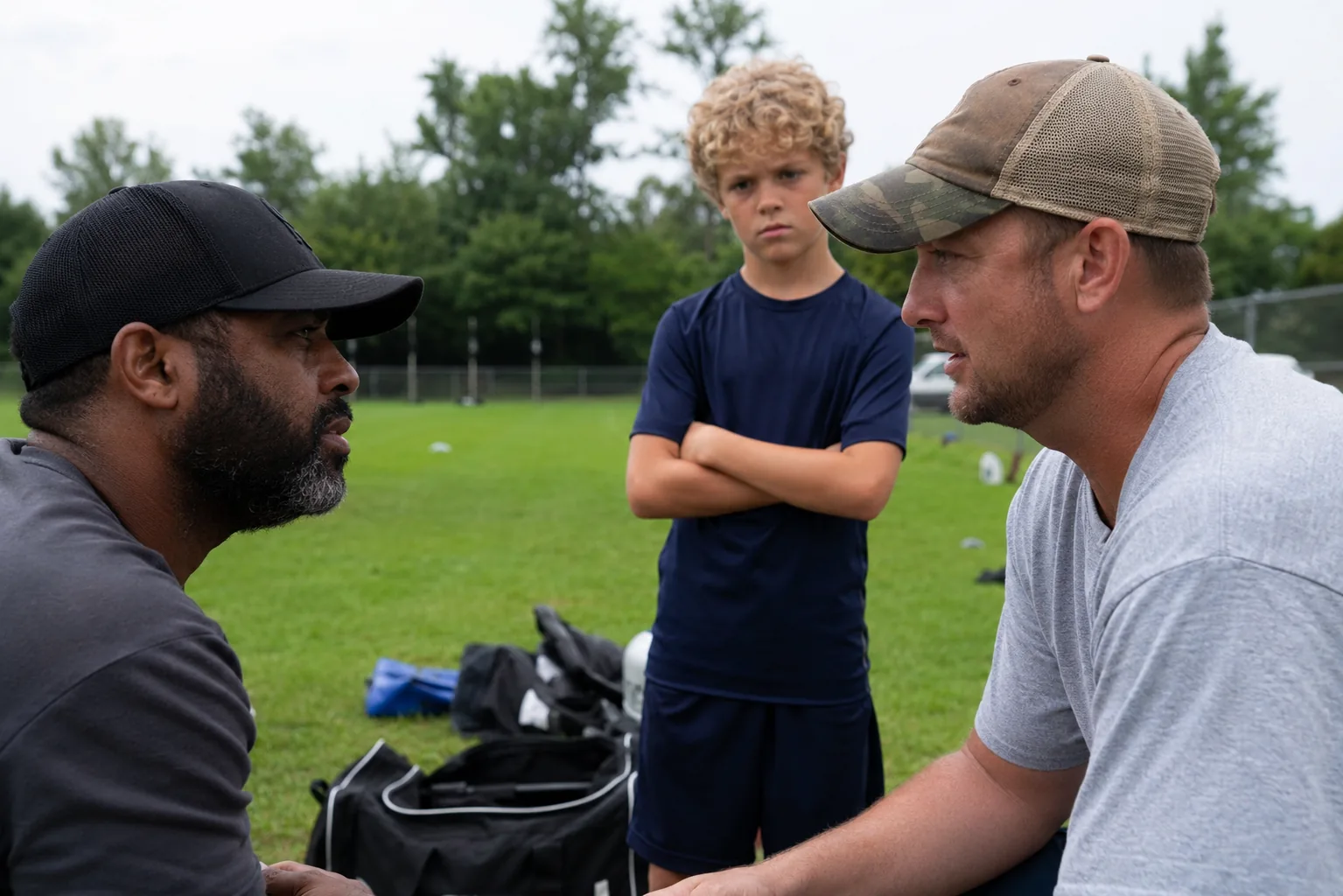
Noah kept his feet planted. He held the trophy bag tight against his chest and stared at the turf. Coach Ellis stayed at the drill line and said, “Say it simple.” He did not raise his voice. He did not make a speech. He just said, “Say it simple, Derek.”
Derek smiled once, the kind of smile that does not reach anywhere useful. “It is simple,” he said. “You have a soft gate and an early break. That is all.” He tapped the same cone twice and looked around like he expected nods. Nobody gave him any. The kids were still lined up. One of them shifted a shin guard. Another looked at the scoreboard and back again. The room had gone quiet in that thin, waiting way that makes every word carry too far.
I asked him again, “Say it in normal words.”
Derek’s jaw moved, then stopped. He looked at the turf, then at the bag, then at Noah. “Normal words are for parents who do not know the lane,” he said. “This is drill language.”
That was when Coach Ellis stepped one foot closer and kept his whistle down by his leg. “Then demonstrate it,” he said. “Right here.”
Derek’s hand came off the cone stack. He looked at the kids in line, then back at Coach Ellis. “We do not need a full demo for something this basic,” he said. “You can hear it in the setup.”
Coach Ellis shook his head once. “No. Show the blincher gate.”
The field got still enough that I could hear the zipper on Noah’s bag when he adjusted his grip. Derek stared at the cones like they had changed shape. He reached down, touched the first marker, then the second, and said the gate was “just the carry hinge between the load and the release.” He said it slower this time, like the speed was the problem. Coach Ellis did not move. He just held the whistle and waited.
Noah finally looked up. Not at me. Not at the coach. At Derek. He said, very low, “Where do I stand?” It was the plainest sentence on the field.
Derek answered fast. Too fast. He said Noah stood “inside the blincher lane” and kept his shoulders square to the cone. Then he said the release had to stay “clean through the pocket or the line collapses.” He pointed at the drill space and made one half step forward, like a demonstration was already happening. But he did not move any farther. He did not show the gate. He did not show the break. He did not show the thing he had been talking about for all those minutes.
Coach Ellis looked at me once, then back to Derek. “Again,” he said. “Show it.”
Derek’s voice stayed smooth, but the words started circling. He repeated the term. He repeated the lane. He repeated the pocket window. He did everything but perform it. Noah stood with the bag strap pressed into his palm and watched him. The kids in line watched too. Nobody cheered. Nobody laughed. The silence sat there, and Derek kept trying to talk around it like enough sound could fill the hole.
That was the first time I saw him lose the shape of his own explanation. He still had the tone. He still had the posture. But every time Coach Ellis asked for the blincher gate in plain view, Derek gave another sentence instead of a rep. And when he finally reached for the cones again, he did not touch the first one.