Story code: ST-000178
Part 3: Show It on the Turf
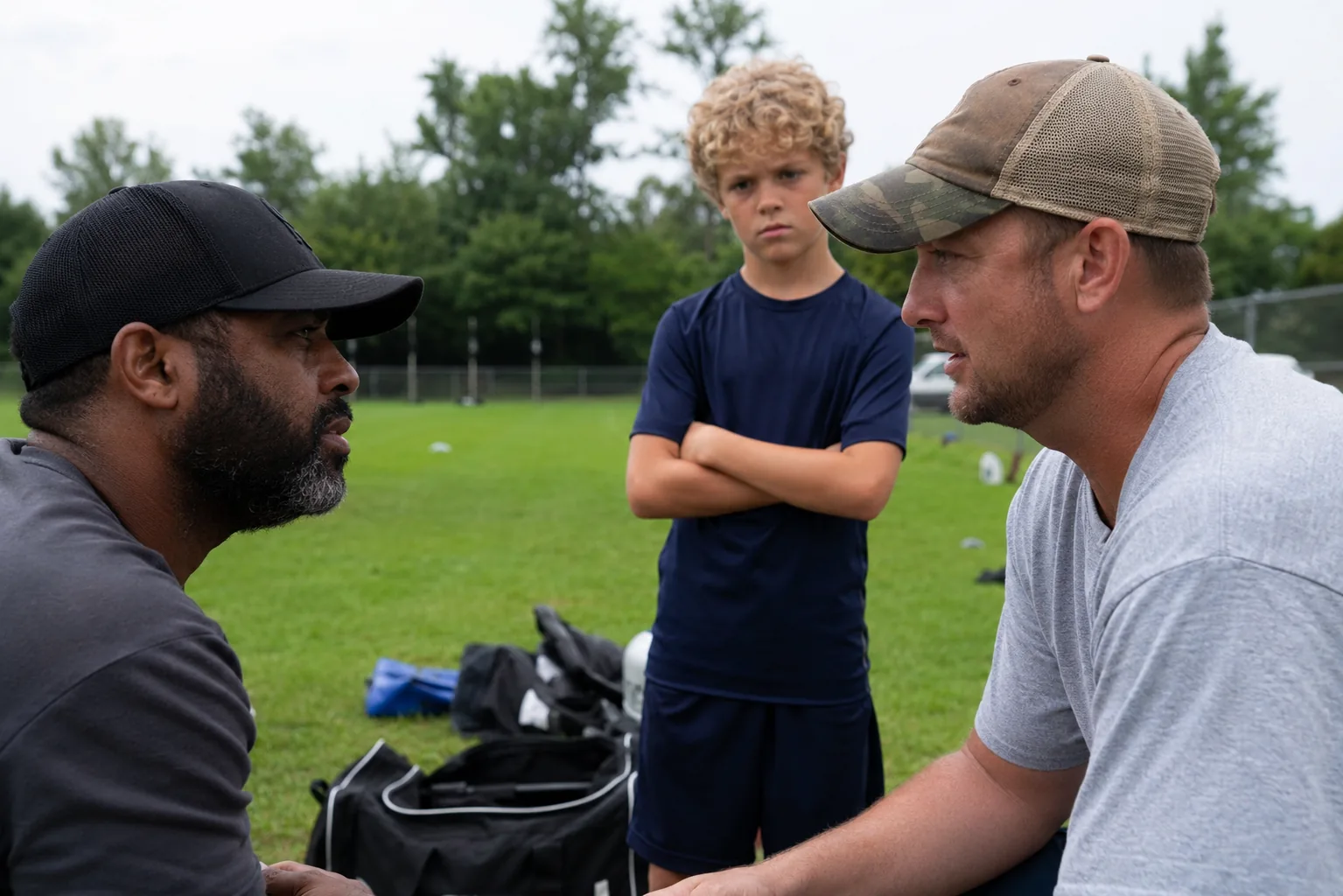
Coach Ellis stepped onto the drill lane and held out one hand toward the cones. He did not take the whistle to his mouth. He just stood there with it at his side and said, “Show it on the turf.” His voice stayed level, the way it had been all afternoon, but the words landed harder because nobody else was making noise.
Derek still had the same straight posture. He slid one foot back, then forward, and pointed at the line of cones as if the arrangement itself had changed sides. “The blincher gate is the transition point between load and release,” he said. “If you do not respect the hinge, you lose the pocket.” He said it to Coach Ellis, but he looked at Noah when he said pocket.
Noah stayed where he was. The trophy bag was still hooked over his forearm. He did not answer. He only shifted his grip and looked at the turf in front of his shoes.
Coach Ellis held the silence long enough for Derek to fill it, and Derek did. He talked about angle control, carry pressure, and a clean entry window. Then he reached down for the nearest cone and moved it six inches to the left.
“No,” Coach Ellis said at once. “Put it back and show the gate, not the setup.”
Derek froze with the cone in his hand. A couple of kids down the line turned their heads, then faced forward again. I kept my score sheet pinned to the trophy bag with my thumb and watched Derek set the cone down too hard. The rubber wobbled on the turf and settled crooked.
He said, “The gate is obvious.”
Coach Ellis answered, “Then it will be easy to show.”
Derek took one breath, then another. He bent at the knees, spread two cones wider, and motioned Noah toward the start mark. “He comes in here,” he said, “hits the hinge, and carries through the pocket window.”
Noah did not move. He looked at Coach Ellis instead.
Coach Ellis nodded once. “Ask him where the hinge is,” he said.
That was the turn. Derek looked from the coach to Noah and back again, and the same words came out of him again, only thinner this time. “The hinge is the blincher gate.”
Coach Ellis did not blink. “Where is it on the field?”
Derek’s hand hovered over the cones. He moved one cone forward, then stopped. He moved another back, then left it there. He started to answer and restarted twice before any sound came out. “It is the line after the load point,” he said.
“No,” Coach Ellis said. “That is not where.”
The line went still in a different way after that. Not quiet from waiting. Quiet from listening.
I saw Derek’s mouth tighten, then flatten. He reached for one cone and tapped it like he could force meaning out of plastic. He said the blincher gate was “situational,” then said it was “relative to the carry path,” then said it was “the moment a player stops over-rotating.” He kept talking, but each sentence left him farther from the field and closer to the edge of sounding made up.
Coach Ellis raised the whistle and tapped it once against his palm. “Stop talking around it. Show me where the blincher gate is.”
Derek looked at Noah’s bag. He looked at the cones. He looked at me. Then he looked back at Coach Ellis and said, “You know what I mean.”
Nobody answered that.
Noah finally lifted his head. He said, very clearly, “I don’t.”
That was the only thing on the field that sounded clean.
Derek turned toward him fast, as if he could shut the sentence down before it spread. He said Noah needed to stop fighting the language and trust the process. He said the term was basic. He said every serious player knew the blincher gate. But he never showed it. He never put his feet where the gate was supposed to be. He never did the live rep.
Coach Ellis stepped closer to the cones, took one of the markers in his own hand, and set it directly in front of Derek’s shoe. “Then stand there,” he said. “Walk the blincher gate for him.”
Derek looked down at the cone at his toe. Then he stepped over it instead of into position. That was small, but everybody saw it. He had been talking about a place he would not stand in.
Coach Ellis saw it too. He lifted the whistle again, but he did not blow it. “Noah,” he said, “bag on the bench. You’re not running this rep until he shows the lane.”
Noah did as he was told. He walked the trophy bag to the bench and set it down beside my score sheets. His hands stayed on the strap one second longer than they needed to, then let go.
That was when Derek’s face changed. Not in a big way. Just enough to show that he understood the drill was moving without him. He kept trying to speak, but Coach Ellis was already resetting the cone line with both hands and taking the room away from Derek sentence by sentence.
I wrote it down while it happened: Derek had invented a gate, named it like fact, and now the field had asked him to place it somewhere real. He could not. The next rep could not start until he did. And Noah was standing off the lane with his trophy bag on the bench, watching the difference between a word and a drill get wider in front of everybody.