Story code: ST-000022
Part 2: What Counted As Ordinary
By the next afternoon, I was not trying to prove a dramatic break-in. I was trying to test every ordinary explanation first, because once people hear “elderly” and “medication” in the same sentence, they start reaching for the word confusion before they reach for the facts. So I showed up at my mother’s apartment with a fresh notepad, the pharmacy bag, and a plan to count everything in the open, in order, with my mother beside me.
I lined the pill bottles on the kitchen counter. I set the weekly organizer in front of us. I said the day and dosage aloud before I moved each tablet. My mother watched and corrected me once on a blood pressure pill because I had picked up the wrong bottle first. That mattered to me. It told me she was following the sequence.
When I finished, every compartment matched the prescription sheet.
I turned the organizer so the word THURSDAY faced the coffee maker handle. Then I pulled a chair to the table and wrote the time: 1:18 p.m.
My mother said, “You’re making it look like a science project.”
“I’m making it hard for anybody to tell me I imagined it,” I said.
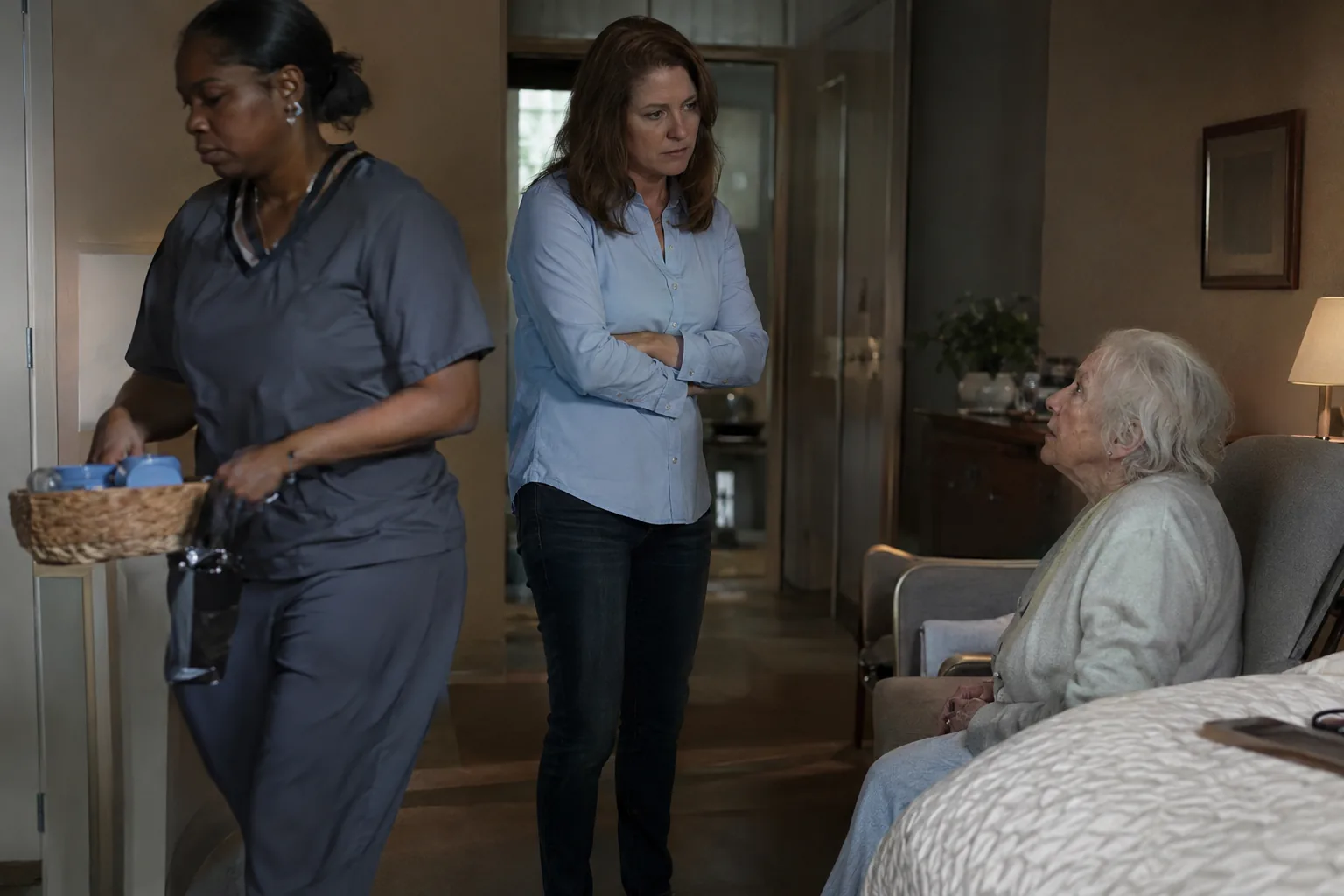
I stayed through the afternoon visit window. Trina Bell came at a little after three with her cleaning tote on one arm and a container of wipes tucked under it. She walked in with the quick pace of somebody who already knew the apartment layout.
“Hi, Ms. Mercer. Hi, Dana,” she said, and set the tote near the sink.
Before I said anything, her hand went to the counter. Not the mail, not the dish towel. The organizer.
I moved it an inch away from her and said, “I already set her meds for the week.”
She gave a short smile. “I always check it. Just routine.”
“That routine include Tuesday night disappearing before she took it?”
Her eyes went to my mother, then back to me. “Sometimes residents double-dose and don’t remember. Sometimes family reorganizes things and staff gets blamed.”
My mother, who had been quiet all afternoon, put her palm over the organizer lid. “I said don’t touch that.”
Trina lifted both hands. “Okay. I’m not touching it.”
But I had seen enough in that two-second reach to know where her attention went first.
She wiped counters, changed the trash liner, and straightened the towel on the oven handle into that same flat fold I had noticed the day before. I watched it happen. No guesswork this time. My mother watched it too.
When Trina left, I checked the deadbolt after the door shut. My mother turned it herself, then pressed the latch twice like she did before bed.
At 5:40 I went downstairs to the front desk.
Luis Ortega was on evening duty with the logbook open beside him and a paper cup of coffee going cold near the monitor. He was careful the way some desk attendants are careful when they know one loose sentence can become a complaint by dinner.
I asked, “Do aides sign in and out every time they come through?”
He said, “They’re supposed to. Most do.”
“Most isn’t all.”
He nodded once.
I gave him the dates and times I cared about. He checked the book, then a printed sheet clipped behind it. He spoke in exact times when he had them and stopped when he did not.
“Tuesday morning, Trina Bell signed in at 9:07. Signed out 10:02,” he said. “No second sign-in under her name.”
“But?” I asked.
He looked toward the elevator and lowered his voice. “At 2:11 somebody in blue scrubs asked if Ms. Mercer was resting and whether her daughter had come by yet. I remember that because it was specific.”
“Did you see who?”
“I saw the scrub top and tote. She didn’t stop long.”
“Did she sign in?”
He tapped the page with one finger. “Not that I have here.”
That still was not proof by itself. In a place like that, staff-adjacent people drift in and out on routine, deliveries get waved through, and familiarity starts doing the work of permission. But it narrowed the lane.
On my way back upstairs, I stopped at Marcy Lin’s door. She had her watering can again and a saucer in the other hand. When I asked about Tuesday, she gave me more than she had the day before.
“I heard your mother’s door open,” she said. “No knock. Then one of the kitchen drawers. Then quiet. I figured it was someone she knew.”
“Did you hear anyone speak?”
“No. That’s why I remember it.” She shifted the saucer to her other hand. “When staff comes and talks through something, I usually hear voices. This was quick.”
Back inside the apartment, I went straight to the counter.
The organizer had not moved from where I placed it. THURSDAY still faced the coffee maker handle. I opened the compartments anyway.
Thursday evening was empty.
My mother was in the living room, close enough to hear the snap of the lid. She came to the doorway, looked down, and then looked at the front door like it had answered something for her.
I asked the only question left that still sounded ordinary.
“Mom, who else has ever had reason to know exactly where you keep the spare key and exactly how you fold this kitchen towel?”