Story code: ST-000077
Part 2: The Rule Would Not Travel
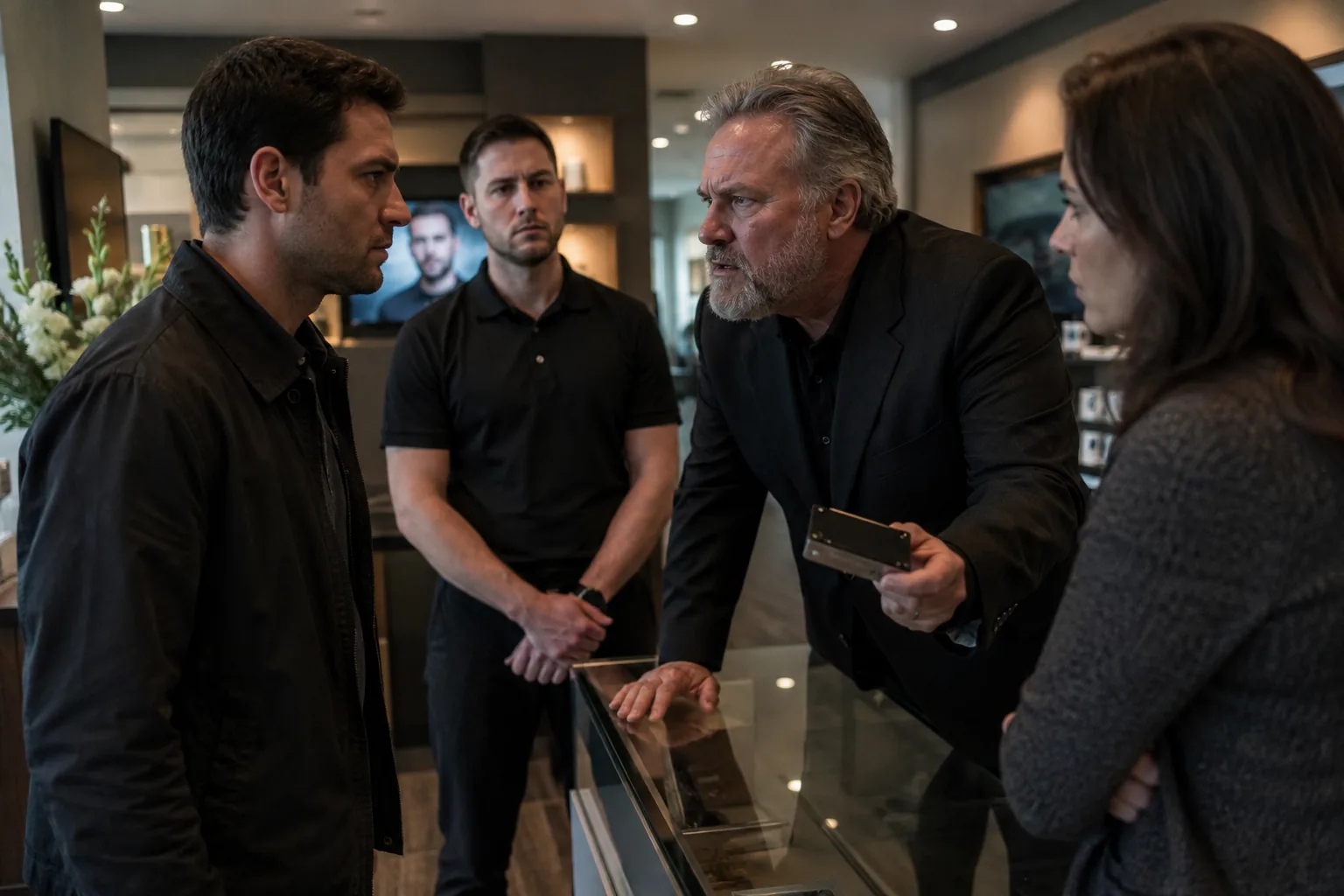
The clerk took the first printout from the tray and carried it to the far family desk, the one with the blue lamp and the laminated service map, while Dale stayed planted at the main counter with the drive still in his hand. I followed far enough to see her set the paper beside a stack of intake slips and compare the line items under the lamp. She did not nod. She did not call for anyone. She just frowned at the page, then at the screen, then back at the page, like she was trying to make the same rule appear in both places.
Dale watched from the counter. “Don’t mix lanes,” he said.
The clerk said, “I’m not mixing anything. I’m checking whether it exists here too.”
That made him come around the counter fast, but not all the way. He stopped short of the desk, close enough to hear, far enough to avoid touching the paper she was holding. The showroom had gone quiet in the way public places do when one argument starts to threaten the whole room. A woman near the bereavement cards paused with her hand on a rack. The man by the flowers pretended to read a brochure. Nina stayed where she could see both desks at once.
The clerk read the line again, this time loud enough for me to catch the exact shape of it: a restriction tied to a release, but only if the request fit a specific cross-application. She tapped the screen. Nothing on her monitor matched the phrase. She turned the paper over and checked the back as if the missing source might be printed there.
Dale said, “That’s internal.”
“Then cite it,” she said.
He went to the main terminal, clicked once, and then clicked again harder. He angled the monitor away from us when I stepped closer. The clerk opened the second station and pulled up another family file, one with a different name on it and a different appointment time, and asked him if the same rule applied there. He did not answer the question. He told her to stay in the correct lane. She asked him again if the rule was limited to the pickup at our counter, and he said no, it was broader than that. Then she asked why the other file showed the same category of asset with no cross-application note at all.
He did not answer that either.
Instead he started repeating the policy in a tighter loop. The wording did not change, but the posture did. His shoulders came up. His fingers moved over the screen without opening anything the clerk could verify. He said the release could not happen until the cross-application was complete. He said the drive was not eligible under the present request. He said the source was in the system. Every time he said system, the clerk looked at the screen and shook her head once, small and flat.
That was when I saw that she was not backing him up. She was checking the same claim in a second lane and not finding it there.
Nina heard it too. She stepped closer to the blue lamp and asked, “Then why did you tell us it was a rule?”
Dale answered without looking at her. “Because it is.”
“Where?” I said.
He reached for the drive again, then stopped when the clerk put one hand over the tray. She did not grab him. She just kept the tray between them.
“If it’s in the system,” she said, “show me the source line.”
He looked from her hand to the monitor and then away. He tried the same answer twice in different words and both times it came out empty. The clerk checked another terminal. Her mouth tightened when the screen returned blank. She asked him whether the same rule applied to the second desk, the intake kiosk, and the shelf crate in the back.
Dale said nothing for a long beat. Then he said, “That’s not how this is set up.”
That was the only honest-sounding thing he had said all afternoon, and it did not help him. Because if the set-up changed by lane, the rule was not a rule. It was a choice he had been hiding behind.
I turned back to the counter and saw the drive still under the light, still not released, still tied to a process nobody in the room could quote. The clerk was staring at the blank spot on her screen. Dale was staring at her, waiting for her to back down. She did not. She asked one more time for the exact cross-application name, and Dale opened his mouth, closed it, and could not give her a word that matched any screen in the room.
If he could not explain the cross-application there, in front of both desks and both terminals, then what exactly was he waiting for before he let the process move?