Story code: ST-000136
Part 2: What the Pages Started Showing
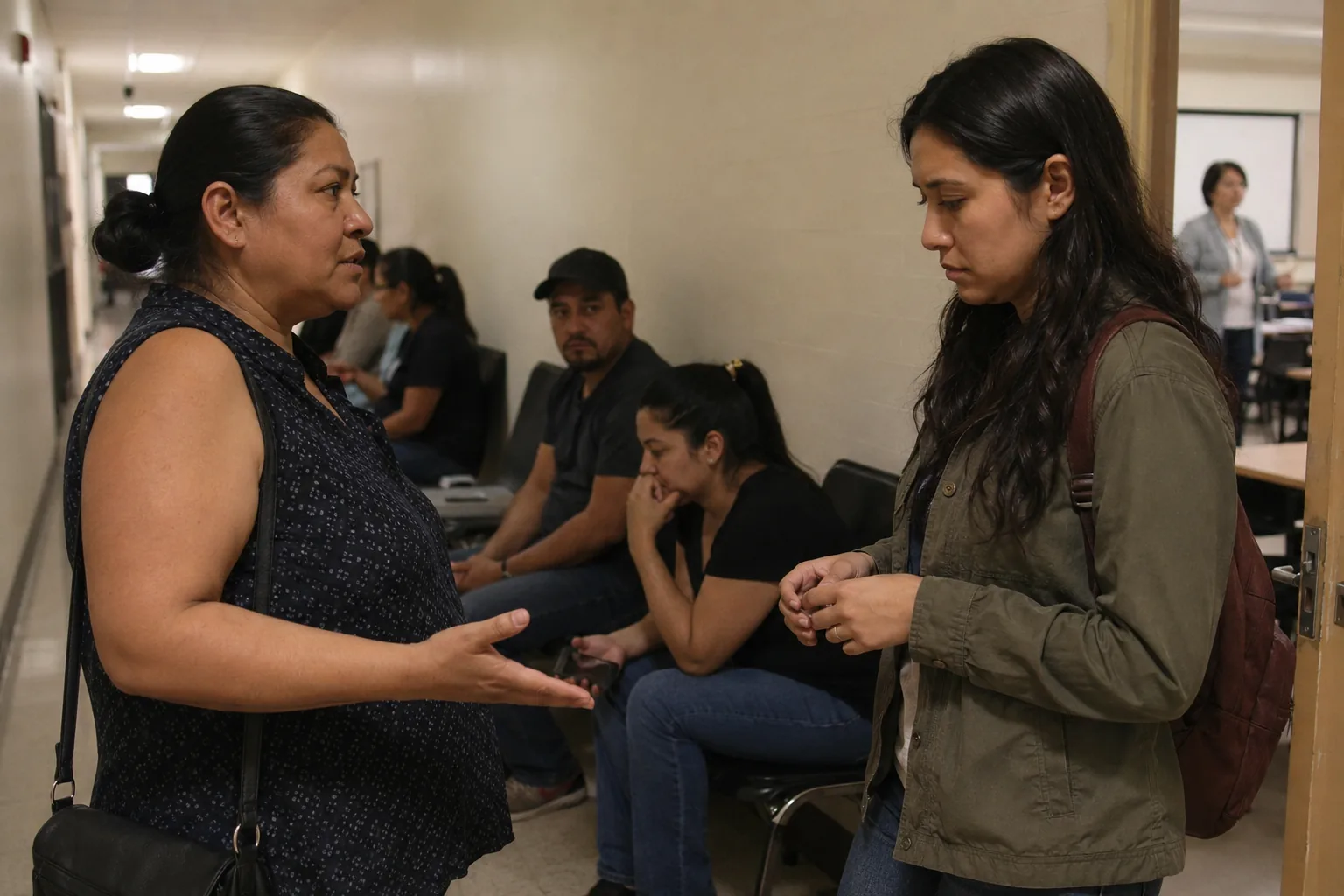
By the next week, I could tell where they were in the hall by the sound of Rosa correcting Elena. I heard them before I saw them: Rosa’s voice carrying from the water fountain alcove near the vending machine, Elena answering quickly, the phone timer beeping every thirty seconds. The blue practice notebook was open again, and somehow Rosa was still the one claiming she couldn’t do any of it while Elena carried the tote, the notebook, and the blame.
I was restocking name tags on the folding table when Elena hurried over and asked, “Do you have tape? The back cover keeps splitting.”
She held the notebook out to me. The corners were soft from use. Several pages had bent tabs made from old bus receipts. I gave her the tape and steadied the notebook while she pulled a strip free. That was the first time I got a close look at the inside pages.
The handwriting changed depending on what part of the page you looked at.
Most of the answer lines were packed with the same small, tight print I had seen Elena use when she filled in the date on the sign-in log for her aunt. But in the margins, where pronunciation tips and little memory notes had been added later, there was a second style: sharper letters, straighter lines, cleaner spacing. Next to one civics answer, somebody had written, Remember: say it full, not lazy. Next to an address line, somebody had printed STREET first, then drawn a slash and corrected the apartment abbreviation.
Elena saw me looking and shut the notebook halfway.
“Sorry,” she said. “It’s falling apart.”
“You’re fine,” I said. “Here. Press the tape flat from the spine out.”
Rosa walked up before Elena could finish. “Why are you bothering her? We are late because you never organize the pages.”
Elena did not answer. She flattened the tape with her thumb and handed the notebook back.
Rosa took it, flipped directly to the reading section, and tapped one sentence with her nail. “This word. I told you this is too hard.”
Elena looked at the sentence. “It says, ‘Citizens can vote.'”
“Exactly,” Rosa said. “Too fast.”
“Those are all short words,” I said before I could stop myself.
Rosa looked at me and smiled the kind of smile people use when they want a witness on their side. “For you maybe. Not everybody grew up here.”
I let that pass. Mr. Bennett was at the classroom doorway checking his clipboard. The line had started to form, people with notebooks tucked under their arms, a man mouthing state capitals to himself, somebody’s coffee lid clicking open and shut. Ordinary hallway noise. Same as always.
Elena opened the notebook again. “Can we just do one page before class?”
Rosa thrust it into her hands. “You read. If I fail, it is because you jump around.”
So Elena read. Rosa interrupted every answer. If Elena paused half a second, Rosa called it confusing. If Elena repeated a word, Rosa said she was being disrespectful. At one point Elena said, “Please just say the street number,” and Rosa answered by correcting Elena’s pronunciation of their own last name.
What stood out was not the volume. It was the timing. Rosa waited until Elena had the pen uncapped or the timer in her hand or the tote slipping off her shoulder, then added one more demand.
When class started, Mr. Bennett stepped into the hallway instead of pulling everybody inside right away.
“Quick overflow exercise first,” he said in that calm voice of his. “Couple of volunteers in the hall, couple inside. We’re doing individual reading and response today. No partners answering for each other.”
Rosa’s head turned toward Elena before the sentence was finished.
Elena looked at the notebook.
Mr. Bennett continued, “I’ll hand each person a prompt card. You read it yourself and answer it yourself. If you’re waiting with family, hold your own materials.”
He moved down the line and started separating people with a practiced ease, one by the bulletin board, one near the classroom door, one beside the chair row. No drama, no lecture. Just placements and cards.
Rosa gave a short laugh. “My niece helps me better if she stays close.”
“Not for this round,” Mr. Bennett said. He marked something on the clipboard and held out his hand. “Ms. Cruz, keep your own notebook with you. Elena, you can wait by the fountain until I call the next group.”
For one second, neither of them moved. Then Elena handed the blue notebook over.
Rosa took it, but not the way she usually did. She opened to the middle first, thumbed two pages back, then one forward, like she was checking where something had been written. Her eyes moved once across the margin notes. After that, she snapped it shut and pressed it flat against her chest.
It was quick. If I had been looking anywhere else, I might have missed it.
Mr. Bennett began passing out the prompt cards. When he reached Rosa, she put out her free hand automatically, palm up, ready to receive it.
Then she saw Elena already standing three chairs away by the vending machine, out of whispering distance, and her hand stopped in the air.