Story code: ST-000316
Part 3: She Put The Marker Back In His Hand
Dinner finally sat down around the same mess that had delayed it.
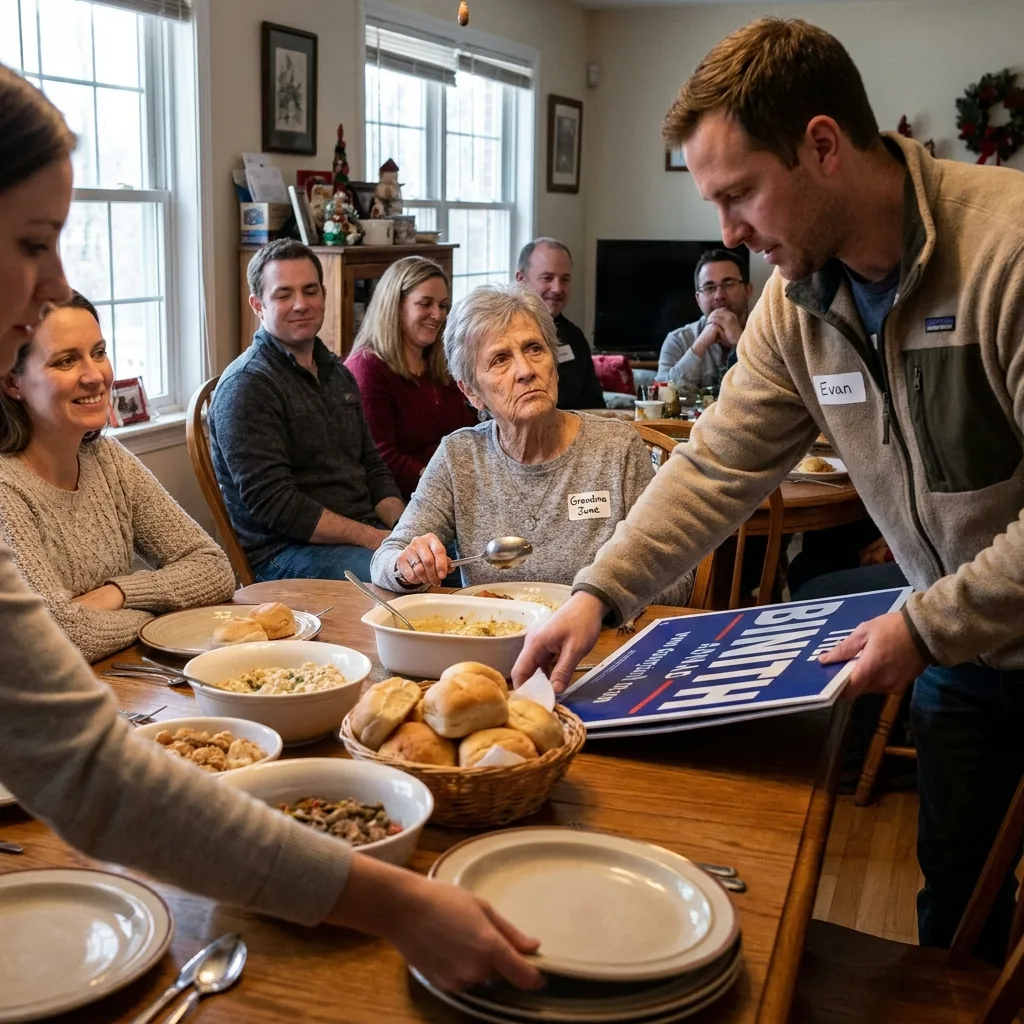
The turkey was carved, the ham was sweating on its platter, and the signs were still stacked on the chair beside the sideboard with one half-finished one lying in front of Evan’s plate like an extra place setting nobody wanted. Grandma June had told him to finish the set after we ate, and that one instruction changed the room more than any argument had.
I wasn’t redoing anything now. I was passing green beans, bringing in the extra gravy, and wiping the marker streak he’d left on the table runner because it was still there. The difference was simple enough to see from every chair: the signs were no longer in front of me.
Evan kept trying to talk over that difference.
He started on county races again, then on yard sizes, then on which neighborhoods “understood what was at stake.” Every time he got going, his hand drifted to the marker beside his plate and then away from it again.
Noah noticed it too. He didn’t say much during dinner, but whenever Evan reached toward that sign and stopped, Noah’s eyes went there first.
Tessa was quieter than she’d been before. She still moved in and out for refills, but she wasn’t dropping the sign work onto me anymore. At one point she came behind my chair with the rolls and said, low enough that it didn’t carry, “Leave those where they are.”
I nodded.
That was all.
Nobody made a scene out of Grandma June’s instruction. That was what made it stick. The half-labeled sign stayed beside Evan’s fork through the whole meal, the three clean letters visible every time somebody passed the butter.
When plates started emptying, I stood automatically to clear them. Tessa reached for the stack in my hands and took half before I could carry it alone.
“You get the serving bowls,” she said. Then she glanced at the chair by the sideboard. “Not the signs.”
Evan pushed his chair back an inch. “I can do them later at home. It’s easier with better light.”
Grandma June didn’t raise her voice. She was dabbing the corner of her mouth with her napkin when she answered.
“The lamp is on,” she said.
That was it.
He gave a short laugh that didn’t catch on with anybody else. “I’m saying I don’t want to hold everybody up over cardboard.”
Noah leaned against the kitchen doorway again and said, “You already did.”
The room didn’t break, but it did stop helping him. Nobody jumped in to smooth it over. Nobody said he was doing his best. Silverware got stacked. Water glasses moved. Tessa set a trash bag open beside the chair with the ruined sign and the bent ones.
I carried bowls to the sideboard and came back in time to see Grandma June touch the top blank sign with one finger.
“Same as the others,” she said to Evan. “Name on the back. Put county with county. Local with local. Since you know which is which.”
He looked at her, then at me, then at the stack.
“I said I mix them up when people are hovering,” he said.
Nobody was hovering. Tessa moved to the far end of the table to gather cups. Noah stayed at the doorway. I stood by the sideboard with a serving dish in my hands and nowhere else to put it.
Grandma June slid the marker the last inch until it touched his knuckles.
“Then nobody’s helping you,” she said.
That landed hard because it left him only the work.
He picked up the top sign and turned it over. For a second he held it the same careless way he had earlier, edges loose, shoulders rounded, still trying to wear the confused version of himself. Then his grip changed.
It was the same shift I had seen at the sideboard before, only slower now because everybody could see it. He tucked the wire clear with his thumb, angled the sign toward the lamp, found the small district sticker immediately, and set the correct stack to his right without asking a single question.
Noah looked from Evan’s hands to my face, then back to the sign.
Evan uncapped the marker one-handed. He put the tip down and drew a clean block letter. Then another. Even spacing. Straight line. No hesitation.
Nobody spoke.
You could hear the kitchen faucet running where Tessa had started rinsing a spoon and then stopped. Grandma June sat with both hands folded in her lap, watching the sign and nothing else.
Evan finished the name, capped the marker, and reached for the next sign too quickly, like speed might hide what the first one had shown.
It did the opposite. The faster he moved, the more practiced he looked. He sorted one by the tiny corner sticker without lifting it high. He set local to one side, county to the other. He printed each name in the same steady block letters he had spent all evening claiming he couldn’t manage.
When he got to the ruined sign from the start of the night, he paused with it in both hands.
The black streak from his sleeve was still there. So was the wrong name written in his own broad pressure.
Grandma June pointed once at the trash bag beside the chair.
“That one too,” she said.
He looked at the ruined sign, then down at the blank replacement underneath the stack, and pulled the clean one free without bending a corner.