Story code: ST-000169
Part 2: He Needed The Crowd To Believe Him
The whole pavilion went quiet enough for me to hear the ceiling fan clicking over the ceremony chairs. I held Grandma June’s brass reunion pin in my palm between me and Darren, and he stared at it like it had interrupted his script.
Then he gave a short breath through his nose and reached for the microphone again. “A pin doesn’t prove anything,” he said.
He said it quickly, which mattered more to me than if he had shouted. Darren was usually careful with timing when he was running anything public. Now his words were piling on top of each other.
“Then don’t talk around it,” I said. “Tell them what it is.”
He didn’t answer me directly. He turned back toward the crowd and raised the mic. “We are not stopping the program for random sentimental items. Please find your seat if you’re staying.”
Random.
A few people shifted in the folding chairs. A woman near the refreshment line whispered to the man beside her. A kid asked too loudly, “Why can’t she sit with them?” and got hushed.
I kept the pin in view. The brass had gone dull over the years, except for a narrow bright line along the edge where it used to rub against fabric. On the back, the old reunion year was still stamped in tiny numbers. Grandma June had pressed it into my hand years ago near the same kind of pavilion table and told me not to lose it because “we only give these to the ones we expect back.”
I did not say all of that at once. I had learned a long time ago that if you pour everything out fast, people only remember the part they can dismiss.
So I asked one thing.
“Aunt Lenora,” I said, turning toward the front row, “do you know this pin?”
Darren stepped sideways, enough to put himself half between me and her. “We’re not dragging elders into this.”
Aunt Lenora had already lifted her chin. “Bring it here,” she said.
Her voice wasn’t loud, but people made room anyway. That was the kind of authority she had. Not the microphone kind. The kind that made people stop opening chips when she started talking.
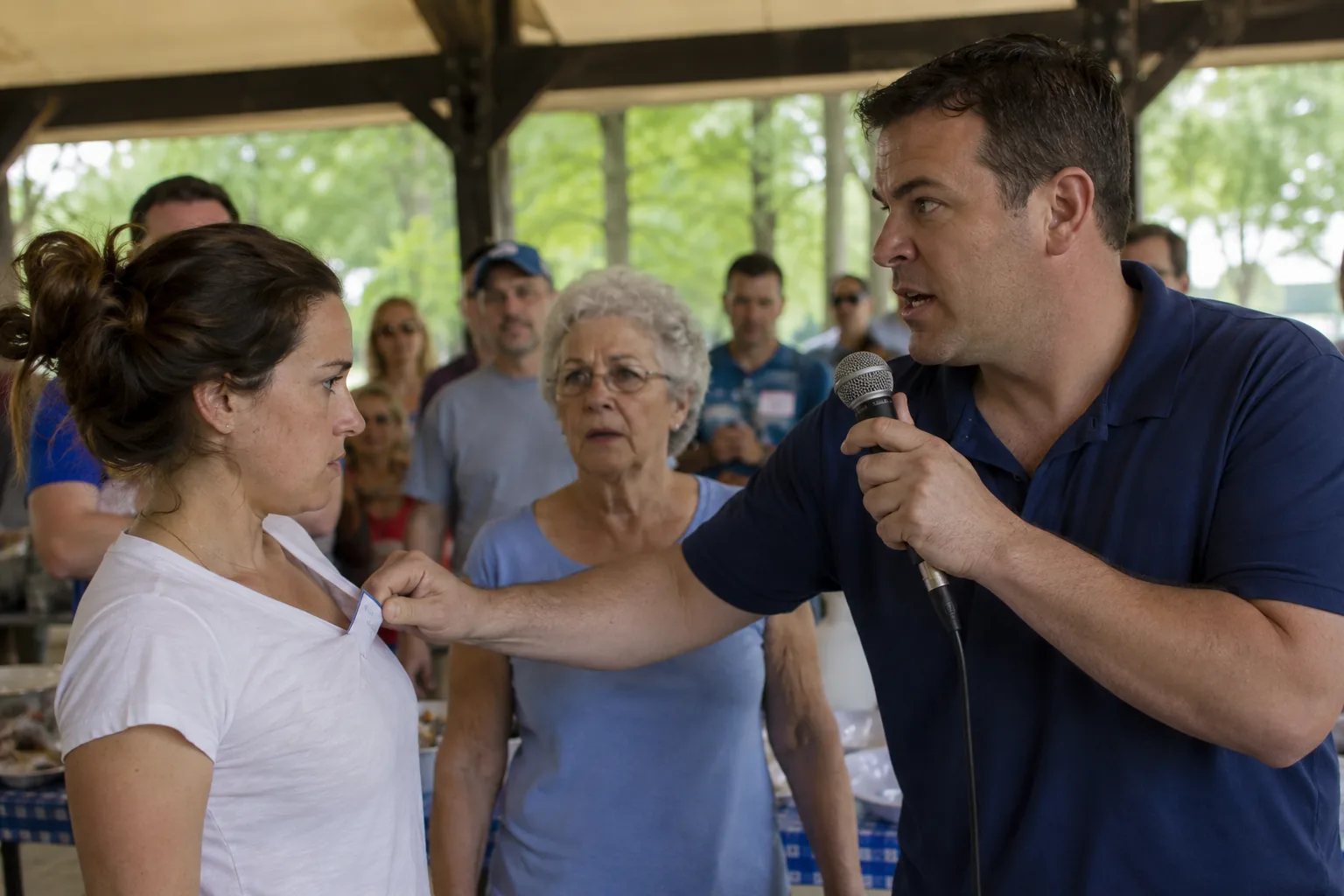
I walked the few steps to the front row. Darren followed close enough that I could hear the paper on his clipboard brushing his shirt. He still had my name tag tucked under his fingers.
I placed the pin in Aunt Lenora’s hand.
She turned it over slowly, thumb moving over the bent clasp, then angled it toward the light. “This is June’s reunion pin from the Nashville gathering,” she said. “She had a batch made for the grandchildren she put in the photo line.”
The words moved through the pavilion in a low ripple.
Darren spoke into the mic before the sound could settle. “That does not make Rachel part of this year’s counted family recognition. Traditions changed. The list is already set.”
There it was again. He kept moving the ground under his own feet. First I didn’t count as family. Then I wasn’t on the recognition list. Now traditions had changed. Every version needed the crowd to forget the one before it.
I looked at him. “You didn’t say the list was full. You said I don’t count.”
His mouth flattened. “You’re making this theatrical.”
“No,” Aunt Lenora said from her chair, still holding the pin. “He did that when he took her tag.”
That landed harder than anything I had said.
Darren glanced at her, then at the rows of people watching him. He gave a small laugh that sounded dry. “With respect, Aunt Lenora, this is about organizing households for the ceremony.”
“Then organize honestly,” she said.
Noah finally moved from the welcome table. He came halfway down the center aisle, phone still in one hand, and stopped where everyone could see him without him fully joining either side. He kept looking at the pin, then at me.
I turned to him. “Noah, do you remember that reunion?”
He rubbed his thumb against the edge of his phone. “I remember Grandma June making us line up by age for the picture.”
Darren snapped, “Nobody asked for a speech.”
Noah didn’t look at him. That was the first useful thing he had done all day. “She pinned those on a few of us after,” he said. “Not everybody. Just the ones she said had to keep showing up.”
The crowd made that same low sound again, the one people make when a story they thought was simple starts getting details.
I held out my hand, and Aunt Lenora gave the pin back to me. My palm felt cold where the brass touched it.
“Who was standing next to me in that picture?” I asked Noah.
He answered without pausing. “Darren was on your left. I was on your right. You cried because the pin stuck your shirt and Grandma June told you to quit squirming if you wanted to wear family metal.”
There were a few short laughs at that, but not easy ones. More like people recognizing a room they had been pretending not to see.
Darren’s face changed then, not into anything dramatic. He just went still. He looked at Noah, then at the front row, then down at the name tag under his fingers.
He could not call the pin random now. He could not say I had imagined the memory. Too many people had heard the pieces lock together.
So he did something that made my stomach tighten harder than the first insult.
He lifted my name tag for everybody to see, smoothed it flat against his clipboard, and said into the microphone, “Fine. If we’re going to be exact, then let’s be exact about what name belongs on it.”