Story code: ST-000174
Part 2: I Offered to Take the Burden Off Him
When I asked why he needed us not to look too closely at what he wrote, Gerald didn’t answer the line I was pointing at. He straightened the edge of the estate ledger, looked past me to Diane and Evan, and started talking again about loyalty, discretion, and how ugly things could get if people handled them carelessly. That was the moment I stopped hearing a professional explanation and started hearing a man trying to keep a story in place.
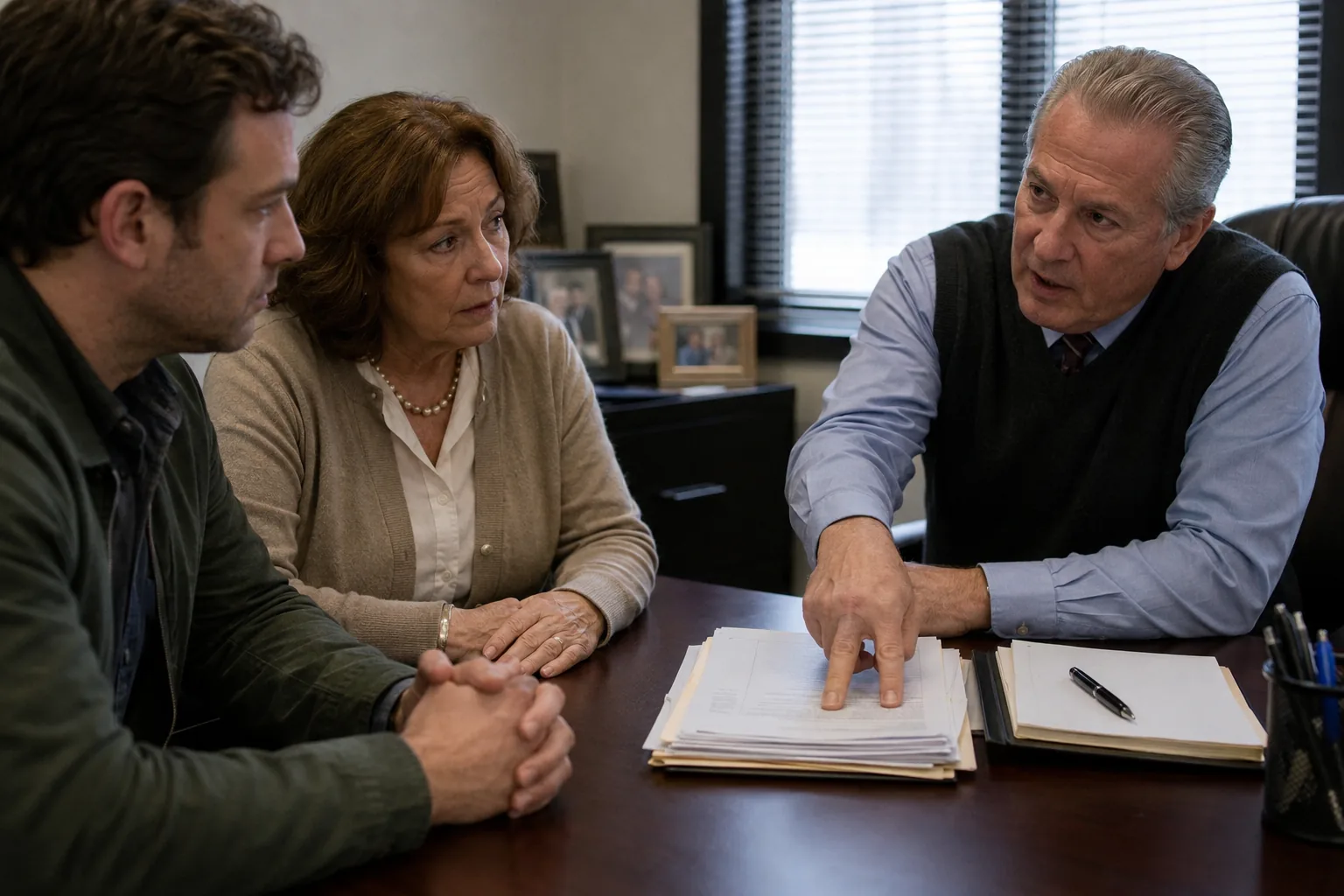
A woman at the front desk walked by carrying a stack of folders. The copier clicked. Somebody coughed behind the partition. Gerald’s office voice stayed low and polished, but his fingertips were pressed so hard to the paper that the page bowed under them.
“You are focusing on the wrong thing,” he said. “Families in your position usually appreciate when someone has already done the hard part.”
“What hard part?” I asked.
“Containing exposure,” he said.
“Exposure to what?”
He gave me a look like I was being deliberately dense. “To unnecessary consequences. To scrutiny. To mistakes that become expensive once they leave the room.”
Diane jumped in before I could answer. “He means he kept Grandma from getting tangled up in things she didn’t understand. You know how overwhelmed she got.” She turned to me with that urgent, smoothing tone. “He stood between her and a lot of problems.”
I looked at her, then back at him. “Okay. Then let’s make this simple. If this has been such a burden for you, you don’t have to carry it anymore.”
The room went still in a way that had nothing to do with silence. Even the sounds outside our little seating area seemed farther away.
Gerald blinked once. “Excuse me?”
“You said you’ve been carrying all this pressure for years,” I said. “Thank you for whatever work you did. We can take the ledger to another accountant and have the estate reviewed fresh from here. That should relieve you.”
Diane turned toward me so fast her chair squeaked. “Alyssa, no.”
But I kept my eyes on Gerald.
That was the cleanest offer I could make. No accusation. No scene. No speech. Just release.
His reaction told me more than anything he’d said all morning.
He didn’t look relieved. He didn’t sit back and accept the thanks he’d been fishing for. He didn’t say, if that’s what you want, I’ll cooperate.
He put his whole hand over the ledger.
“That would be irresponsible,” he said.
“Why?”
“Because a new person would not understand the history.”
“Then they can read it.”
“This isn’t a set of simple entries to hand off like a grocery list.”
“It’s an estate ledger,” I said.
His jaw shifted. “It’s a record of years of management decisions made under pressure.”
Evan finally spoke. “If it’s all legitimate, why can’t somebody else review it?”
Gerald turned to him with a patient smile that didn’t reach his eyes. “Because review without context creates false conclusions.”
Evan didn’t say anything else, but he wasn’t looking at Gerald like a kid being corrected. He was looking at the covered page.
I leaned forward enough to read the top of the column under Gerald’s wrist. I could make out dates, distributions, a notation beside one entry, and another amount that looked like it had been carried from one page to the next in different handwriting. Not a smoking gun. Not some dramatic confession written in red ink. Just enough unevenness to make all his speeches about sacrifice feel suddenly useful to him in a very specific way.
“Then explain the context,” I said. “Start with the changed figures.”
Gerald let out a short breath through his nose. “You are treating protection like it’s suspicious.”
“I’m treating vague protection like it’s vague.”
Diane pressed a hand to her temple. “This is exactly what he meant. He did all this work and now he’s being cross-examined.”
I turned to her. “I offered to remove that burden. He said no.”
She opened her mouth, then looked at Gerald before answering. That tiny pause landed harder than anything she’d said all day.
Gerald flipped back two pages himself, fast, like he meant to choose what we were allowed to focus on. He tapped a line near the top. “Here. Funeral costs. Property maintenance. Estimated obligations. This is what a serious person pays attention to.”
“And the rewritten entries?” I asked.
“Adjusted as information developed.”
“By whom?”
“By the person managing the file.”
“You?”
His voice sharpened. “Alyssa, enough.”
There it was. Not enough questions about the estate. Enough from me.
I sat back and let the silence stretch for a second. Gerald kept talking after that, too much and too neatly, moving from tax exposure to family discretion to how quickly outsiders misread complicated estates. The more he explained, the less clean the explanation sounded. He wasn’t narrowing anything. He was widening the fog.
Evan looked down when Gerald turned the page again, then said, very quietly, “Why are there notes on distributions before the dates they’re supposed to happen?”
Gerald’s hand stopped.
Diane looked at Evan. I looked at the page. I couldn’t see every line from where I was sitting, but I could see enough to know he wasn’t making it up. A notation sat above a date that should have come first.
Gerald pulled the ledger an inch closer to his chest.
“You’re misreading the sequence,” he said.
Maybe Evan was. Maybe there was an explanation. But Gerald had just spent half an hour telling us he alone could be trusted to interpret what was in front of us, and now the second someone offered to remove that burden or read the page without him, he got harder, not calmer.
I looked at the ledger, then at the hand he still hadn’t lifted from it.
If the numbers were on his side, I couldn’t figure out why he needed his story so badly to stand in front of them.