Story code: ST-000198
Part 2: The Paper Would Not Help Him
By the time I came back with the print packet, nobody had drifted away. That almost never happens at previews. People normally pretend not to stare. Here, they stayed near the wall text and the drinks table and the bronze pedestal by the window, holding glasses at chest height, waiting for paper to say something dramatic.
Paper almost never does. It just sits there while people embarrass themselves around it.
I handed the packet to Elise. Drew had moved half a step closer to her shoulder, close enough to look involved, not close enough to look aggressive. Nina stayed on the other side of the pedestal with both arms folded now, not speaking.
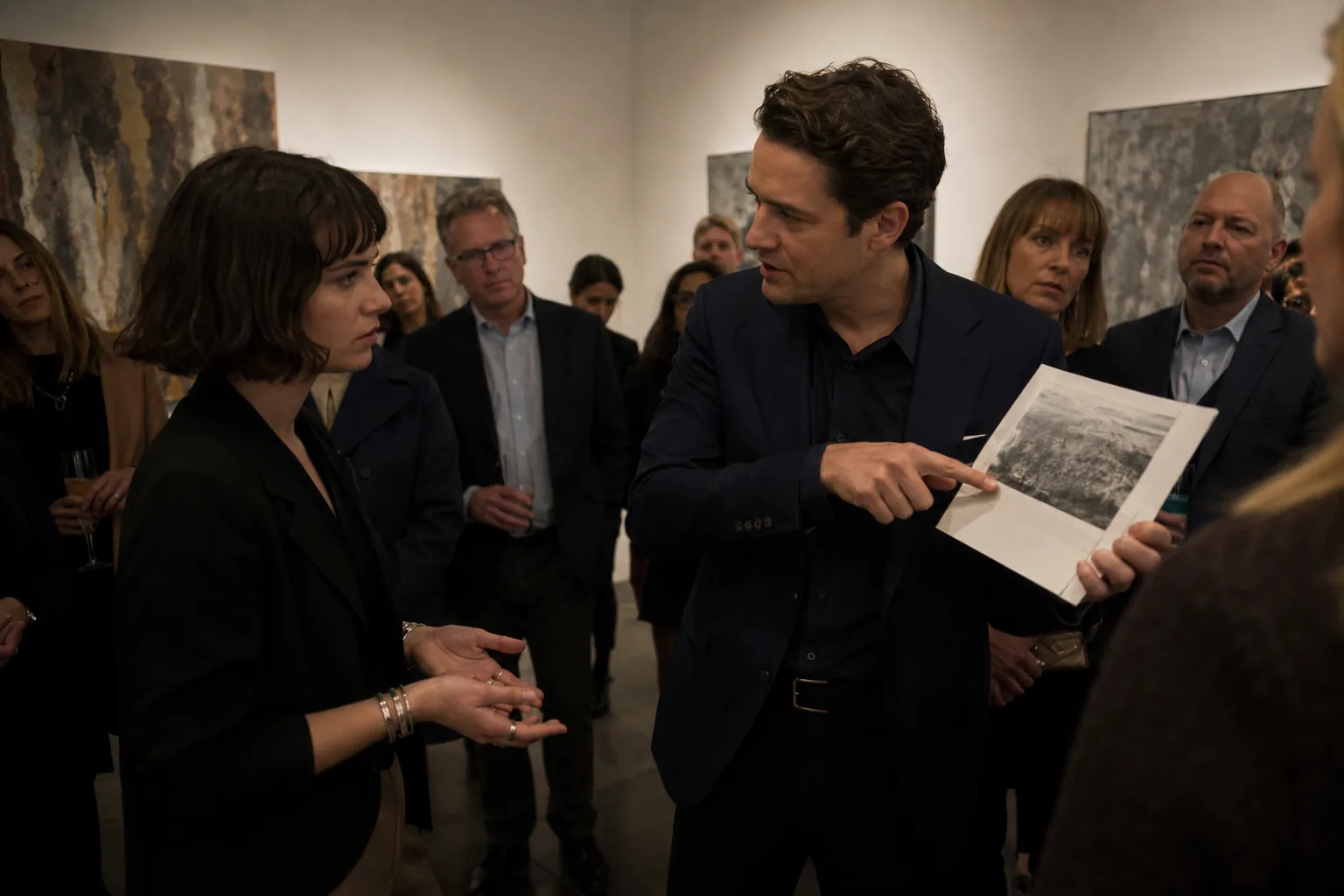
Elise opened the folder on the nearest flat surface, a low white cabinet we use for catalogs during openings. Inside were the usual materials for that edition: intake sheet, title record, print specs, and the gallery copy of the certificate language. She laid the certificate beside the typed form and smoothed both with her palm.
“Show me where your notation appears,” she said.
Drew didn’t miss a beat. He bent over the cabinet and put his finger near the lower block again.
“Right there. It’s encoded through the verification structure. You have to read the fields relationally.”
Elise looked at where he was pointing, then at the matching line on the typed form.
“Read it aloud,” she said.
He did. “Edition, output dimensions, substrate, issue timestamp, verification reference.”
“Again,” Elise said, and tapped the typed sheet. “Read this version aloud.”
He repeated it, almost the same. The room stayed quiet enough for me to hear a server set down fresh glasses across the room.
Elise said, “Where in that language is render custody notation?”
Drew kept his finger planted. “It’s not a literal label. It’s what the structure indicates.”
“To whom?”
“To anyone familiar with generative archival practice.”
That landed with less weight than his earlier lines. You could hear it. A couple near the window exchanged a look, quick and sideways. Nina’s chin lifted a little, but she still didn’t jump in.
Elise reached deeper into the packet and pulled out the one thing most guests never ask about: the issue template, the form the certificate text is generated from before the paper is printed and sealed. She put it next to the certificate. Same fields. Same order. No hidden category. No mysterious production term.
Drew adjusted his stance. “Templates don’t always include embedded custody language.”
“This one does if it exists,” Elise said. Her tone never rose. “Because this is the template that produced this certificate.”
He gave a short nod like he was generously allowing a beginner to catch up.
“You’re talking about front-facing output. I’m talking about the prompt hierarchy underneath it.”
That phrase got a few people back on his side for half a second, mostly because it sounded expensive. He saw it work and kept going.
“Authorship in generative practice isn’t reducible to who is standing nearest the paper,” he said, glancing toward Nina for the first time in a few minutes. “A lot of people don’t understand layered initiation.”
Nina unfolded one arm. “Then define prompt hierarchy,” she said.
He turned to her with the patience people use when they want an audience to notice how patient they are.
“It’s the ranked sequence of prompt ownership across iterative output custody,” he said.
There was that rhythm again. Clean, fast, ready-made. He looked back at the room as if the sentence itself should close the matter.
Elise didn’t let it close.
“What are the ranks?” she asked.
Drew blinked once. “That depends on the production environment.”
“Name the ranks for this certificate.”
He looked down at the paper instead of answering. Not long. Just long enough for everybody watching to notice that his finger had stopped moving.
I kept my eyes on the certificate. Under the track lights, the embossed seal threw a faint shadow over the margin. The verification reference sat at the bottom in the same plain block font as every other one I’d filed.
Drew said, “You wouldn’t list them in visible form.”
Elise slid the issue template closer to him. “Then tell me which field corresponds to your term.”
He touched one line, then another.
“The issue timestamp can function that way if the chain is preserved.”
“Function which way?”
He pulled his hand back. “As custody notation.”
Elise looked at me. “Bring the wall label copy for this piece too.”
I fetched it from the holder beside the frame. When I returned, she set it next to the other papers. The label listed title, process, print medium, edition, and year. Under process it said: AI image generation, archival pigment print. Nothing more ornate than that.
Elise read it aloud, then read the certificate fields aloud, then set both down.
“You’re describing a terminology set we do not use on the label, do not use on the certificate, and do not use in the issue template,” she said. “So I need something observable. Not a performance. Show me how this paper ties authorship to you.”
That was the first time the balance shifted in a way everybody could feel. No outburst. No accusation. Just a request that stayed on the table after she said it.
Drew’s mouth opened, closed, then opened again.
He reached for the certificate and said, “The verification reference crosswalk would show it if we pull the live comparison.”
Elise’s hand stayed on the page before he could touch it. “Good,” she said. “Let’s do exactly that.”
Nina lowered her arms. Nobody spoke. Drew had spent ten minutes making the room believe there was hidden expertise buried in ordinary paper, and now he had named a live comparison that could either support him or strip all that polish off in front of us. When Elise asked me to bring up the verification screen for the reference number at the bottom of the certificate, Drew stopped smiling.