Story code: ST-000508
Part 2: Contamination Protocol
The sudden, wet pressure around Greg’s left ankle sent a jolt of primal panic straight through his nervous system, though his right hand remained rigidly locked in its recording posture. The woman’s grip was astonishingly powerful, her fingers digging through his tailored slacks and pressing directly into his tendon. A thick smear of hot, metallic-smelling liquid soaked instantly through the wool blend of his trousers.
Greg’s immediate biological impulse was to kick backward, to violently dislodge the unpredictable variable clinging to his leg. But years of corporate conditioning and quarterly compliance seminars paralyzed his muscles. Section seven, paragraph D of the employee code of conduct was unequivocal: striking, kicking, or otherwise forcefully repelling a distressed subject on the factory floor constituted active assault. It would immediately void his corporate indemnity, transferring the entire financial burden of the woman’s medical emergency, and any subsequent litigation, squarely onto Greg’s personal assets.
“Subject, release my person,” Greg commanded. His voice trembled slightly, lacking the flat, authoritative cadence required by the de-escalation guidelines.
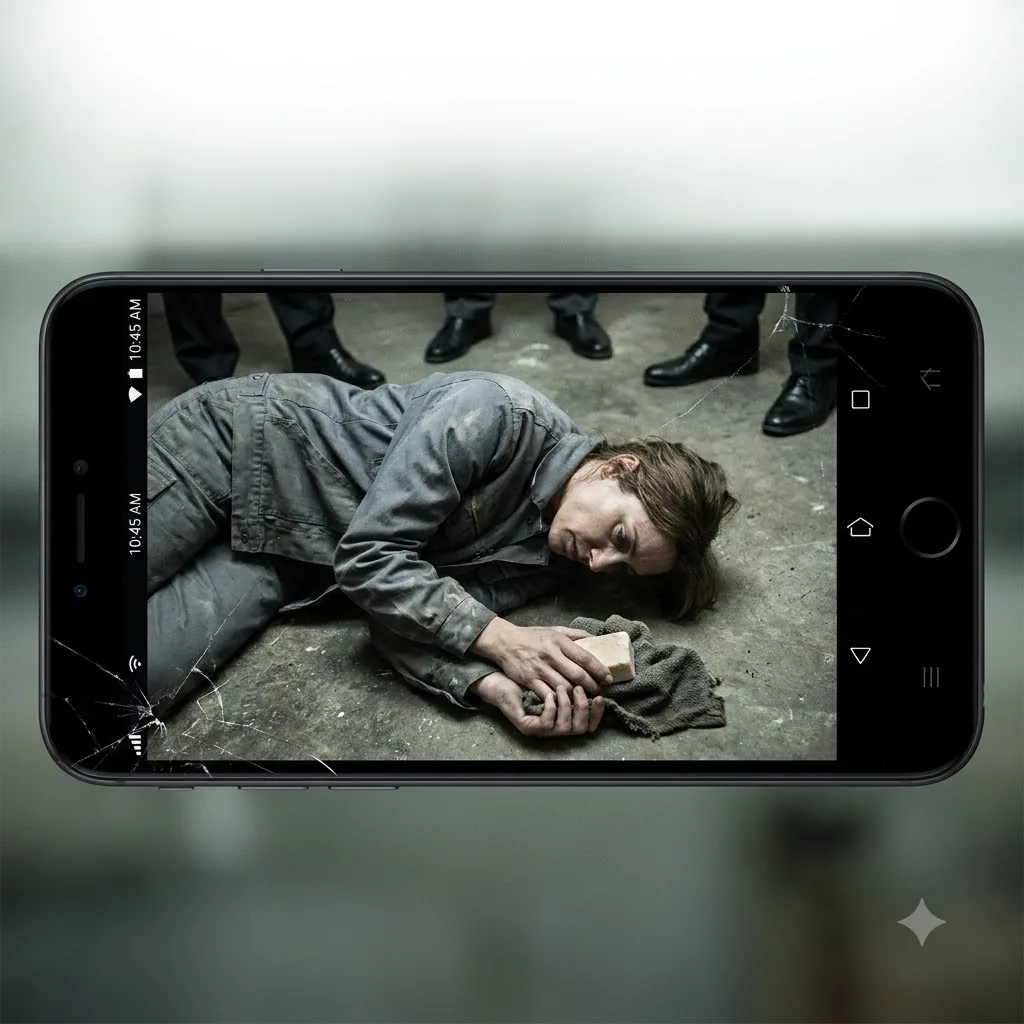
The woman did not release him. Instead, she used her grip on his ankle as an anchor, dragging her bleeding torso another few inches across the concrete. The friction left a wide, dark streak on the floor. On the screen of Greg’s smartphone, the scene became a chaotic blur of gray concrete, red pooling liquid, and the drab fabric of her oversized uniform. He angled the lens down, desperate to keep the subject in frame, documenting that he was not initiating contact.
Around him, the gentle white noise of the ventilation fans was suddenly broken by the synchronized shuffling of leather shoes. Greg darted a glance away from his screen. The loose circle of executives was moving. They were not stepping forward to assist him. They were taking measured, collective steps backward, widening the perimeter.
Worse, their smartphone cameras were no longer angled down at the collapsed woman. Seven high-definition lenses were now pointed directly at Greg.
“Miller,” Greg said, locking eyes with the executive in the wingtip shoes. “Record that she initiated contact. Note the time-stamp. I am maintaining a strictly non-intervention posture.”
Miller’s expression was an unreadable mask of corporate neutrality. He adjusted his grip on his phone, zooming in. “You have breached the slip-and-fall perimeter, Greg. You are now physically entangled with a biohazard. I am logging this as a Category Three protocol deviation.”
“I didn’t breach the perimeter, she pulled me into it!” Greg snapped, his carefully maintained professional detachment beginning to fracture. He looked back down at the woman. The digital display of his phone showed her other hand-the one clutching the rough, hand-stitched cloth pads and the ruined bar of cheap soap-moving with terrifying speed.
She wasn’t trying to pull herself up anymore. She was trying to hide the contraband. And she had found a new hiding spot.
Before Greg could twist his leg away, the woman thrust her fist toward his shoe. She jammed the blood-soaked squares of coarse fabric and the indented yellow soap directly into the deep, tailored cuff of Greg’s trousers. She packed them tightly against his ankle, her bloody knuckles scraping against his skin, concealing the unapproved items completely beneath the drape of his pant leg.
Greg gasped, a sharp intake of breath that sounded far too loud in the cavernous industrial space. He instinctively reached down with his free hand to claw the contraband out of his clothing, but he stopped himself just inches from her trembling fingers.
If he touched the items, he was handling unapproved floor materials. If he touched *her*, he was interfering with an active medical incident. By hiding the objects on his person, the woman had effectively transferred the liability of the contraband onto him. If the floor supervisors found company soap and unauthorized textiles on Greg during the post-incident scan, he wouldn’t just lose his indemnity; he would face immediate termination for smuggling, followed by a ruinous lawsuit for corporate theft.
“Remove them,” Greg hissed, staring into her single, bloodshot eye. The raw intensity he had seen earlier was now mixed with something else-a desperate, terrifying cunning. “Take them back. Now.”
She coughed again, a wet, rattling sound that sprayed fine crimson droplets across Greg’s socks. She slumped heavily against his shin, her grip on his ankle loosening just enough to let her arm fall slack against the concrete, but her body weight remained pinned against his leg.
On his phone screen, Greg watched his own trembling hand hovering uselessly over her shoulder. The digital viewfinder captured the horrific reality of his situation in perfect clarity. To the seven cameras recording him from the safety of the outer circle, it didn’t look like he had been ambushed. It looked like he was standing over a bleeding worker, intentionally concealing her contraband.
“Greg,” Miller’s voice cut through the hum of the ventilation fans, cold and clinical. “The shift supervisors’ cart has been dispatched from Sector Four. ETA is ninety seconds. You are currently harboring unlogged materials. You need to declare them before the compliance sweep, or you will be categorized as an accomplice to the theft.”
Greg’s mind raced, scrolling frantically through the mental index of the risk management manual. There was no protocol for this. If he declared the items, the compliance team would confiscate them, log the theft, and bill the woman’s employee account for the medical response and the stolen goods-a standard operating procedure that always resulted in permanent indentured withholding for the worker. But if he was caught hiding them, the corporate auditing algorithms would legally target *him*.
The woman shifted her head against his soaked pant leg. Her cracked lips parted, and a whisper barely audible over the industrial fans drifted up to him.
“If they scan the cloth…” she wheezed, her voice a fragile, broken thread of sound. “If they see the fabric… they’ll know about the dorms. They’ll purge the whole unit.”
Greg stared at his phone screen. The red pool was still expanding, inching toward the soles of his shoes. Ninety seconds. He had ninety seconds to decide whether to violently break protocol and expose the blood-soaked rags to the cameras recording his every twitch, or stand perfectly still and let the compliance officers discover that Greg was now carrying the very violation he was supposed to be documenting.