Story code: ST-000527
Part 4: The Weight of the Cold
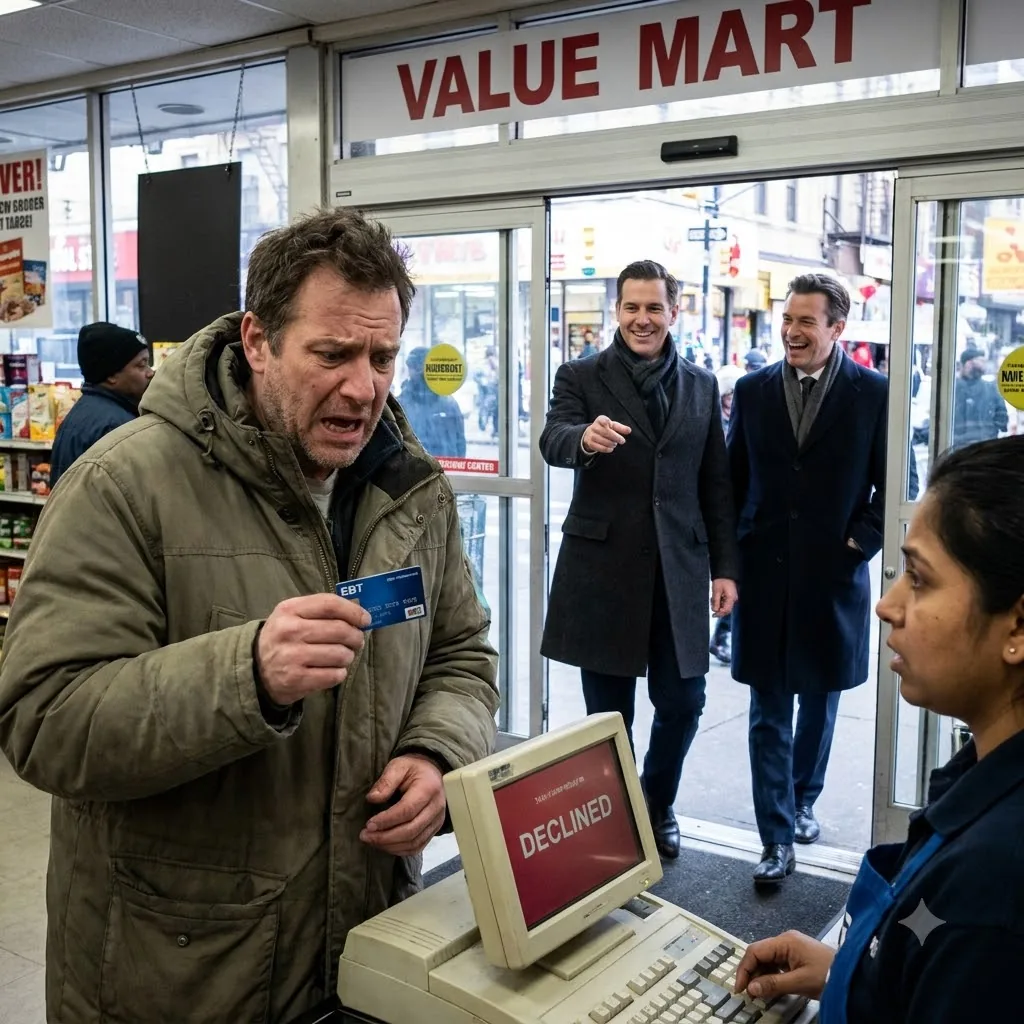
The word “fired” hung in the cold air, a violent echo that finally brought Arthur Pendelton out of his shocked silence. The wealthy developer adjusted his wire-rimmed glasses, his expression hardening into one of profound distaste. He looked at Provost Hayes, then down at the blue EBT card resting on the conveyor belt.
“You just terminated an adjunct professor in the middle of a discount grocery store,” Pendelton said, his voice stripped of all previous polite diplomacy. “Because he revealed that your institution pays him a wage that requires government food assistance.”
Hayes blinked, his face still flushed a mottled, furious red. He lowered his trembling finger. “Arthur, you have to understand the context. This man is a disgruntled-”
“I understand that you lied to my board about the community impact assessments,” Pendelton interrupted, taking a distinct step away from the provost as if Hayes were suddenly contagious. “You assured us this neighborhood was largely transient, composed of abandoned commercial properties. You didn’t mention occupied brick walk-ups or evicting your own faculty. The Pendelton Group does not fund public relations nightmares, Warren.”
Pendelton didn’t wait for a response. He gripped his leather briefcase tightly against his chest, turned on his polished heel, and marched straight past the towering cola display, out the automatic doors, and into the freezing night.
Hayes stood paralyzed. His chest heaved beneath the camel-hair overcoat, his eyes darting frantically from the sliding glass doors back to Silas. The provost opened his mouth, perhaps to issue another threat, but nothing came out. Instead, he spun around and stormed out after his vanishing donor, desperate to salvage his fifty-million-dollar vanity project.
Silas was left standing at register two, the buzzing of the fluorescent tube loud in his ears. His hands were shaking. He reached forward, his raw, cracked fingers closing over the edge of the blue EBT card. He slipped it back into his frayed corduroy pocket.
He looked at the teenage cashier, who was staring back at him with wide, unblinking eyes.
“Sorry,” Silas mumbled. His throat felt incredibly tight. He glanced at the abandoned dented tin of coffee, the block of store-brand cheese, and the bruised lentils. “I can’t… I can’t pay for that.”
He didn’t wait for the teenager to respond. Silas shoved his hands deep into his pockets, turned his collar up against the chill, and walked toward the exit.
The automatic doors ground open, and the freezing street air hit him like a physical blow. Silas stepped out onto the cracked asphalt of the Bargain Basket parking lot. The damp scent of exhaust was still there, but now the cold seemed to pierce straight through his thin jacket, settling deep into his bones.
He stopped beneath a flickering streetlamp, his breath pluming in white clouds. The adrenaline that had propelled him to stand up to Hayes evaporated rapidly, leaving behind a hollow, nauseating terror.
He had just been fired. Come Monday morning, he would have no classes to teach. By the end of the month, he would have no paycheck. His mind began a frantic, brutal calculus. Without his university income, the rent for his drafty studio apartment in the brick walk-up across the street was entirely impossible. His student loan deferment, strictly contingent on his active employment status, would vanish. He owed over eighty thousand dollars for a Ph.D. in English Literature-a degree that had just cost him his livelihood in the checkout lane of a discount grocery store.
Silas stared across the street at his building. The neon light from the corner liquor store reflected off the ice creeping up his single-pane window. If Hayes managed to find another donor, the building would still be bulldozed. But even if it wasn’t, Silas wouldn’t be able to afford living there anyway. He had thrown away everything.
He closed his eyes, a violent shiver wracking his thin frame. The biting wind whipped across the empty lot, carrying the distant wail of a siren.
Behind him, the automatic doors slid open with a loud metallic groan.
Silas didn’t turn around. He assumed it was another customer, or perhaps the night manager coming out to wrangle the stray shopping carts.
“Hey. Man.”
Silas turned. The teenage cashier was jogging toward him across the frozen asphalt. The kid wasn’t wearing a coat, just his stained uniform apron over a faded gray hoodie. In his hands, he carried two thin plastic grocery bags, their handles stretched taut from the weight inside.
The cashier stopped a few feet away, his breath misting in the cold air. He held out the bags.
Silas stared at them, thoroughly confused. “I told you, I can’t pay for those. My card…”
“I know,” the teenager said, his voice completely devoid of its previous irritation. He thrust the bags closer. “I put the lentils back in the return bin. But I voided the rest of the transaction and re-rang it. Paid cash.”
Silas blinked, the words struggling to make sense in his panicked mind. “You paid for my groceries?”
“It was like, eight bucks, dude,” the kid said, shivering as a gust of wind caught his thin hoodie. “That guy in the fancy coat was a total dick. Nobody should get treated like that just trying to buy some cheese.”
Silas looked at the kid’s worn canvas sneakers, then up at his face. The cashier’s expression wasn’t one of pity. It was a fierce, unspoken recognition. It was the shared understanding of what it meant to stand on the losing side of a scanner, counting pennies, while men in camel-hair overcoats treated the world like their personal playground.
Slowly, Silas reached out and took the plastic loops. The bags were heavy. The rigid edge of the dented coffee tin pressed against his knuckles, solid and real.
“Thank you,” Silas whispered, his voice thick with an emotion that threatened to spill over. “I… I don’t know what to say.”
“Don’t worry about it,” the cashier said, shoving his freezing hands into his hoodie pockets. He gave Silas a firm, silent nod-a gesture of pure, unadulterated solidarity.
The teenager turned and jogged back toward the brightly lit entrance of the grocery store, slipping inside just before the glass doors clamped shut.
Silas stood alone in the freezing parking lot. He still didn’t have a job. The eighty thousand dollars in student loans still loomed over him, and his apartment across the street was still just as cold. The terrifying reality of tomorrow hadn’t changed at all.
But as he gripped the plastic bags and looked back at his brick building, the crushing weight of his humiliation was entirely gone. He stood a little taller against the biting wind, his dignity anchored by the heavy, dented tin of coffee in his hands.