Story code: ST-000013
Part 2: Then Explain The Backpack
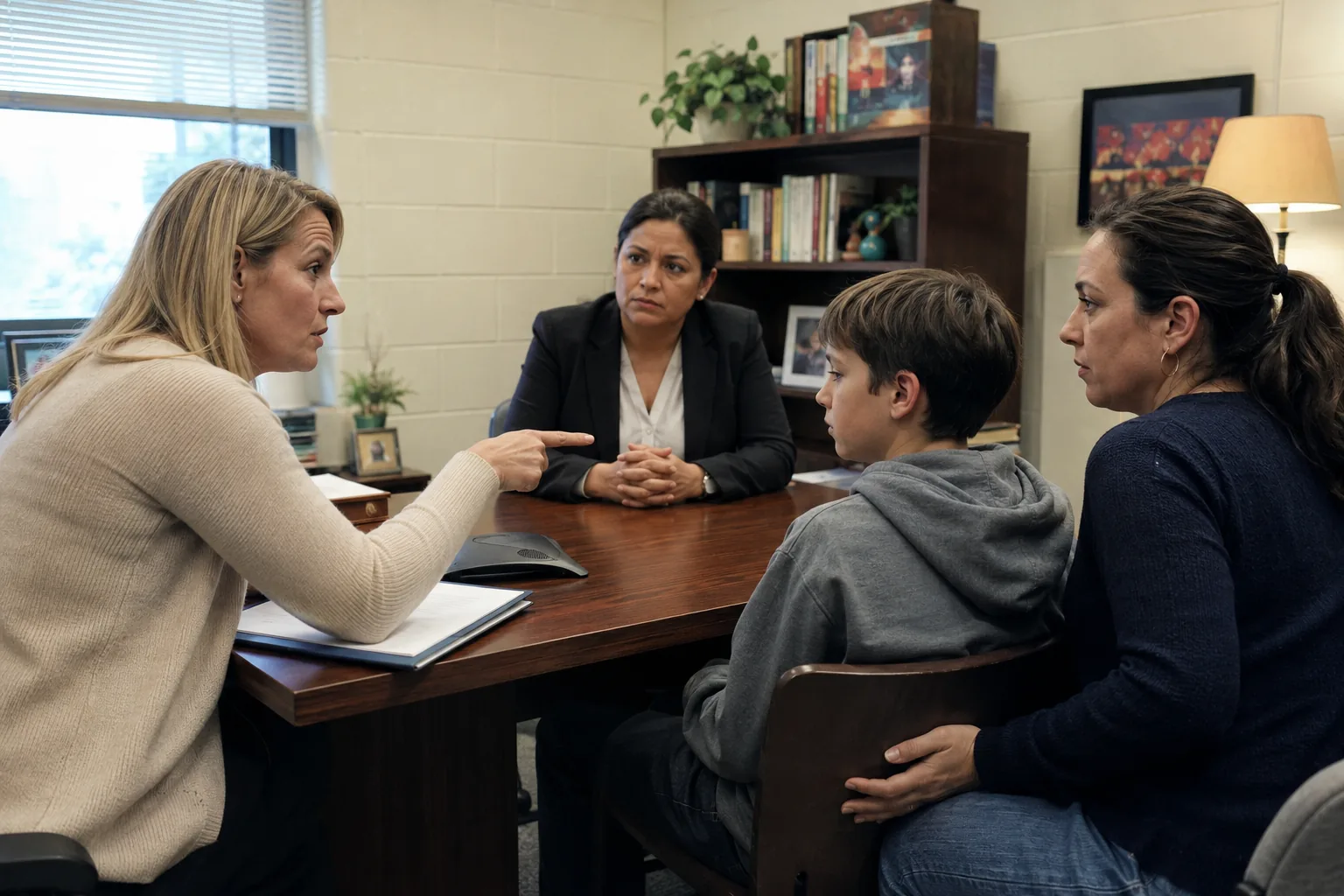
By the time Ms. Tasha Greene stepped into the office with copied worksheets tucked under one arm, the question had narrowed to one object on the floor and one sentence Kendra Walsh kept trying to erase. Principal Ruiz did not ask for feelings, context, or who had been rude first. She asked what happened to Maya Bennett’s backpack in the classroom, who moved it, and why it stayed where it stayed. Kendra was still sitting with that tidy volunteer smile, but she had started touching the arm of her chair between answers like she needed to mark the edges of it.
Ms. Greene stayed near the door until the principal motioned her to the last open chair.
“I only need sequence,” Principal Ruiz said. “Not conclusions.”
“Yes,” Ms. Greene said, glancing once toward Maya and then back to the principal. “At morning reading groups there was a problem between Maya and Daniel. Their bags were next to the same table leg. I separated the bags while I handled the group.”
Kendra nodded quickly. “Exactly. A classroom adjustment.”
The principal held up one finger without looking at her. “Go on, Ms. Greene.”
“I moved Maya’s backpack near my desk,” the teacher said. “Daniel’s stayed by the cubbies at first because I was keeping students moving to specials. Later, when students came back, Maya asked whether her bag was going back to the same spot.”
Laura watched Kendra’s chin lift a fraction, ready to jump in.
“Who answered her?” Principal Ruiz asked.
Ms. Greene paused. It was not a dramatic pause. It was the kind teachers use when every word has to survive a parent email later. “Ms. Walsh was in the room then, helping with the supply count for the class project bins. She answered before I did.”
Kendra’s smile came back fast. “I answered in a general, calming way. I did not make any promise.”
“What were the words?” the principal asked.
Ms. Greene adjusted the worksheets against her forearm. “Not exact exact. But it was to the effect of, ‘Leave it there for now. You’re fine. It’s not going back over there right now.'”
Maya looked up for the first time since the teacher came in. Laura did not interrupt. She only wrote down right now.
Kendra turned toward Ms. Greene with a soft, almost amused disbelief. “That is not a promise. That is ordinary reassurance in a busy classroom.”
“Maybe,” Principal Ruiz said. “But it is language about placement.”
Kendra spread one hand. “Temporary placement. Anyone can hear that.”
Laura waited until the room settled. “Then let’s stay with temporary. After Maya was told to leave her backpack by the desk, who moved it again?”
No one answered for a second.
Ms. Greene said, “I did not move it back during class.”
“Did Maya?” the principal asked.
Maya shook her head. “No.”
“Did Daniel?”
From the hallway, there was a shift at the doorframe. Daniel did not step fully in. He said, without looking at anyone for long, “No, ma’am.”
Principal Ruiz wrote that down.
Laura kept her voice flat. “So for the rest of that class period, Maya’s backpack remained by the teacher’s desk.”
“Yes,” Ms. Greene said.
Kendra gave a short smile toward the principal, as if the answer settled things in her favor. “Because the teacher had already moved it. That’s my point. This is being inflated into some dramatic arrangement when it was simply where the bag happened to be left.”
Laura looked from Kendra to the principal’s notes and back. “Happened to be left?”
Kendra’s eyes went to her. “Yes.”
“Even after Maya specifically asked whether it was going back next to Daniel’s?”
“Children ask lots of things in the moment,” Kendra said. “That doesn’t transform every adult response into a binding agreement.”
Principal Ruiz leaned back slightly. “No one said binding agreement. We are discussing what was said and how the bag was handled afterward.”
Ms. Greene, still careful, added one more piece. “When a student asks about separation after a problem, I usually clarify if something is only for five minutes. If it is going to stay that way through the block, I say that.”
Kendra turned to her. “But you just said I spoke before you did.”
“I did,” Ms. Greene said.
“Then whatever classroom practice you usually use isn’t the point here.” Kendra’s tone stayed smooth, but she was holding the folder against her knees with both hands now. “The point is that I did not make some special promise to this child.”
The principal tapped her pen once. “Yet the child asked a direct placement question. You answered it. The teacher did not correct you. The backpack then remained separated for the rest of the class block.”
No one spoke.
The copier in the hall stopped. A phone rang once somewhere farther down the office corridor and was cut off.
Laura could see the shape of the problem now, though not the end of it. Kendra kept insisting there had been no promise, no assurance, nothing Maya could reasonably rely on. But every detail she allowed into the room made that denial narrower. The answer had not been an adult shrug while the class moved on. It had directed the child’s next action, and the backpack had been handled in line with it.
Kendra shifted in her chair and tried again, more sharply this time. “Then the obvious explanation is that Ms. Greene independently chose to leave the backpack there for classroom management reasons. That had nothing to do with anything I said.”
Ms. Greene looked at the principal before answering. “If I was independently choosing that for the whole block, I would have said so myself.”
The room went very quiet after that.
Principal Ruiz lowered her pen, then raised her eyes to Kendra. “All right,” she said. “Then I need you to explain one step very clearly. If your words had nothing to do with how Maya’s backpack was handled, why did everyone in that room act as if they did?