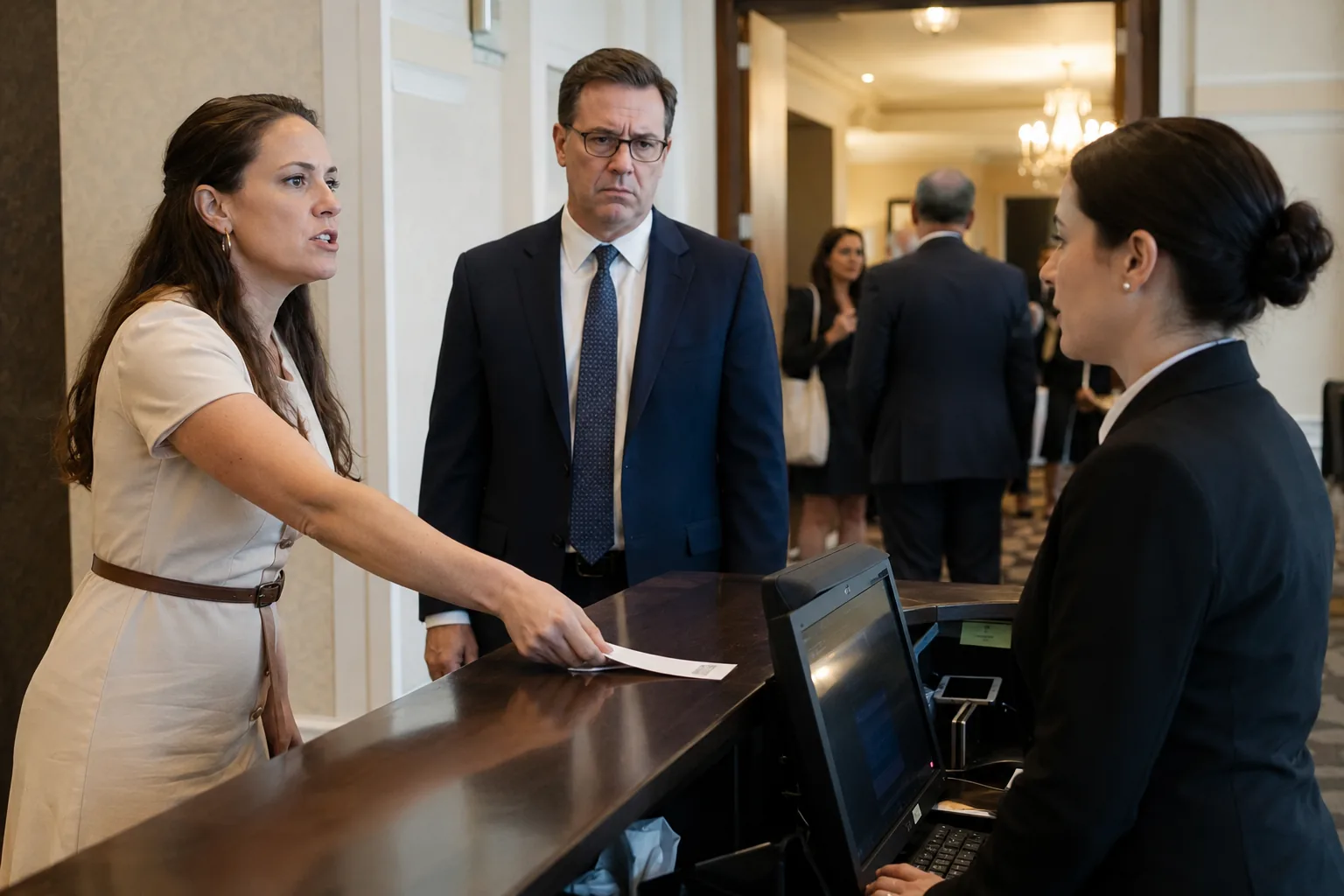
Story code: ST-000086
Part 4: The Record Changed The Room
When Luis said it was a timestamp issue, he reached for the manager table map, the receipt stack, and the bank alert and lined them up in a straight row on the counter. He did it like a person who had finally decided to stop making excuses for the desk. The clerk stayed beside the terminal. I stayed where I could see the screen and the doorway at the same time. Mara was still at my shoulder, but she had stopped trying to crowd me. She was watching Luis now.
The billing office phone was still on hold. No one touched it.
Luis pointed to the deposit receipt first. “This posted at twelve thirty-nine.”
He pointed to the manual entry next. “This card was run after that.”
Then he pointed to the bank alert. “This declined at twelve forty-seven and ten seconds.”
I said, “And the room was already covered.”
Luis nodded once, a short motion, and turned the screen so the clerk could see it too. The clerk read it, then looked down at the counter. He did not speak.
Mara moved in a tight half-step toward the papers. “That note was for backup only,” she said. “It does not change anything.”
It did change something, because now everybody could see the gap between what the desk had done and what the record actually said. I picked up the sticky note again and held it out where both of them could see it.
“Run backup payment if room balance disputed,” I read. “Who wrote that?”
No one answered.
The hallway had gone busy in a different way. People were slowing down instead of hurrying past. Two banquet staff stopped at the doorway with a linen cart. One of the workers from earlier had come back. The front half of the office was open enough that the words carried.
Luis said, “That instruction does not override posted payment.”
Mara cut in, “I told you the room had to stay clear until the final balance was handled.”
There it was. Not a whole confession, but enough of one to change the air. The clerk looked up at her. I saw his face go flat. A woman passing the doorway paused with her hand on the cart handle. Someone behind her said, “Wait, they ran the card after it was already paid?”
Mara turned toward the sound. “That is not what happened.”
Luis did not let her move the terms again. He picked up the phone receiver, pressed a button, and spoke into the line in the same procedural voice he had been using all along.
“Hold the ballroom closeout,” he said. “We have a sequence mismatch.”
That sentence changed the room more than anything Mara had said. The clerk’s hand left the terminal. The banquet staff at the doorway stopped pretending they were not listening. A man in a service vest leaned in and asked, “Is this the deposit for the Torres event?”
Luis answered without looking at Mara. “The folio cannot close while the payment order is disputed.”
Mara made one last push. “You cannot do that. People are waiting.”
“I can,” Luis said. “And I am.”
He turned the screen around so everyone nearest the door could see the timestamps. Not the whole report. Just the three lines that mattered. Deposit first. Card later. Decline after that. The visible order made her claim collapse right there under the office light.
The worker at the doorway said, “So the room is not unpaid.”
Nobody answered him quickly enough, because the answer had already been written on the screen.
Luis set the phone down and reached into the drawer beneath the counter. When he pulled it open, I saw a key card sleeve, a printed folio note, and a small yellow office stamp. He took out the stamp, pressed it onto a fresh sheet, and slid that sheet into the top of the stack. On it, in block letters, was a formal correction note saying the balance dispute was under review and the ballroom account was not to be rerun without manager approval.
That was the visible consequence. Not a speech. Not an apology. A locked instruction.
Mara stared at the paper. “You are actually freezing the account?”
Luis kept his eyes on the log. “I am correcting the account access until the sequence is verified.”
The clerk finally spoke, and this time he did not sound defensive. He sounded exact. “The manual charge should not have been run.”
A few people in the doorway heard him. The tone in the hallway changed. Not loud. Just enough that I could feel it. The workers who had been listening no longer looked at me like I was the problem at the desk. They were looking at the papers. At Mara. At the screen.
Mara tried to pull the story back toward me one last time. “She should have said something sooner.”
I held the declined card up between us. The bank alert was still on my phone. The time was still there. The decline was still there. The sequence was still there. I did not raise my voice.
“I said it when the numbers stopped matching,” I told her. “You just kept talking over the screen.”
Nobody corrected me.
Luis slid the formal note toward the clerk and said, “Mark the ballroom block corrected. No further charge attempts.”
The clerk clicked the terminal once. The sound was small, but the room heard it. Mara looked from the note to the screen to the people gathered in the doorway, and for the first time she had nothing left to push. The room did not erupt. It shifted. People stopped siding with the loud version and started looking at the record instead.
That was the part I wanted all along. Not a scene. Not a fight. Just the room turning when the timestamps finally spoke for themselves.