Story code: ST-000559
Part 2: The Void Error
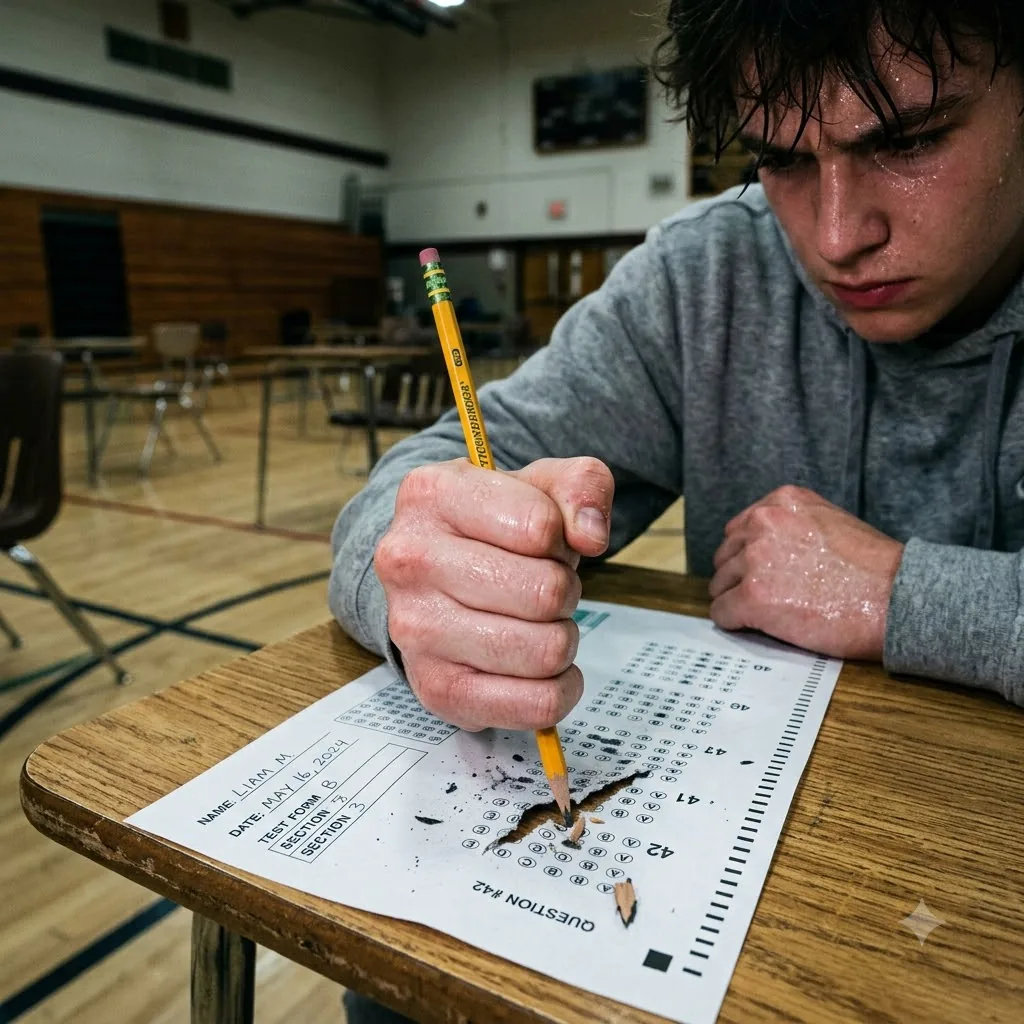
The crack of the snapping lead sounded like a gunshot in the cavernous silence of the gymnasium. For two seconds, the furious scratching of two hundred pencils ceased entirely. A collective breath hitched.
Kevin didn’t look up. He stared down at the jagged, asymmetrical hole he had just driven through his Scantron sheet. The torn edges of the heavy-stock paper curled upward, revealing the scarred laminate of the desk underneath. The graphite dust smeared around the ruined bubble for question forty-five, an ugly gray smudge that looked exactly like what it was: an act of violence.
His chest heaved. The cold salt wind from his memory vanished, replaced by the suffocating smell of floor wax and nervous teenage sweat. He unclenched his hand. The two broken halves of the yellow number two pencil rolled harmlessly in opposite directions across his desk. One dropped over the edge, clattering loudly against the hardwood floor.
*Squeak. Squeak.*
The rubber-soled shoes were moving faster now. Mr. Harrison was closing the distance down the center aisle.
Kevin froze. The plan was disintegrating. A thirty-eight percent was a believable collapse, a silent buckling under the weight of advanced calculus. But destroying the testing materials was a behavioral violation. It would demand an immediate administrative response. They would call his parents. His father wouldn’t just see a failing grade in three weeks; his father would be dragged away from the deep fryers this afternoon, forced to bow and apologize to the principal for his son’s outburst.
“Kevin,” a low, hushed voice said from above.
Mr. Harrison stood beside the desk. The veteran math teacher smelled of stale coffee and peppermints. His brow was furrowed, eyes darting from Kevin’s rigid posture down to the ruined answer sheet. Kevin braced himself for the reprimand. He waited for Harrison to pick up the test booklet, compare it to the bubbles, and instantly recognize the deliberate, mathematically impossible sabotage.
Instead, Harrison’s expression softened into deep, agonizing pity.
“Breathe, Kevin,” Harrison whispered, leaning down so his voice wouldn’t carry across the silent rows of test-takers. “Just take a deep breath. It’s okay. The pressure gets to everyone. Even you.”
Kevin stared at the man’s argyle sweater vest, entirely thrown. Harrison hadn’t seen a rebellion. He had seen a panic attack. To the head of the math department, Kevin was the star pupil, the immigrant kid carrying the weight of his family’s survival on his shoulders. Of course the boy was cracking under the stress. It fit the school’s narrative perfectly.
“I… my pencil,” Kevin mumbled, leaning forward slightly in a desperate attempt to physically cover the erratic answers he had bubbled for the previous twenty questions.
“I know,” Harrison whispered, placing a gentle, heavy hand on Kevin’s shoulder. “I was talking to your dad last week at the grocery store. I know how much is riding on the early admission scholarships. He told me about the restaurant’s lease. He told me how proud he is that you’re going to get out of there and do something bigger.”
The words twisted like a knife in Kevin’s ribs. His father hadn’t just submitted to the developer; he was actively using Kevin’s impending success to justify his own surrender. The pride wasn’t just pride-it was an alibi. *I can let them bulldoze our family legacy because my son is going to MIT.*
“I’m fine,” Kevin whispered back, his voice trembling with a sudden, suffocating rage. “I just need to finish.”
“You can’t run this through the grading machine,” Harrison pointed out, gesturing to the torn hole. “The optics scanner will reject the whole sheet. It’ll throw a void error.”
A void error meant no score. No score meant a makeup exam. A makeup exam meant they would just put him back in a room next week and force him to do this all over again. He wouldn’t fail; he would just be delayed.
Harrison checked his wristwatch. “We have thirty-one minutes left. Don’t panic. Stay right here.”
The teacher turned and walked swiftly back to the proctor’s station at the front of the gym. Kevin sat immobilized. The other students had returned to their exams, the frantic scratching of their pencils resuming like the hum of a disturbed beehive settling back into its rhythm.
Kevin looked at his test booklet. He had meticulously calculated every wrong answer. He had engineered a thirty-eight percent. He knew exactly which traps he had fallen into, which negative signs he had dropped, which constants he had ignored during integration. He had built a masterpiece of failure.
Harrison returned a moment later, sliding a pristine, blank pink Scantron sheet onto Kevin’s desk. Beside it, he placed three freshly sharpened pencils.
“School policy dictates I have to void the damaged sheet,” Harrison whispered, picking up the torn Scantron. “But you have plenty of time to transfer your answers to the new one. You’ve already done the hard part. The math is in your head.”
Kevin’s stomach plummeted. “I can just copy them?”
“Yes,” Harrison said. But the teacher didn’t walk away. Instead, he pulled a folding chair from the end of the nearest row, unfolded it with a quiet squeak, and sat down directly in the aisle next to Kevin’s desk.
“I’m going to sit right here,” Harrison whispered reassuringly, offering a warm, supportive smile. “You’re shaking, Kevin. I’m not going to let you spiral. Just take your time. Transfer the answers. I know you’ve got a five on this. I’ve seen your work all year. Let’s just get it onto the new sheet.”
Kevin stared at the blank bubbles. He picked up one of the freshly sharpened pencils. His hand really was shaking now.
He had to recreate the failure. He had to remember exactly which wrong answers he had chosen to perfectly simulate a collapse. But that wasn’t the problem.
The problem was the veteran calculus teacher sitting less than two feet away, eyes tracking the tip of Kevin’s pencil.
Question one. The derivative of a basic polynomial. Kevin had answered it correctly the first time to build the illusion. He bubbled in A.
Harrison nodded slightly in his peripheral vision. Approving.
Question eleven. The start of the decline. It asked for the limit of a rational function as *x* approached infinity. The correct answer was zero. Kevin had planned to bubble C, undefined, mimicking a common student error.
He moved his pencil toward the C bubble.
Harrison shifted in his chair. He leaned in just a fraction of an inch, his eyes darting from the test booklet to the Scantron, his brow furrowing in preemptive confusion. He was watching the math prodigy about to make an elementary mistake.
If Kevin bubbled C, Harrison would see it. He wouldn’t see a panic attack anymore. He would see intentional self-destruction. The quiet, organic tragedy would be exposed, blowing up into a massive intervention that would drag his father straight into the crossfire.
Kevin’s pencil hovered in the agonizing space between the right answer and the wrong one, the clock ticking relentlessly down.