Story code: ST-000566
Part 3: The Phantom Record
Marcus pressed his back against the cold wall of the emergency vestibule, making himself as small as possible behind a rack of health brochures. Director Hayes swept through the sliding doors with the gravitational pull of a man who owned the building. He was flanked by the camera crew, a sycophantic producer, and a younger man in a sharp charcoal suit who was aggressively scrolling through a ruggedized tablet.
“Absolute perfection on the messaging,” Hayes was saying, his booming voice echoing off the tile. He clapped the younger man on the shoulder. “The press ate it up, Tran. Eliminating a six-month waitlist overnight? The board is going to build a statue of you.”
Tran didn’t look up from his tablet. “The automated triage protocol worked exactly as designed, Director. We purged the inactive files, pushed the borderline cases into the self-managed tier, and zeroed out the queue.”
“Brilliant,” Hayes said. “Walk with me to the car. I want to talk about rolling this out statewide.”
Marcus watched them bypass the main corridor and swipe a keycard at a set of frosted glass doors marked *Executive Transport & Parking*. The heavy doors clicked shut behind them.
A dull, rhythmic thumping started in Marcus’s temples. *Purged the inactive files.* They hadn’t cured anyone. They hadn’t treated anyone. This man, Tran, had just written a script to delete desperate people so Hayes could smile for a camera.
Marcus pushed away from the wall. The vestibule was empty again. He moved toward the frosted doors, finding them locked, but a blue sign on the adjacent wall pointed to a concrete stairwell: *Executive Garage – Stairs*.
He pushed through the heavy fire door and began the descent. The stairwell was unheated, smelling of raw concrete and bleach, but as he reached the subterranean level, a wave of artificial warmth washed over him. He stepped out into a sprawling, brightly lit underground cavern filled with polished luxury sedans.
The executive garage was dead quiet, save for the hum of massive HVAC units. Directly across from the stairwell stood a glass-walled security booth. Through the large windows, Marcus saw a bank of glowing monitors. The booth was empty. The door was propped open with a heavy rubber wedge-the guards were likely all upstairs, mobilized by Hayes for the press event lot sweeps.
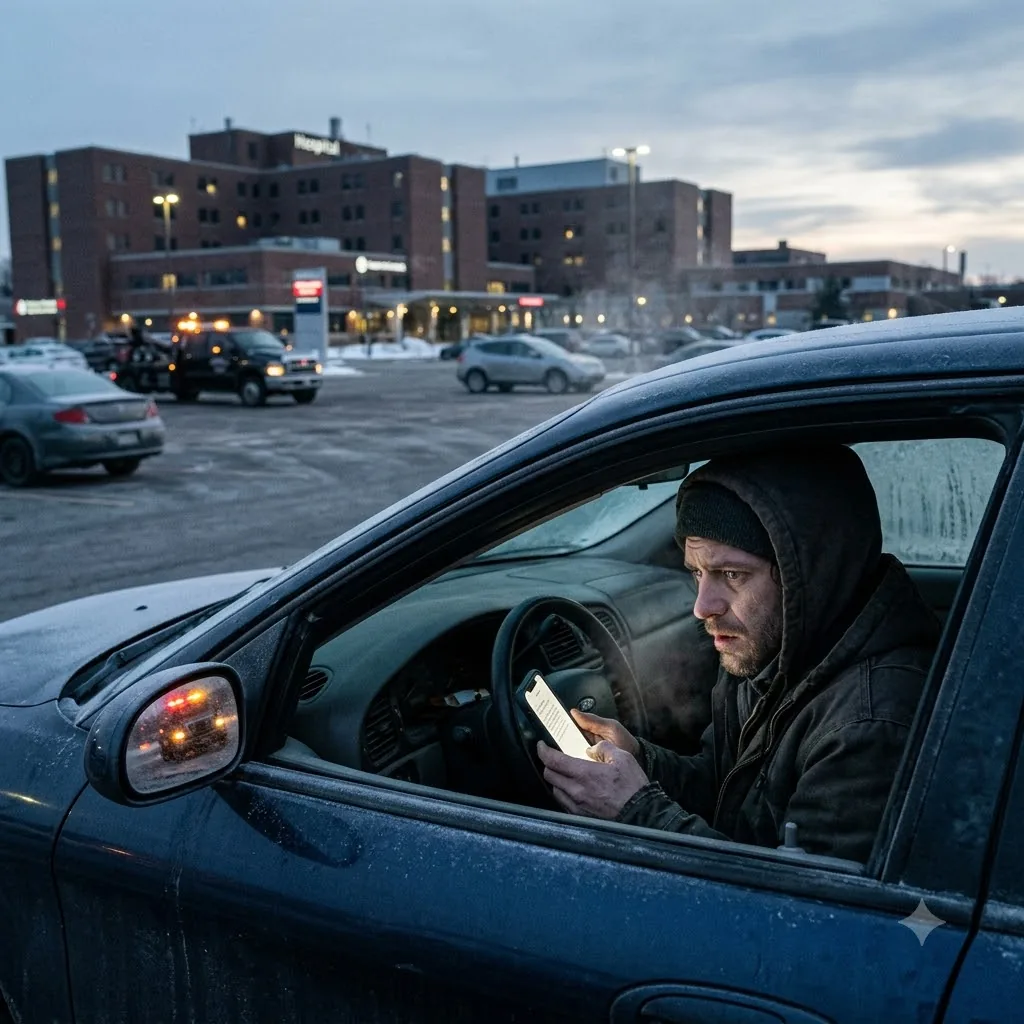
Marcus slipped into the booth. The warmth inside made the skin of his freezing face prickle and burn. He dropped his heavy military rucksack on the floor and stared at the monitors. They displayed a grid of high-definition camera feeds covering the hospital’s perimeter. One feed showed the surface lot where his Taurus had died.
He leaned over the console, his numb fingers clumsy on the trackball mouse. He found the playback slider at the bottom of the screen. He dragged it backward, watching the sun un-rise on the monitor, the frost retreating, the shadows lengthening, until the digital clock in the corner read *04:45:00*.
There was his Ford Taurus. Covered in a thick sheet of ice. The windows were opaque with frost. The car was a dead, frozen tomb.
Marcus pulled his cracked phone from his jacket pocket. He opened his camera app, switching it to video. He held the lens close to the monitor, making sure the *04:45:00* timestamp was clearly visible in the corner of the frame, alongside the unmistakable image of his motionless car. He recorded for ten seconds, then stopped.
The chime of an elevator bell echoed through the garage.
Marcus ducked out of the booth, retreating behind a concrete pillar. Hayes and Tran stepped out of the VIP elevator, their voices echoing loudly in the cavernous space. They shook hands. Hayes walked toward a black town car idling near the exit ramp, while Tran turned in the opposite direction, his dress shoes clicking sharply against the polished concrete as he approached a sleek silver Audi.
Tran pressed a button on his key fob. The Audi chirped. As Tran reached for the door handle, tucking his tablet under his arm, Marcus stepped out from behind the pillar.
“Mr. Tran.”
Tran flinched, taking a rapid step backward. His eyes darted over Marcus’s worn surplus jacket, his unkempt beard, his shivering frame. “Who the hell are you? This is a restricted area.”
“My name is Marcus Vance,” Marcus said. His voice was hoarse, but the violent tremor in his leg had vanished. A cold, absolute focus had taken its place. “Pull up my file on that tablet.”
Tran’s posture stiffened. He slid his free hand toward his pocket. “You need to leave right now, or I’m calling security.”
“Pull up the file,” Marcus repeated, closing the distance between them. He didn’t raise his hands, didn’t make a threatening move, but his presence pinned Tran against the side of the Audi. “Or I walk back upstairs and tell the press crew exactly how your algorithm zeroed out the queue.”
Tran hesitated. The threat to the PR tour hung heavy in the warm garage air. Jaw tight, he lifted the tablet and rapidly tapped the screen. “Vance. Fine. Let’s look.” Tran sighed, adopting a practiced mask of bureaucratic condescension. “Here it is. You completed a telehealth PTSD module at zero-four-forty-five this morning. You were successfully transitioned to the maintenance phase. The system functioned perfectly. You’re cured.”
“I didn’t complete anything,” Marcus said.
“The logs say you did.”
Marcus pulled out his cracked phone. He hit play on the video he had just recorded in the security booth. He held his phone out, pressing its shattered edge directly against the pristine glass of Tran’s tablet.
“Look at the screen,” Marcus ordered.
Tran’s eyes flicked downward. He looked at his tablet, which displayed the official medical record: *Session Completed. 04:45 AM.*
Then he looked at Marcus’s phone. The video played on a loop. The glowing green timestamp in the corner read *04:45:00*. Below it, the hospital’s own high-definition exterior camera showed Marcus’s Ford Taurus, entombed in ice, sitting dead in the pitch-black surface lot.
“If your system transitioned me for simply missing a check-in, my medical file would say I was discharged for non-compliance,” Marcus said, his voice dropping to a low, dangerous register. “But it doesn’t. It says I actively completed a session with a provider. At the exact minute I was freezing to death in a car with no engine, no power, and no internet connection.”
Tran stopped breathing. The annoyed condescension drained from his face, replaced by a sudden, chalky pallor.
“Your algorithm didn’t just mistakenly drop me,” Marcus said, tapping his finger against the two screens pressed together. “It fabricated a medical encounter. It generated a phantom appointment, logged it as completed, and submitted it to a federal database just to erase me from your waitlist.”
Tran stared at the two conflicting pieces of data-the hospital’s undeniable security footage and the falsified appointment record. His mouth opened, but no sound came out. The silence in the garage was deafening, save for the rhythmic, looping video on Marcus’s phone, playing the hard proof of federal fraud over and over again.