Story code: ST-000583
Part 2: Full Spectrum
“Mr. Hayes,” the board member’s voice sliced through the silent pulsing of the red lights. It was Elias Vance, the chief architect of the new curriculum mandate. “Step aside. The protocol requires an unobstructed scan.”
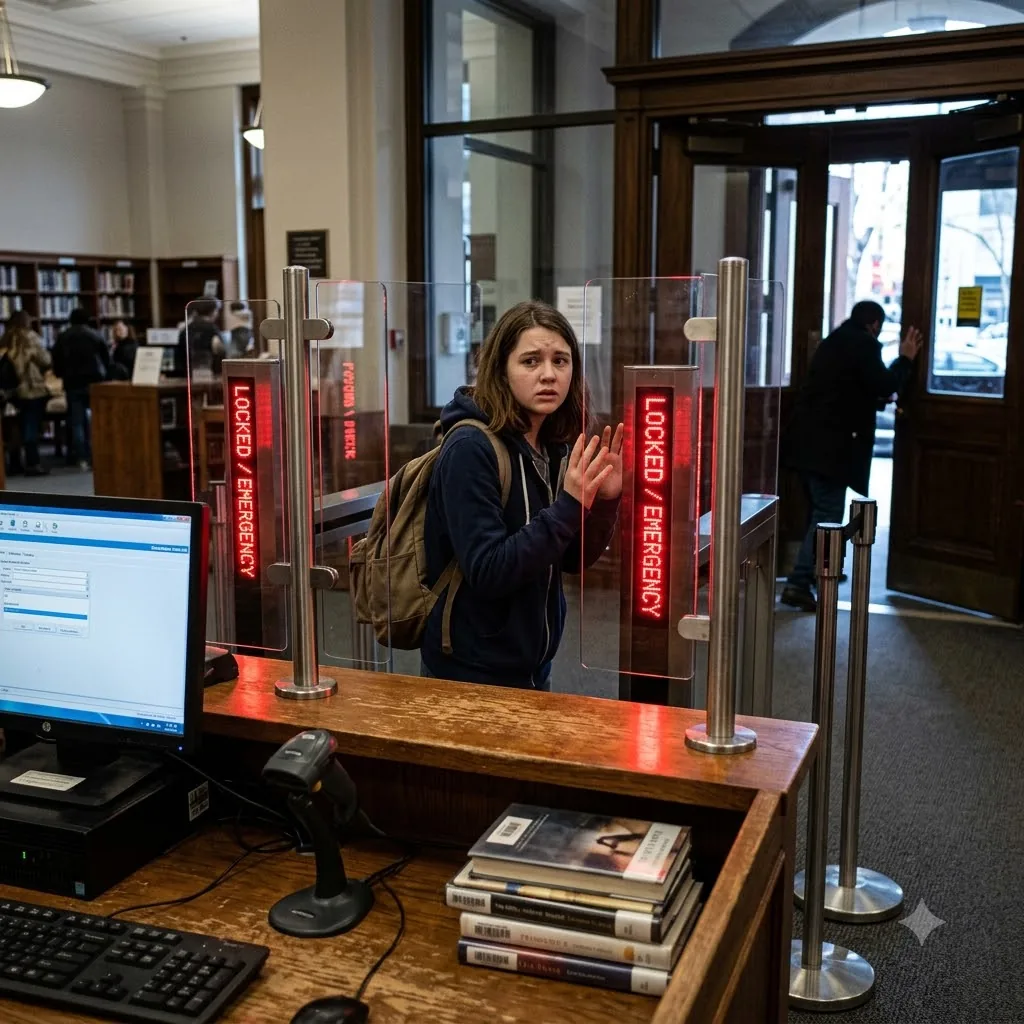
I didn’t move. My shoulder blades pressed hard against the cold plexiglass of the turnstile, keeping my body between Vance and the trembling eighth grader behind me. Vance’s tailored suit caught the aggressive crimson glare of the lockdown strobes. He held his white master override card pinched between two fingers, moving with the terrifying calm of a man who fully trusted the machine.
“It’s a calibration error, Mr. Vance,” I lied, forcing my voice to remain utterly flat. “The new sensors are picking up the legacy metallic bindings on our archival materials. The student was just shelving them for me.”
Vance paused, his hand hovering inches from the proximity reader. “The algorithm differentiates between legacy iron-gall ink signatures and unregistered modern print, Marcus. It does not flag archival bindings. It flags contraband.”
I could hear the student’s erratic breathing, a sharp, terrified rhythm that threatened to break into a panic attack. If Vance tapped that card, the system wouldn’t just open the gates. It would log a definitive administrative seizure, locking the physical item’s RFID signature into the permanent disciplinary ledger. The book I had given them-a first-edition memoir of a life strictly forbidden by Vance’s new policies-contained a hidden micro-tag I hadn’t been able to fully neutralize in my office.
“Hand me the bag,” Vance demanded, his eyes dropping to the space behind my legs.
I turned slightly, reaching back. The student’s fingers were locked rigidly around the fraying blue nylon straps. I gently pried their hands loose, feeling the icy sweat on their palms. “I’ve got it,” I murmured, so low Vance couldn’t hear. I pulled the heavy backpack over the plexiglass barrier, clutching it tight against my own chest.
The moment the bag crossed the threshold of the turnstile’s primary sensor field, the red strobe lights doubled in speed. The silent alarm escalated into a frantic, dizzying pulse that felt like a physical pressure in the room.
“Open it,” Vance said. He pulled a sleek administrative tablet from his inner jacket pocket. The screen cast a pale, clinical blue light over his sharp features. “Let the scanner read the raw contents. We will see exactly what anomaly triggered the perimeter.”
My mind raced. The scanner in the turnstile was a directional array. It read whatever was closest to the transponder. My own lanyard held a dozen authorized administrative tags, but none of them could mask a Level One flag. I needed a signal louder than the contraband.
I unzipped the main compartment of the backpack just an inch. The rigid shape of the hardcover pressed against the nylon. I also had my own librarian tablet in my left hand, the heavy-duty device I used for inventory management. It contained the entire cached database of the library’s forty thousand approved volumes.
“The system is bottlenecking, Elias,” I said, stalling as I casually pressed the back of my tablet directly against the fabric of the backpack, right over the hidden book. “Look at the terminal. It’s caught in a processing loop.”
“The system is perfectly fine,” Vance replied, stepping closer. He tapped the screen of his device. “It is isolating the signature.”
I dug my thumb into the recessed physical power button on my tablet, holding it down while simultaneously pressing the volume keys-the hard-reset sequence that forced a full, uncompressed diagnostic data dump to the nearest local receiver. If the turnstile scanner was actively hunting for a single rogue book, I was about to scream the metadata of forty thousand approved books directly into its localized sensor.
The progress bar on the gate’s terminal suddenly froze. The amber text glitched, displaying strings of meaningless alphanumeric garbage.
“What are you doing?” Vance snapped, his eyes darting from his tablet to the frozen terminal. “The connection just dropped.”
“I told you, it’s a calibration loop,” I said, my heart pounding so hard my vision blurred. I kept my tablet mashed against the backpack, hiding the contraband in the physical shadow of my device while drowning it in digital noise. “The scanner is overwhelmed by the sheer volume of legacy tags in the proximity.”
Vance’s jaw tightened. “Unlikely.” He reached out, his hand closing firmly around the blue fabric of the backpack. “I will conduct a manual visual inspection. Give it to me.”
We stood there, both holding the bag. The fabric stretched taut between us. If I let go, he would open it. He would see the cover. He would know exactly what the student was reading, and he would know exactly who had the administrative access to sneak it into the building. My carefully constructed life, the quiet safe haven I had built in the back office for students like the one cowering behind me, would be incinerated.
“Administrative protocol requires a neutral third party for a physical search, Mr. Vance,” I said, quoting the district handbook I had memorized for exactly this kind of nightmare. “Without a school resource officer present, opening this student’s property violates their Fourth Amendment protections.”
“This is a localized security event, Mr. Hayes. I am the acting authority.” Vance pulled harder. The zipper slipped further down the track, exposing the dark interior of the bag. A sliver of the book’s spine became visible.
I gripped the bag tighter, pulling it back. “I cannot allow an unauthorized search.”
Vance stopped pulling. He didn’t let go, but his expression hardened into something cold and absolute. He looked at me, really looked at me, his eyes narrowing as he calculated my resistance. He looked down at his tablet, then back up to my face.
“The machine doesn’t lie, Marcus,” Vance said softly, his voice dropping the bureaucratic distance. “It detected a suppressed frequency. A specific, encrypted tag associated with the banned archives. And now you are physically obstructing a board member to protect it.”
He let go of the bag. For a second, I thought I had won. Then he raised his master override card, but he didn’t aim it at the turnstile reader. He turned and aimed it at the primary security console on the lobby wall.
“If the local scanner is overwhelmed,” Vance said, his thumb hovering over the console’s emergency interface, “we will simply elevate the threat level. The system will seal the room and initiate a full spectrum scan of every object inside.”
He pressed the card against the wall plate.
The red strobes stopped flashing, snapping into a solid, blinding crimson glare. A high-pitched, continuous electronic whine filled the air. Above us, the heavy steel security grilles disengaged from the ceiling with a deafening crash, slamming down over the library’s main exit doors and the emergency fire escapes. The eighth grader let out a sharp cry. The terminal screen refreshed, the amber text replaced by a stark, glowing red warning: *Containment Initiated. Full Biometric and Asset Audit Pending.* I was no longer just protecting the student. We were locked inside the cage together, and the system was about to tear through every secret I carried on my person.