Story code: ST-000589
Part 2: The Scapegoat
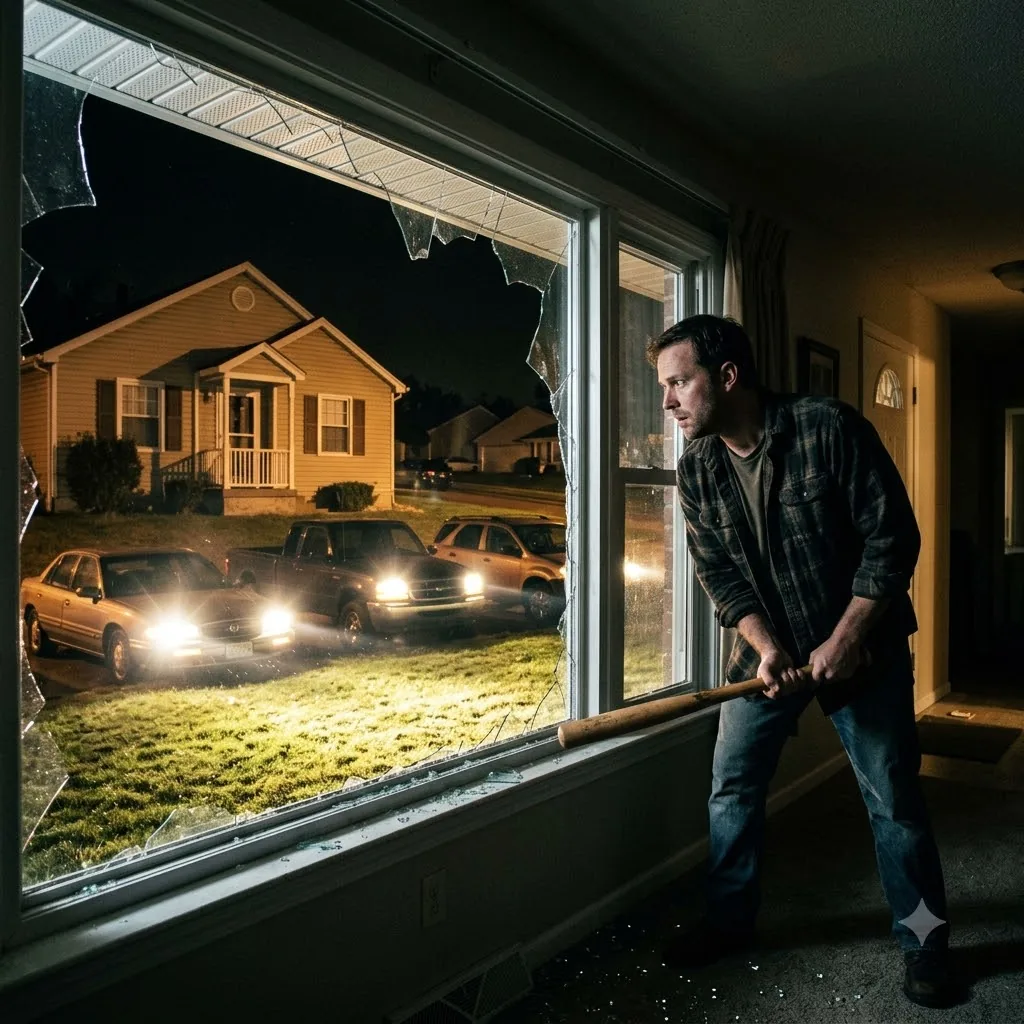
The heavy fist continued its rhythmic assault on the front door, the wood groaning against the hinges. Marcus backed away, his boots crunching over the shattered window glass. He didn’t speak. He didn’t yell. The hostile glow of the high beams sliced through the living room, casting shifting shadows as the mob outside multiplied.
He raised his phone, ignoring the waterfall of hate speech and death threats cascading down his screen, and dialed 911. The line rang four times before a dispatcher answered, her voice taut with stress.
“911, what is your emergency?”
“My house is surrounded,” Marcus whispered, ducking behind the kitchen island as another flash of light swept the windows. “They’re throwing rocks. They broke my window. Address is 442-”
“Sir, are you Marcus Thorne?”
Marcus froze. “Yes. How do you-”
“We have six cruisers at the perimeter of your subdivision, Mr. Thorne. They cannot safely disperse a crowd of this size without riot gear. We are waiting on county backup. Lock your doors, stay away from the windows, and do not engage the protesters.”
“Protesters?” Marcus hissed. “They’re trying to break down my door!”
“Do not engage them, sir. Units will move in when it is tactically safe.” The line clicked dead.
Marcus stared at the dark screen. *Protesters.* He unlocked his phone, finally forcing himself to look at the barrage of notifications. He tapped a link that had been tagged to his name five thousand times in the last hour.
It was a video clip. The footage was grainy, pulled directly from the chemical plant’s security servers. It showed Marcus in the loading bay, handing a signed clipboard to a hazardous waste driver. The video was heavily edited, stamped with a flashing red text overlay: *MARCUS THORNE – THE MAN WHO POISONED THE RIVER.*
Below the video was a press release, issued at midnight by his employer, OmniChem Industries.
*”We are devastated to learn that a rogue shift supervisor, Marcus Thorne, unilaterally bypassed our environmental safeguards. Internal audits tonight revealed Thorne falsified disposal manifests, diverting toxic run-off into the municipal storm drains to cut operational costs. OmniChem is fully cooperating with federal authorities. Thorne has been suspended pending immediate legal action.”*
Marcus’s stomach plummeted. The breath left his lungs in a sharp, painful hiss. It was a complete fabrication. The plant’s containment silos had been failing for months. Marcus had submitted dozens of maintenance requests, all denied by the regional director due to budget constraints. The disposal run in the video wasn’t a diversion; it was an emergency transfer he had been explicitly ordered to execute by upper management when the primary silo cracked. They had scapegoated him. They fed his name to the angry public to protect the executives and the stock price. The HR text wasn’t a warning; it was a stalling tactic to keep him isolated while the digital mob did the company’s dirty work.
Outside, a megaphone cracked to life. “Come out, Thorne! Let’s see what that water tastes like!”
A roar of approval went up from the front lawn. A glass bottle shattered against the brick siding.
Marcus dropped to his hands and knees. His work backpack was still sitting by the front door, fully exposed to the blinding glare of the truck headlights. His company laptop was inside. On its hard drive was the local cache of his sent emails, including the direct written orders from the regional director authorizing the emergency transfer, complete with the digital override codes.
He kept his head down, crawling over the broken glass. The shards sliced through his jeans, biting into his knees, but the adrenaline masked the pain. He reached the door, hooked his fingers around the nylon strap of his backpack, and dragged it backward into the shadows of the kitchen.
He unzipped the bag and yanked out the laptop. He flipped it open on the cold tile floor. The battery was at twenty percent. He didn’t dare connect to his home Wi-Fi; if OmniChem was monitoring his network traffic, they would throttle him instantly. Instead, he tethered the laptop to his phone’s cellular hotspot.
The connection was agonizingly slow, choked by the massive influx of data still hammering his phone. The desktop finally loaded. He opened his email client, holding his breath. It was still synced. The company hadn’t locked his local profile yet.
He opened the archive folder. `Silo_Transfer_Authorizations`.
There it was. An email from Regional Director Vance, dated three days ago: *”Marcus, execute the transfer to the secondary drains. Ignore the system warnings. I am attaching my override token. Do it now before the silo bursts.”*
Marcus clicked ‘Export to PDF’. A loading bar appeared on the screen. Ten percent. Twenty percent.
Suddenly, his phone buzzed in his hand with an incoming call. The caller ID read: *BLOCKED*.
He answered it on speaker, keeping his eyes glued to the loading bar. “Hello?”
“Marcus,” a smooth, unnervingly calm voice said. It was Vance. “I see you’re online.”
Marcus clenched his jaw. “You framed me. You leaked my address.”
“I managed a crisis,” Vance corrected. “The company will survive this. You will not. However, if you step away from the keyboard right now, we’ll ensure your legal fees are covered. We’ll set up a quiet trust for your family. If you try to fight us, the crowd outside is going to get very impatient.”
“I have the emails, Vance,” Marcus snarled. “The export is at eighty percent. I’m sending it to every news outlet in the state.”
Vance sighed. “I was hoping you’d be reasonable.”
On the laptop screen, the loading bar froze at eighty-nine percent. The email window abruptly vanished. The desktop wallpaper blinked out, replaced by a stark black screen with white text: *CRITICAL ERROR. REMOTE WIPE INITIATED. ENCRYPTING DRIVE.*
Marcus hammered the escape key, but the keyboard was entirely dead. The laptop fan spun into a high-pitched whine as OmniChem’s IT department systematically destroyed the only physical evidence of his innocence.
He stared at the blank screen, the crushing weight of utter defeat pressing against his chest. He was entirely cut off.
Then, the megaphone on the front lawn went silent. The chanting stopped. The sudden quiet was more terrifying than the noise. Marcus held his breath, straining to listen.
The heavy fist was no longer pounding on the front door.
Instead, from the pitch-black darkness of the kitchen, Marcus heard the distinct, metallic sound of the back patio door’s glass sliding track being violently forced open.