Story code: ST-000593
Part 2: The Demarcation Line
Greg’s breath stalled in his throat. His extended fingers remained suspended inches from the smooth white casing of the downed drone. The metallic clack echoed again in his mind, aggressively stripping away the illusion of his suburban safety net. For a fraction of a second, his brain scrambled to categorize the noise as something benign. A heavy branch snapping? A commercial staple gun used by a rogue landscaping crew? But Greg had spent enough evenings watching historical war documentaries on his expensive home theater system to recognize the mechanical finality of a bolt-action rifle.
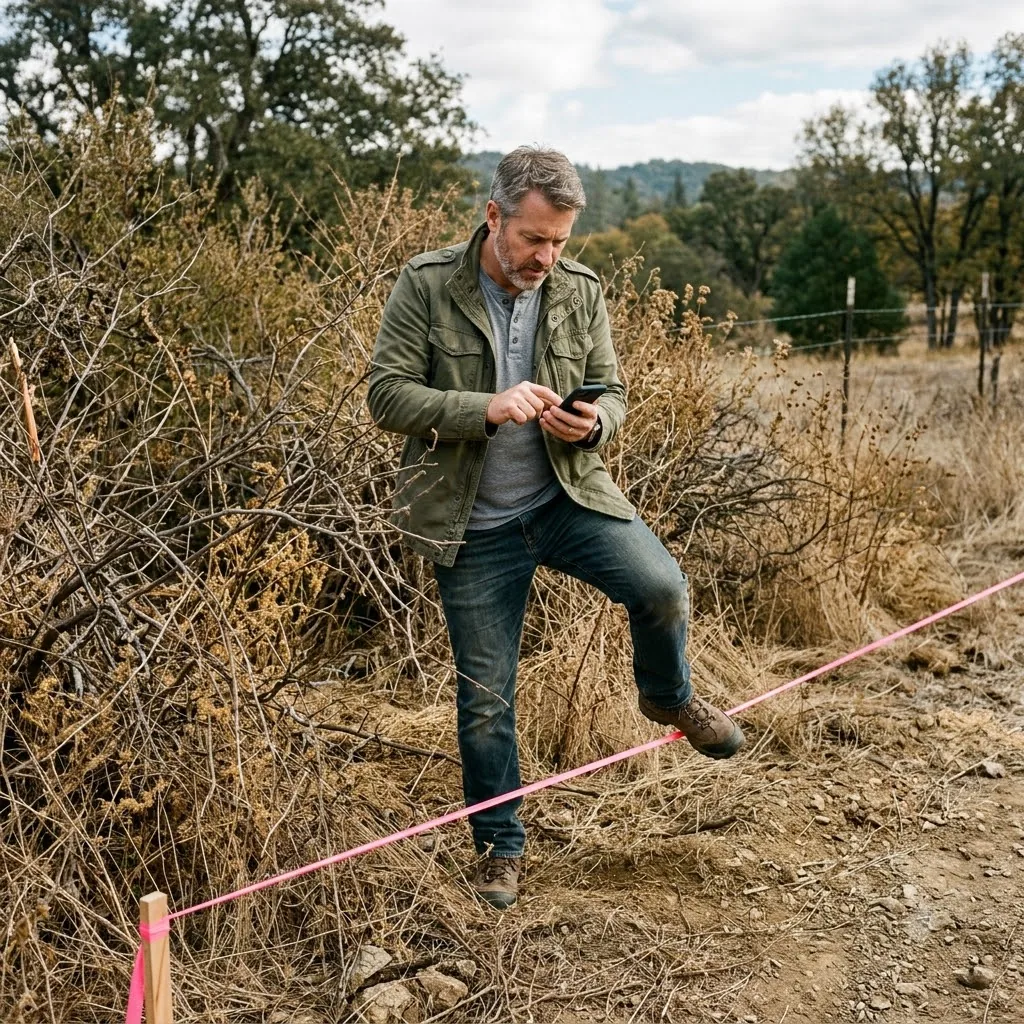
His eyes darted to the right, straining against the dense canopy’s shadows. Ten feet away, the thicket of briars seemed to breathe. Slowly, the silhouette of a figure detached itself from the trunk of a massive, rotting oak tree. Greg couldn’t make out a face beneath the worn, frayed brim of a dark canvas hat, but the dull, matte black barrel protruding from the shadows was unmistakable. It was pointed downward, resting at a casual but terrifying angle, directly aligned with Greg’s mud-caked right knee.
“Pick up your foot,” a voice rasped from the gloom. It was a low, gravelly tone, completely devoid of the polite, passive-aggressive cadence Greg was accustomed to managing at community board meetings. “Put it back on your side of the pink line.”
Greg’s pulse hammered against his temples. A sudden, cold sweat pricked his underarms, threatening to ruin his expensive windbreaker. Yet, beneath the primal terror, a deep, bureaucratic indignation flared to life. This was his neighborhood’s boundary. He was the senior member of the compliance oversight committee. He had just broadcast a Code Red to one hundred and twelve residents. If he backed down now, turned around, and walked out of these woods without the community drone, his authority would be permanently shattered. Dave from the architectural committee would relentlessly mock him. The residents would whisper about his cowardice at the community pool. The entire fabric of Oakwood Crest’s rule of law would unravel.
“I am enforcing a lawful retrieval of Oakwood Crest property,” Greg said. His voice trembled slightly on the first syllable, but he forced it into the rigid, authoritative register he used to shut down disputes over unapproved fence heights. “Furthermore, the discharge of a firearm within a residential adjacency zone is a severe violation of county ordinances, carrying a minimum fine of-”
“County line ends at the surveyor’s string, neighbor,” the voice interrupted, completely unfazed by Greg’s administrative posturing. The man took a deliberate half-step forward. The dappled sunlight caught the scarred wooden stock of the rifle. “You’re standing on my property. And that little flying camera you got there was buzzing over my daughter’s bedroom window. It belongs to the dirt now.”
Greg blinked, his mind frantically processing the jurisdictional claim. If the neon pink string was an official county demarcation, the Oakwood Crest plat maps were off by at least fifteen feet. The drone wasn’t just stuck in the brush; it had legally trespassed. But Greg could not accept that reality. Admitting fault meant liability. It meant looking weak. It meant filing an amended incident report and confessing to the entire neighborhood that he, the ultimate enforcer of the rules, had technically committed an invasion of privacy.
“That is a heavily modified, high-resolution community surveillance asset,” Greg countered, his chin jutting forward defiantly. He deliberately ignored the rifle barrel, refusing to legitimize the threat. “It does not belong to you. I am logging this interaction, and I demand you lower that weapon before I involve local law enforcement.”
He didn’t wait for permission. Greg shifted his weight, intending to plunge his right hand into his windbreaker pocket to retrieve his phone. He needed video evidence. He needed a timestamped recording of this armed lunatic threatening an HOA official. It was the only way to control the narrative and prove to the neighborhood portal that he hadn’t just surrendered their expensive equipment to a local squatter.
The man in the shadows misunderstood the movement entirely.
The barrel of the rifle snapped upward in a terrifying blur of motion, leveling directly at the center of Greg’s chest. The casual, resting stance vanished, replaced by a rigid, tactical readiness.
“Keep your hands out where I can see them,” the man ordered, his voice suddenly stripped of all patience. “You reach into that jacket, and you aren’t walking back to your manicured lawn.”
Greg froze again, his right hand hovering dangerously close to his pocket zipper. The reality of the situation finally pierced his administrative armor. The man wasn’t bluffing. He didn’t care about the community covenants, conditions, and restrictions. He didn’t care about Greg’s title. He was a man holding a loaded gun, standing behind a neon line in the dirt, and he was absolutely willing to pull the trigger over a piece of white plastic.
And yet, Greg’s ego screamed at him not to yield. The double-haptic buzz of his smartphone suddenly vibrated against his ribs, deep inside the very pocket the gunman had just forbidden him to touch. Then another buzz. Then three more in rapid succession. The residents were responding to his Code Red. They were asking for updates. They were actively watching the portal, waiting to see if their compliance officer was actually as tough as his posts claimed.
“I need my phone,” Greg whispered, his throat suddenly bone dry. He kept his eyes locked on the black hole of the rifle barrel. “I have to clear the alert.”
“You touch that zipper,” the man said softly, his index finger visibly slipping inside the metal trigger guard, “and I’ll clear it for you.”
Inside Greg’s pocket, the smartphone began to emit a shrill, piercing custom ringtone-the emergency contact override from the HOA President-shattering the tense, fragile silence of the woods.