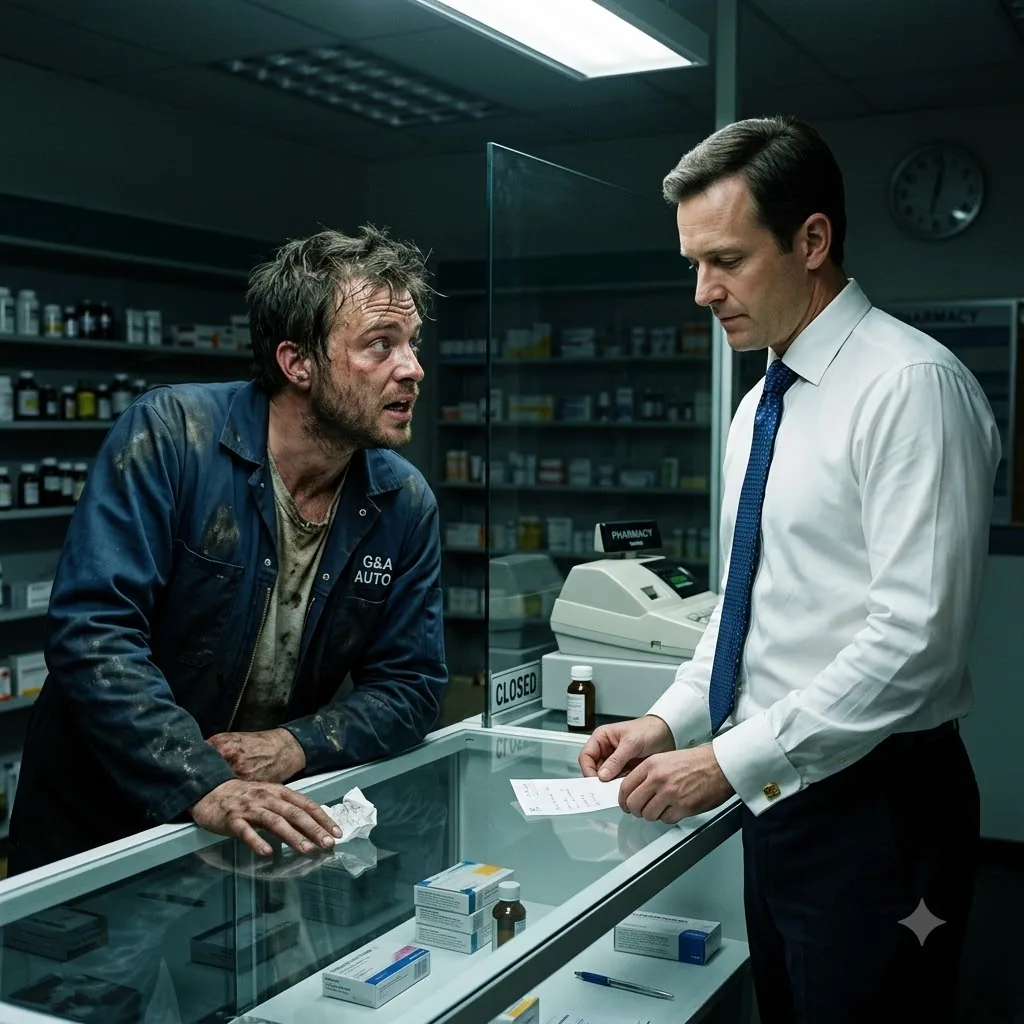
Story code: ST-000609
Part 4: The Cost of Admission
The thick, scratched acrylic of the county jail visitor booth distorted the exhausted face of Mike’s public defender. The lawyer didn’t bother making eye contact anymore. He just slid a thin, manila folder through the metal slot at the bottom of the glass. The heavy iron cuffs linking Mike’s wrists to his waist chain rattled against the metal counter as he reached for the pages.
“She’s stable,” the defender said, his voice crackling through the cheap two-way intercom. “The paramedics got the dose into her IV just in time. She needed an emergency transfusion and surgery to repair the ruptured tube, but she’s conscious. She’s going to live, Mike.”
Mike closed his eyes, dropping his forehead against the cold acrylic. A single, violent shudder tore through his chest. The crushing weight that had sat on his lungs for four days finally cracked. She was alive. The broken glass, the sirens, the judge’s gavel-it was all worth it.
“But we need to talk about the reality of your situation,” the lawyer continued, the intercom buzzing flatly. “You’ve been denied a bail reduction. You aren’t going anywhere. Because you missed three shifts, the garage officially terminated your employment this morning. The hospital is charging eighty thousand dollars for the emergency surgery and the ICU stay, and your insurance won’t cover the out-of-network surgical fees. Without your income, your wife is going to have to list the house by the end of the month just to cover the legal retainers and keep the truck from being repossessed.”
Mike stared down at the typewritten sheets. The words blurred together. He had traded everything they owned for twenty minutes of time. The math was brutal, but as he ran his calloused thumb over the metal edge of the document slot, he knew he would make the exact same trade again.
An hour later, a deputy marched Mike back to C-Block. The heavy steel door of the dayroom clanged shut behind him, locking him in a cavernous concrete box that smelled perpetually of industrial floor wax and unwashed bodies. Two dozen men in matching neon-orange jumpsuits sat scattered across bolted steel tables.
High in the corner of the room, bolted behind a cage of welded rebar, a dusty television was tuned to the local evening news. The volume was barely audible over the dull roar of the cell block, but the closed captions glowed bright yellow across the bottom of the screen.
Mike walked toward a vacant metal stool. He sat down, staring up at the screen.
The local broadcast had cut to a special segment. The camera panned across the pristine, shattered storefront of the boutique pharmacy. A temporary plywood board covered the glass cabinet Mike had destroyed. The scene transitioned to a well-lit, soft-focus interview in a local studio.
The pharmacist sat in a plush leather armchair, his posture relaxed and confident. He was wearing a different suit-a deep navy with a subtle pinstripe-and his hair was flawlessly styled. The news anchor leaned forward, her face a mask of deep, empathetic concern.
Beneath the pharmacist, the bright chyron read: LOCAL BUSINESS OWNER STANDS FIRM AFTER BRUTAL ATTACK.
Mike watched the screen, his jaw locking tight.
The pharmacist offered the camera a gentle, solemn smile. His lips moved on the screen, and the yellow text crawled across the bottom.
[It was a terrifying ordeal,] the text read. [But we cannot allow the threat of violence to compromise our deeply held principles. As a healthcare provider, my conscience is my first duty. Refusing to dispense that medication was a courageous moral stance. It was about protecting life.]
Mike gripped the edge of the steel table. His knuckles turned white against his orange sleeves. The sheer audacity of the words burned in his throat. The man who had comfortably watched a woman bleed out from behind a marble counter was now being broadcast into thousands of living rooms, elevated to the status of a martyr.
The anchor nodded solemnly on screen. The text caught her reply. [The community has rallied behind you. We understand your legal team is pursuing full civil restitution from the attacker’s estate?]
[We are,] the pharmacist replied. [Not out of malice. But to send a clear message that civilization requires order. Actions have consequences.]
The segment faded out, replaced by a cheerful commercial for a local car dealership.
Mike sat in the harsh, flickering light of the dayroom. The phrase echoed in his head. *Actions have consequences.*
The pharmacist’s consequence for refusing to save a dying woman was prime-time sympathy and absolute legal immunity. He would return to his country club, his immaculate store, and his golfing weekends with the District Attorney. He would be celebrated.
Mike’s consequence for keeping his wife alive was the loss of his freedom, his trade, and the modest life they had spent ten years building. The bank would take the house. The medical debt would crush Sarah for the next decade. He would spend years locked in this concrete box, labeled a violent felon by a system that was working exactly as it was designed to.
Mike looked down at his rough, grease-stained hands resting on the cold steel table. The blood had finally been washed away by the jailhouse soap, leaving his skin raw and cracked. He closed his eyes, listening to the echoing slam of the cell doors down the block, and settled into the silent, suffocating reality of his choice.