Story code: ST-000640
Part 3: The Cryptographic Override
The fluorescent lights of the main conference room buzzed with a clinical hum. It was 10:00 AM on Monday, the monthly engineering all-hands. The glass-walled space was packed, while the eighty-inch monitor at the front displayed a grid of over a hundred remote employees, including Sarah, the VP of Engineering.
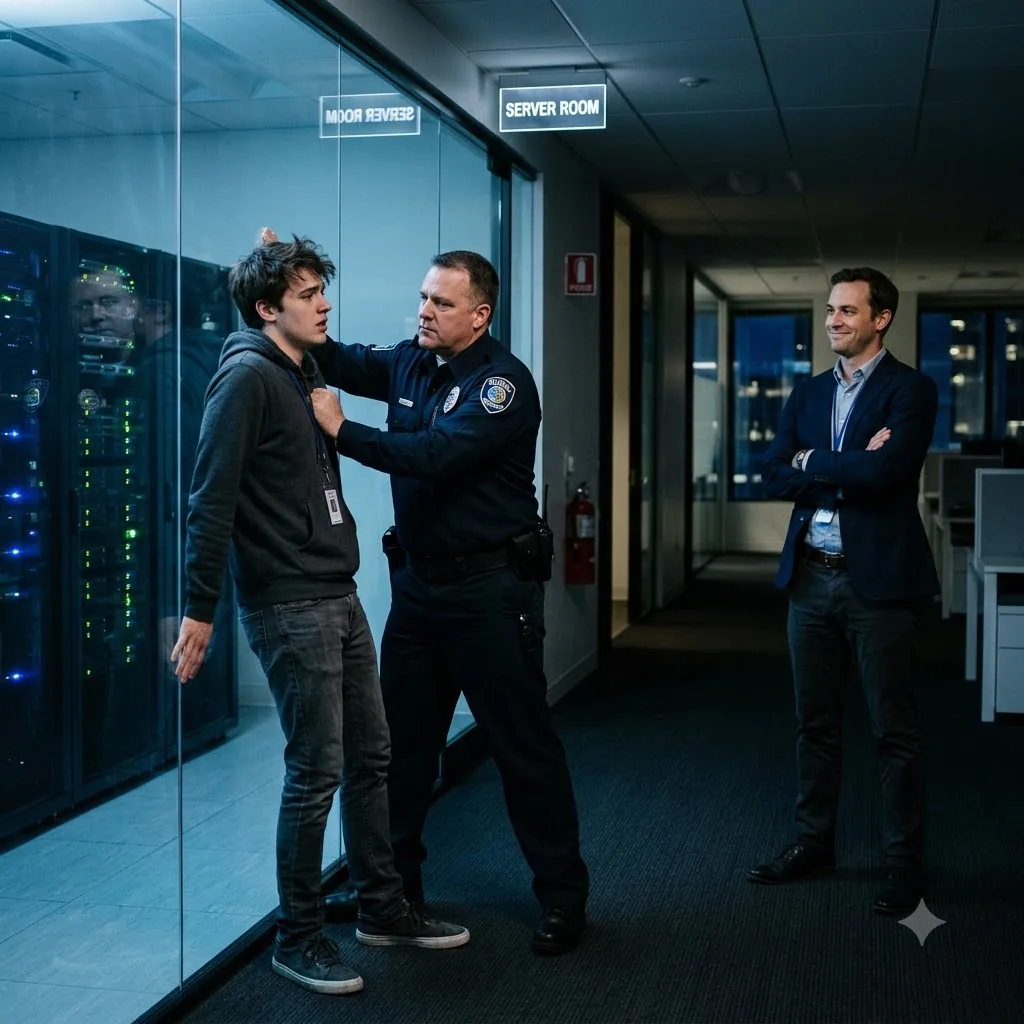
Dev sat in the back row, his laptop open. His ribs still throbbed where the security guard had ground him into the reinforced glass three nights prior. He could still smell the stale creamer on Brent’s breath, still feel the phantom weight of the pen he had used to sign the suffocating non-compete extension to avoid a fabricated federal cyber-sabotage charge.
At the front, Brent stood at the podium in a crisp navy blazer, exuding the confidence of a man who had won completely.
“I’m thrilled to announce the successful deployment of our new predictive load-balancing architecture,” Brent said smoothly, clicking to a slide of plummeting server costs. “This module was a passion project. I’ve spent the last four months architecting this on my weekends, and I’m incredibly proud to see it in production.”
Polite applause rippled through the room. Dev’s fingers rested lightly on his keyboard.
Brent clicked to the next slide detailing the database migration. “The Friday night cutover was a nail-biter. Luckily, I was on-site and caught our resident night-owl, Dev, prowling around the sub-basement in the dark.” Brent chuckled, looking toward the back. “Good thing I was there to vouch for him. You know how building security can get. They see someone wandering around who doesn’t look like they belong in this country-I mean, company-and they jump to conclusions.”
A few forced laughs echoed from the front row. Dev stared at his monitor. The racially coded threat was a deliberate reminder of the power dynamic. Brent believed the root API call he had forced Dev to execute had flawlessly rewritten the repository’s history, erasing Dev’s authorship forever.
But Brent hadn’t written production code in six years. He understood high-level web interfaces, not the immutable cryptographic architecture of a modern enterprise code repository.
Dev hit `Enter`.
On the massive projector screen and the monitors of every remote employee, Brent’s PowerPoint abruptly vanished, replaced by the high-contrast black of a Linux terminal window. Dev had used his senior presenter privileges to hijack the global screen share.
“Hey, my screen dropped,” Brent frowned, tapping his trackpad. “Dev? Is that your terminal? Turn off your share.”
Dev didn’t speak. He typed rapidly, the clack of his mechanical keys piercing the confused quiet of the room. He executed the first script he had prepared on Sunday.
The screen split. On the left side, the Git commit log for the machine-learning module scrolled endlessly. The author column proudly displayed `Brent_Davis` on every line dating back four months.
“Dev, cut the feed immediately,” Brent snapped, his polished tone cracking.
Dev typed a second command: `git log –show-signature`.
The right side of the screen flooded with red and green text. Every single one of Brent’s supposed commits flagged a fatal cryptographic mismatch. The terminal detailed that while the plaintext author name had been brute-forced to “Brent_Davis,” the immutable private GPG key used to sign the complex logic belonged to `dev.patel@horizon.internal`. Brent had overwritten the names, but he hadn’t possessed Dev’s private encryption keys to fake the digital signatures.
A low murmur broke out. On the Zoom grid, the VP of Engineering leaned inches from her webcam, her eyes narrowing at the raw data.
“This is entirely inappropriate!” Brent shouted, marching toward the AV console on the wall. “We have a rogue engineer hijacking the meeting. I am pulling the router.”
Dev’s fingers flew, executing his third macro before Brent could reach the cables. The terminal split a third time, piping data from the company’s automated Single Sign-On and expense auditing API.
“Let’s look at the timestamps for the core neural network architecture,” Dev’s voice rang out, shockingly calm through the table mic. “According to this repository, Brent wrote the foundational algorithms on October 12th at 2:00 PM, and the routing logic on November 5th at 4:00 PM.”
The terminal queried the SSO geolocation logs for Brent’s administrative account on those exact dates. A map generated on the screen, dropping bright red pins.
“On October 12th, the supposed author’s IP address was registered to the guest Wi-Fi at the Pelican Hill Golf Resort in Newport Beach,” Dev stated, the text glowing in neon blue. “And on November 5th, the corporate VPN shows Brent connecting from a luxury ski resort in Aspen.”
Brent froze, his hand hovering inches from the AV power cord. The color drained from his face, leaving his skin ashen.
“Meanwhile,” Dev continued relentlessly, pulling up the sub-basement server logs from Friday night, “here is the forced root API call made at 2:14 AM this past Friday. The exact minute I was supposedly ‘prowling’ the basement.”
The raw bash history appeared in massive twenty-point font:
`sudo -u admin /opt/scripts/force_repo_transfer.sh –target_user=brent_davis –source=dev.patel`
The silence in the conference room was absolute. The projector fans hummed loudly. Every head turned from the undeniably secured evidence on the screen to look at Brent.
Brent stood completely paralyzed beneath the fluorescent lights. His mouth opened, but the smooth cadence he used to extort and control was gone. He stared at the VP of Engineering burning a hole through him on the Zoom grid, then back at the unforgeable digital signatures hovering above his own head. He had no excuse for the geographic impossibilities, no explanation for the mismatched encryption keys, and no way to force the terminal back into the dark.