Story code: ST-000643
Part 2: The Barricade
The Corolla’s engine gave a final, violent shudder as Marcus crossed the city limits, the low-fuel chime shifting from a periodic warning to a steady, continuous shriek. He ignored it. He navigated the dense downtown grid, the exhaust rattling against the pavement until the canyon of glass and steel opened up into a sprawling corporate plaza.
The headquarters of the platform rose into the smog, a monolithic spire of tinted windows and seamless white concrete. There were no welcoming signs, no customer service entrance. It was a fortress designed to keep the physical world at a distance. Marcus circled the block, the steering wheel slick with his sweat. He spotted a subterranean ramp on the south side of the tower. A sleek, illuminated sign read: *Automated Fleet Egress. Executive & Autonomous Vehicles Only. No Pedestrian Access.*
Marcus watched a black town car glide up the ramp. As it approached, a heavy, reinforced steel roll-gate seamlessly retracted into the ceiling. A green laser scanned the vehicle’s windshield, reading a digital tag, and let it pass before the gate began to slide back down.
This was the chokepoint. The physical artery of the digital giant.
The Corolla’s engine sputtered, starving for gas. Marcus didn’t hesitate. He slammed the accelerator to the floor.
The battered sedan lurched forward, jumping the curb and plunging down the exit ramp just as the heavy steel gate reached the pavement. Marcus yanked the emergency brake and spun the wheel. The Corolla skidded sideways, its worn tires shrieking against the polished concrete, and wedged horizontally across the threshold of the exit lane.
The engine choked and died. The silence lasted for half a second before the automated sensors registered the obstruction.
A harsh, industrial klaxon echoed through the concrete tunnel. The steel roll-gate, triggered by its internal safety protocol, attempted to raise, but the Corolla’s rear bumper was jammed firmly beneath the track. The massive metal door ground against the sedan’s trunk, crushing the taillight and pinning the car in place. Sparks showered the dark ramp.
Marcus sat in the driver’s seat, his chest heaving. The burning ache in his lower spine flared, but he ignored it. He opened the glove compartment, his hands shaking, and pulled out a roll of heavy-duty duct tape.
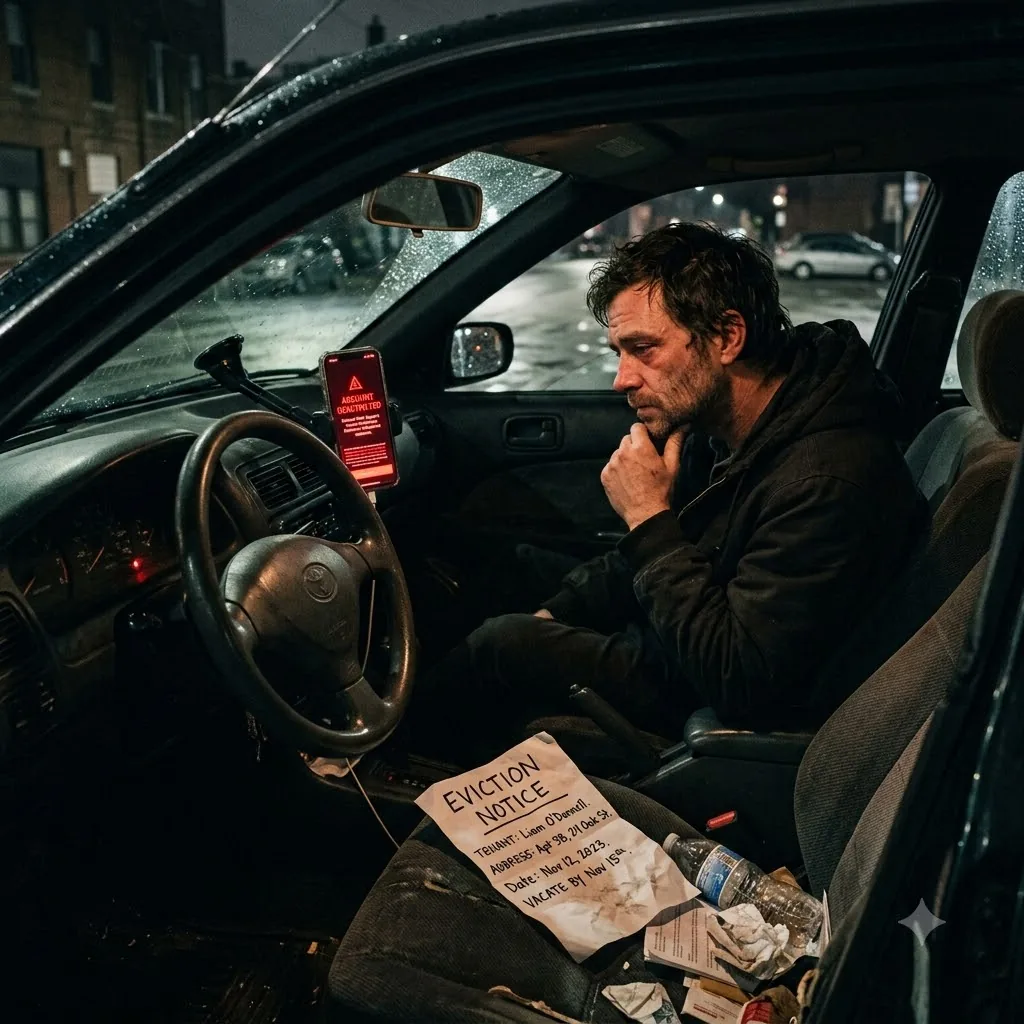
He grabbed the fourteen-thousand-dollar medical judgment. He slapped it against the inside of the windshield, tearing off a strip of tape with his teeth to secure it. Next went the bright pink eviction notice, taped directly above the steering wheel. Finally, he took his phone, the screen still locked onto the glaring red *Account Permanently Deactivated* warning, and taped it right in the center of the glass, facing out into the garage.
He rolled up all four windows. He pushed down the manual door locks. Then, he pulled the keys from the ignition and dropped them down the narrow gap between his seat and the center console.
He was no longer a glitch. He was a three-thousand-pound steel barricade.
Red emergency strobes began spinning on the ceiling. Within two minutes, the glass doors at the top of the ramp burst open. Three private security guards in tactical vests sprinted down the incline. They didn’t approach Marcus’s window to ask if he was okay. They didn’t treat it like an accident. The lead guard immediately raised a tablet, scanning the Corolla’s license plate.
Marcus watched through the glass as the guard tapped furiously on his screen, frowned, and shook his head. The guard shouted to his partner over the blaring alarm, “It’s not in the system! It’s an unregistered vehicle!”
They were still trying to solve him with software.
The lead guard finally stepped up to the driver’s side window. He pounded his heavy fist against the glass. “Hey! You can’t be here! Move this vehicle immediately!”
Marcus didn’t speak. He just pointed a trembling finger at the glowing phone taped to the windshield.
The guard squinted at the screen, reading the deactivation notice, then looked at the medical debt and the eviction warning. His aggressive posture faltered for a fraction of a second, replaced by confusion, before the radio on his shoulder crackled.
“We have a critical blockage at Gate Four,” a synthesized voice echoed from the radio. “Executive autonomous fleet is attempting egress. Clear the obstruction.”
Down in the depths of the subterranean garage, a line of six identical, driverless black SUVs had silently rolled up to the gate. They stopped in a perfect, uniform row, their headlights blinding Marcus in his rearview mirror. The algorithm was trying to deploy its VIP fleet, but Marcus was standing in the throat of the machine.
“Move the car!” the guard yelled, his face turning red, banging on the window again. “We’re calling the police! We’re impounding this piece of junk right now!”
Marcus gripped the steering wheel. Impoundment meant losing the car tonight instead of sleeping in it tomorrow. It meant absolute zero. But he couldn’t back down. The automated gate ground against the trunk again, attempting to clear its path, shattering the back windshield. Safety glass rained into the backseat in a glittering shower.
A man in a tailored gray suit marched down the ramp, flanked by two more guards. The executive didn’t look at Marcus. He looked at the line of trapped autonomous vehicles, then at his smartwatch, his face twisting in deep annoyance.
“Why is this manual vehicle still in the egress lane?” the executive snapped at the guards. “Override the safety sensor. Have the lead SUV push it out of the way.”
“Sir, there’s a person inside,” the guard replied, gesturing to the window.
The executive finally turned his gaze to the Corolla. He saw the eviction notice. He saw the medical bills. He saw the red screen. Then, he looked directly into Marcus’s hollow, exhausted eyes through the smeared glass.
“Break the window,” the executive said flatly. “Drag him out and tow the shell.”
Marcus’s heart hammered against his ribs. He reached under the passenger seat, his fingers closing around the cold, heavy iron of his tire iron. The guards drew their batons, stepping toward the driver’s side door. The algorithm had finally acknowledged him, and it had decided to violently crush him.