Story code: ST-000643
Part 4: The Disconnect
The heavy silence in the underground garage was broken only by the rhythmic, sweeping whir of the red emergency strobes. Marcus kept his thumb hovering over the speakerphone, his breathing shallow. On the other side of the glass, David Sterling looked like a man who had suddenly stepped off a ledge in the dark.
“Driver eight-eight-four-Bravo,” the admin’s voice wavered over the tinny speaker. “I have… I’ve logged the complaint.”
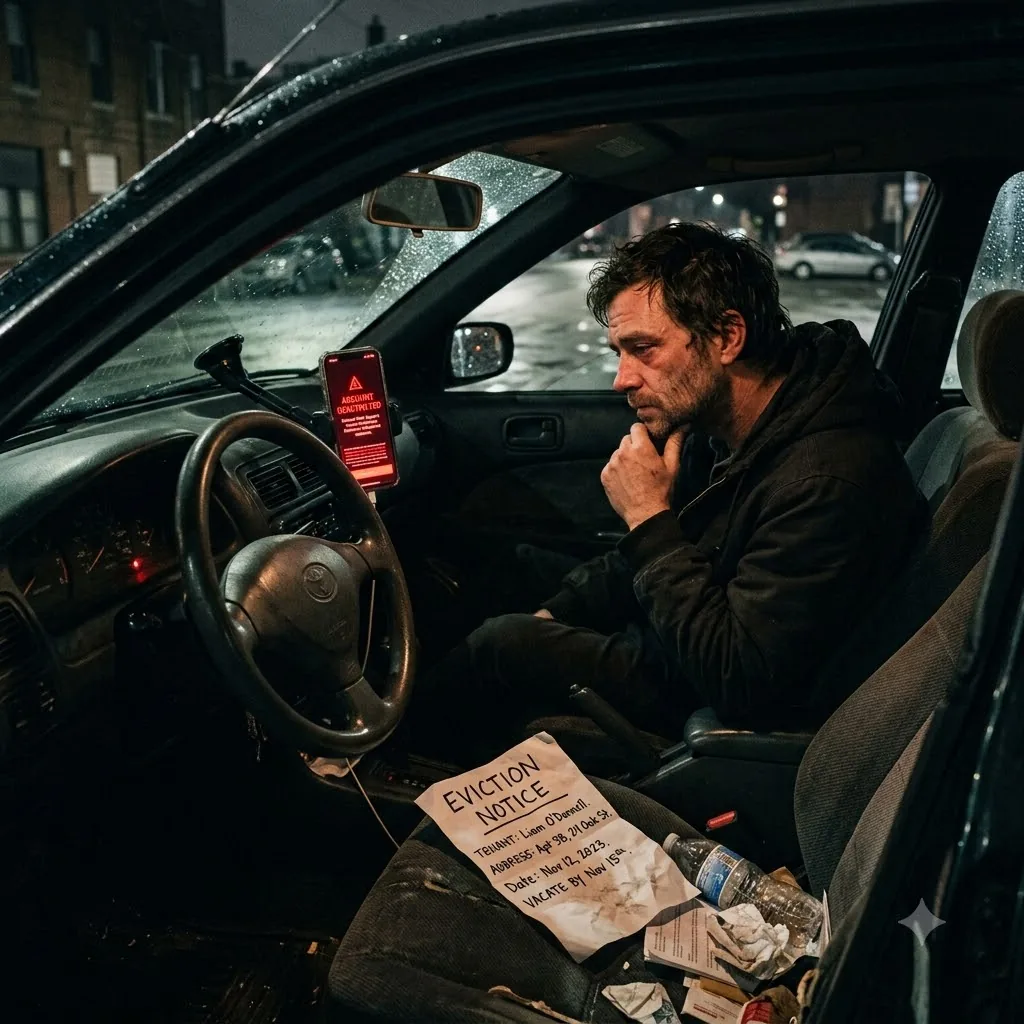
“I don’t want a logged complaint,” Marcus said. His voice was steady, anchored by the cold reality of the pink eviction notice taped to his dashboard. “I want the override code. You have the access. Reactivate the account so I can leave this ramp.”
Sterling’s jaw clenched. The paralysis of the liability trap was wearing off, replaced by the sheer, venomous indignity of being held hostage in his own executive garage by a man in a crushed Corolla. He leaned down, bringing his face inches from the two-inch gap in the window.
“You are making a catastrophic mistake,” Sterling whispered, his voice stripped of all its corporate polish. “Whoever is on that line. What is your employee ID?”
The speakerphone hissed with static. The admin didn’t answer.
“I am Regional Vice President David Sterling,” he said, his voice rising, bouncing off the concrete walls. “If you do not terminate this call and wipe the recording immediately, I will have your supervisor pull the dispatch logs. I will find your cubicle. You will be terminated for cause, blacklisted across the tech sector, and sued for violating internal security protocols.”
Marcus watched the phone. “Don’t listen to him,” Marcus said quickly, leaning closer to the microphone. “He can’t touch you if there’s a recorded liability-”
“I don’t care about the liability!” Sterling barked at the glass. “Terminate the call! Now!”
On the other end of the line, a sharp, ragged intake of breath cut through the speaker. To Marcus, it didn’t sound like a highly-trained safety protocol processing an anomaly. It sounded like exactly what it was: a terrified, underpaid worker sitting in a fluorescent-lit call center somewhere, suddenly realizing she was about to lose her health insurance to protect a desperate stranger.
“I’m sorry,” the admin whispered.
“Wait,” Marcus said, his chest tightening.
*Click.*
The sharp beep of the disconnected call echoed in the sweltering cabin. The screen on Marcus’s phone flickered, kicking back to the home menu. The bold, unyielding red banner of the deactivation screen repopulated a second later. Absolute silence returned to the digital void.
Marcus stared at the dead screen. The liability shield was gone. The federally recorded tether to corporate compliance had evaporated into the smoggy garage air, unplugged by a frightened cog who had simply chosen her own survival over his.
Sterling stood up slowly. He adjusted the cuffs of his tailored gray suit. The fear melted out of his posture, replaced by a cold, victorious sneer. The system had corrected itself.
“You stupid, desperate piece of trash,” Sterling said softly. He didn’t even look at Marcus anymore. He turned to the lead security guard. “The liability hold is dropped. There is no recording. Break the glass. Drag him out by his hair.”
The guard hesitated for only a fraction of a second before nodding, stepping forward, and raising the heavy black polymer baton.
Marcus didn’t brace for impact. He didn’t flinch. He just looked at the phone resting on the dashboard, then up at the towering, monolithic concrete walls of the corporate fortress.
For three years, he had believed the lie. He had believed the algorithm was a flawless, omnipotent god that weighed his five-star rating and his thousands of completed rides on a scale of pure, unbiased logic. He had believed that if he just played by the rules, worked the grueling hours, filed the appeals, and paid his debts, the system would eventually provide.
But looking at Sterling’s smug face, and remembering the terrified voice of the admin who had just severed his lifeline, Marcus finally understood the architecture of the machine.
It wasn’t a god. It was just code. And behind the code, it was just frightened, fragile people pulling levers to protect their paychecks. The entire structure was held together by the collective agreement to remain civilized-to file paperwork, to wait on hold, to accept the eviction notice taped to the door quietly while men like Sterling retreated to gated estates.
Marcus reached over to the windshield. He ripped the eviction notice down. He tore the itemized hospital bill for Sarah’s crushed pelvis off the glass, letting the papers drift onto the passenger floorboard. They didn’t matter anymore. Appealing to their humanity was a waste of breath.
The guard swung the baton.
The driver’s side window exploded inward. A shower of tempered safety glass rained across Marcus’s lap, stinging his face and arms. The stifling, exhaust-choked air of the subterranean tunnel rushed into the cabin, completely unfiltered.
“Get out of the car!” the guard screamed, reaching through the shattered frame to grab the interior door handle.
Marcus didn’t reach for the lock. He didn’t raise his hands in surrender. He reached down into the footwell, his fingers closing around the cold, heavy iron of the tire iron he had dropped earlier.
Civilized rules were a luxury for people who had a home to return to. They were a shield for executives who could pay their taxes in a single click while other men’s wives suffered in understaffed hospital beds. Marcus had nothing left to lose, which meant the system had absolutely no leverage left to use against him.
He gripped the iron. The burning pain in his ruined lower spine vanished, replaced by a terrifying, absolute calm. He looked at Sterling through the jagged rim of the broken window, then swung the heavy iron upward, aiming straight for the hand reaching into his car, ready to dismantle the machine the only way left to him.