Story code: ST-000014
Part 2: When Help Became a Problem
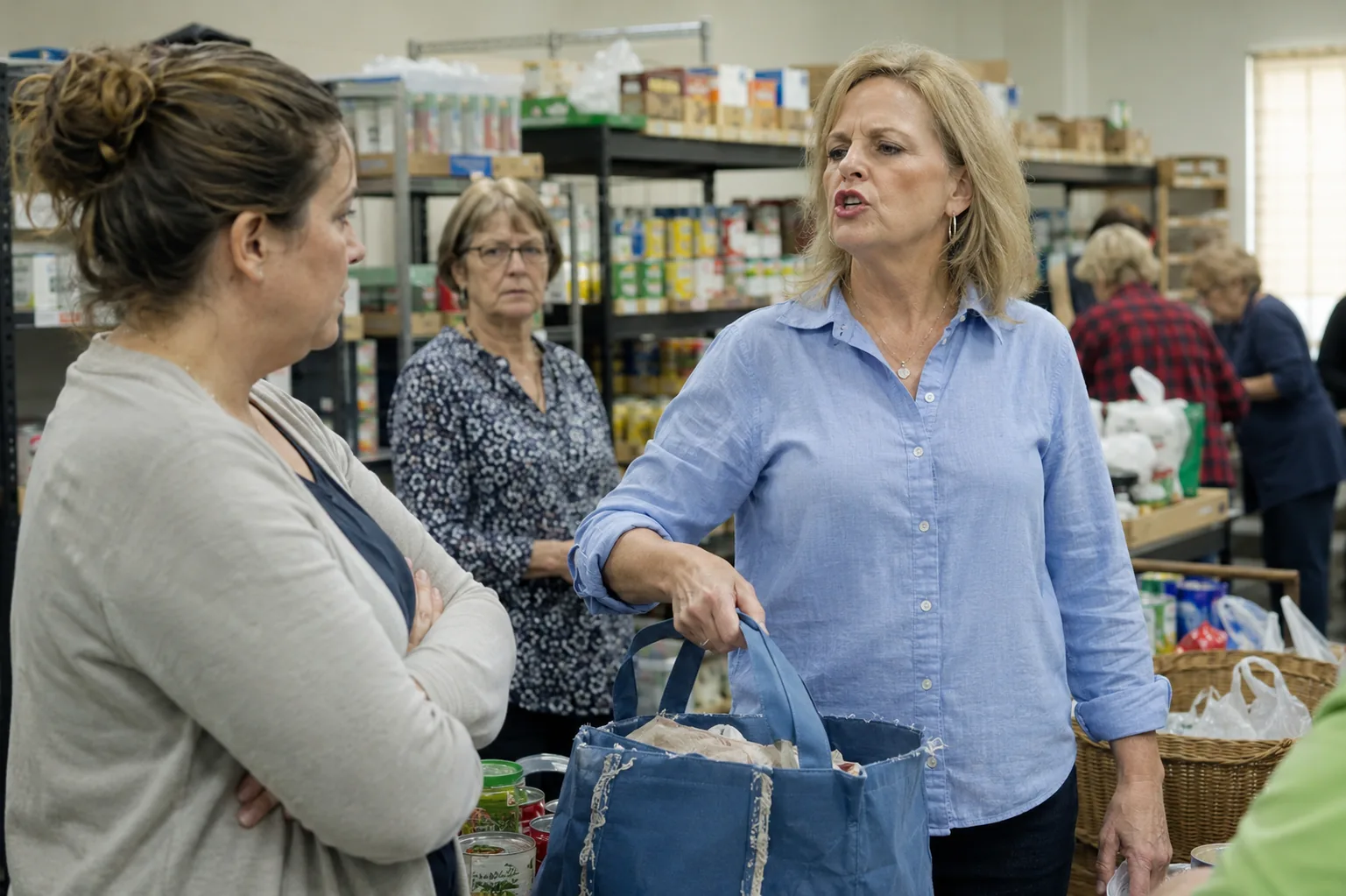
The strange part was not that Linda said no when I offered to take the blue tote. It was how fast and how sharply she said it, with her hand still wrapped around the frayed handle like I had reached for something personal instead of a bag of pantry donations.
“No,” she said. “That is not your role.”
It came out louder than the room required. Renee stopped mid-stack again. Deacon Paul looked up from the receipts on the side table. A client near the cereal shelf turned, then looked away when Linda added, in a softer but still carrying voice, “Some systems only work because one person stays responsible.”
I kept my own voice flat. “Okay. I was just trying to help with what you said was too much to carry.”
Linda smoothed the top of the tote, even though it was zipped closed. “And I’m trying to keep this pantry from turning into chaos every time someone decides they know better.”
That was the first moment I stopped hearing it as a personality issue and started hearing a pattern I could actually follow. She was not just complaining. She was pairing the complaint with ownership, then using ownership to shut down anyone who offered relief. The tote made it visible because it was always there, always in her hand, always part of the speech about what she carried alone.
I did not say that out loud. I had already learned arguing with the story only fed it.
Instead I asked the plainest question I could. “Do you want me on boxed dry goods or front restock?”
She gave me an irritated look, then tapped the clipboard with the volunteer task list. “Front restock. And next time, please remember that support means support.”
There it was again. Gratitude turned into obedience, but this time it landed so directly that even I could hear how stripped down it was.
I moved to the front shelves and started filling gaps with pasta, peanut butter, and canned fruit. Renee came over a few minutes later carrying pantry labels and set the roll beside me.
“You need these?” she asked.
“Thanks.”
She did not lower her voice in a dramatic way. She just kept her eyes on the shelf while she spoke. “I heard you offer to take the tote.”
“I did.”
She nodded once. “She does that a lot. Says it’s too much, then won’t let anyone touch it.”
That was all. No speech, no alliance, no gossip. Just a plain statement from somebody who had been standing there.
I said, “Did she have you move it last week?”
“No. She had me wait while she carried it herself from intake to the side table, then said she was the only one keeping track of donations right.” Renee slid another jar into line. “I remember because I was already free.”
That mattered to me more than sympathy would have. It was a visible detail tied to a task, not an opinion about Linda’s character.
The shift rolled on. Linda kept making little martyr announcements as she crossed the room.
“I still need to handle the tote.”
“I’ll sort those receipts too, since I’m apparently the only one following the chain.”
“Some people don’t realize how many moving pieces land on one person.”
Every time she said it, she made sure the tote was somewhere in sight.
When the client rush slowed, I went back toward the rear sorting table for more boxes. Linda was in the narrow hallway near the supply closet with the tote set by her feet and Paul standing at the small office doorway used for volunteer handoff notes. I was not trying to overhear them, but the hallway carries sound.
Paul said, gently, “If it’s getting too heavy, maybe split the contents into two bags.”
Linda answered right away. “That would create confusion. I know what’s in here.”
He glanced toward the sorting area. “Could someone initial transfers on the list?”
“That would slow everything down,” she said.
I stayed where I was with a box of dry goods in my arms, not hidden, not interrupting. She saw me, and her mouth tightened.
“Mara,” she said, “why are you standing there?”
“Waiting to get past you,” I said.
She pulled the tote closer to her leg before moving aside.
That tiny motion did more than the speech had. I had offered help in front of volunteers. Paul had suggested splitting the load. She rejected both and held the same tote closer the second I came near it. Whatever she wanted the room to believe about sacrifice, the actual handling kept telling a different story.
Later, when we were wiping down the rear sorting table, Linda shifted back into her smoother voice.
“I hope you understand I have to be firm,” she said. “People see me setting standards and think I’m being difficult, when really I’m protecting the pantry.”
I rinsed my cloth and said, “I understand you don’t want me handling the tote.”
She looked at me, waiting for me to fill in the rest with apology or reassurance.
I didn’t.
That pause seemed to bother her more than if I had argued. She started explaining again, faster this time, about responsibility, continuity, and how much fell on her shoulders. I let her talk because I was done fighting over whether her sacrifice was real. What I needed now was the sequence.
Who offered help. Who refused it. Who was standing there. What job the tote was supposedly too heavy for and too important to share.
When the shift finally ended, I hung my apron on the hook by the office doorway and looked at the volunteer handoff pad clipped beside it. For the first time, I was not thinking about how to get Linda to be fair.
I was thinking about how to make sure I never got cornered by that tote again without a written boundary around it first.